

Have you ever received a short “YW” after saying “thank you” and wondered what those two letters meant? 🤔 You are not alone. Texting has created a language of its own, filled with abbreviations, slang, emojis, and quick responses.
The most common YW meaning in text is “You’re welcome.” People use it as a fast, casual way to respond when someone thanks them. Instead of typing the complete phrase, they simply write YW.
For example:
Person A: Thanks for helping me with my homework!
Person B: YW 😊
In this situation, YW simply means “You’re welcome.”
However, context matters. Like many texting abbreviations, YW can occasionally have other meanings. Your relationship with the sender, the conversation, capitalization, and surrounding words can all help you understand what they intended.
Let’s explore the meaning, origin, examples, tone, and proper use of YW in detail. 👇
What Does YW Mean in Text?
The most common YW meaning in text is “You’re welcome.”
It is an abbreviation created by taking the first letters of the words:
- Y = You’re
- W = Welcome
So:
YW = You’re Welcome
People commonly send YW after another person says:
- Thanks
- Thank you
- Thanks a lot
- Thank you so much
- Appreciate it
- Much appreciated
Quick definition
YW is a casual texting abbreviation for “you’re welcome.” It is usually used as a short response to someone who has thanked you.
For example:
“Thanks for sending that!”
“YW!”
The meaning is straightforward: “You’re welcome!”
Because it saves time and typing effort, YW is particularly common in text messages, direct messages, group chats, and social media conversations. 📱
YW Meaning in Text at a Glance
If you only need the quick answer, here is the essential information:
| Question | Answer |
|---|---|
| What does YW mean? | You’re welcome |
| Where is it used? | Texting, DMs, chats, social media |
| Tone | Usually casual and friendly |
| Is YW formal? | No |
| Is it rude? | Usually not |
| What does YW reply to? | “Thanks” or “Thank you” |
| Example | “Thanks!” → “YW 😊” |
So, when someone responds with YW after you thank them, they are generally acknowledging your gratitude.
There is usually no hidden message behind it.
Why Do People Use YW Instead of “You’re Welcome”? 💬
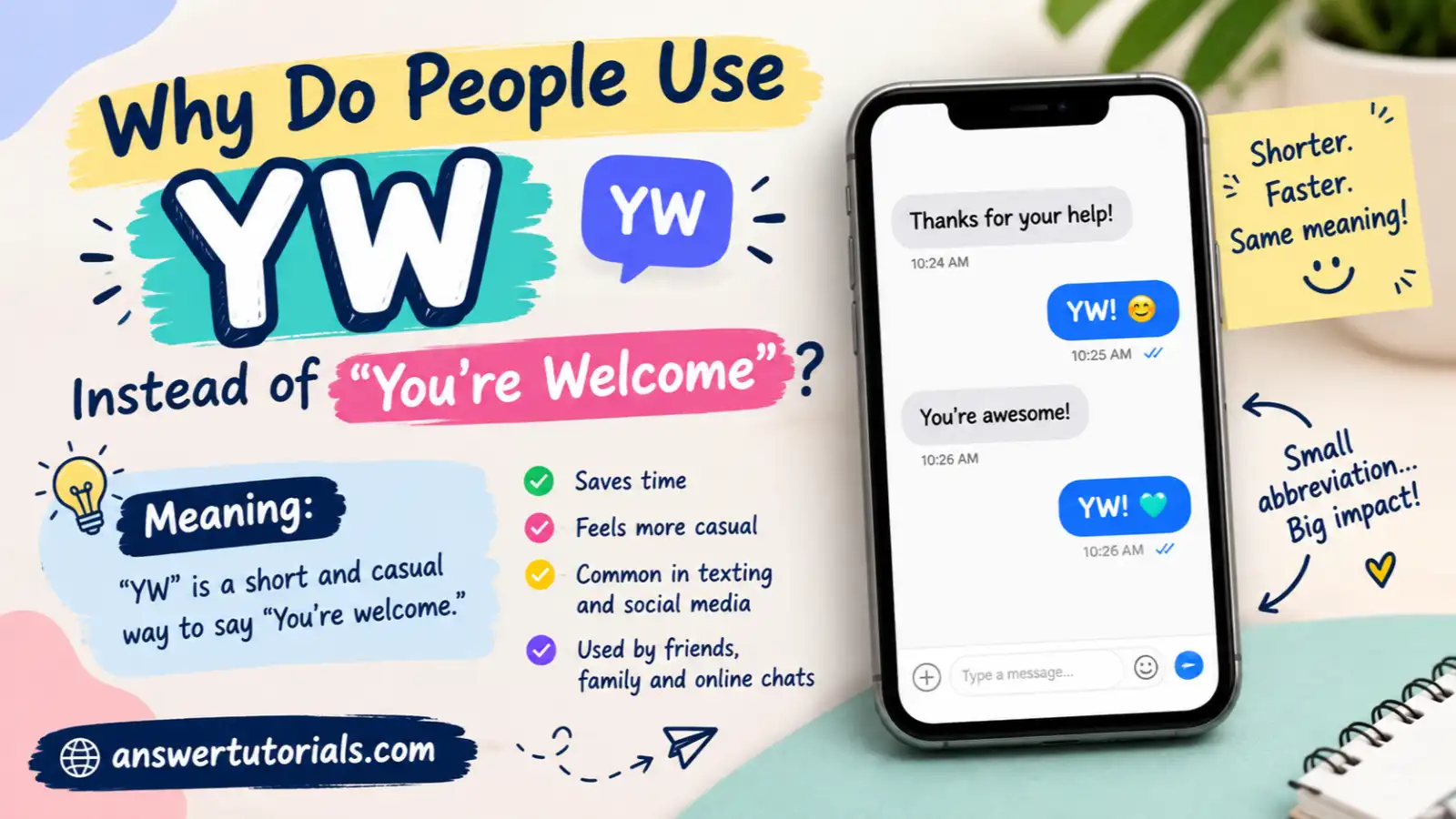
Texting is built around speed and convenience. People often want to communicate an idea without typing a complete sentence.
That is why abbreviations such as LOL, BTW, IDK, OMG, TY, NP, and YW became common in digital communication.
Typing:
“You’re welcome!”
takes longer than:
“YW!”
The shorter version can feel natural, especially between friends.
People may use YW because:
- They are typing quickly.
- They are having a casual conversation.
- They want to keep the reply short.
- They already have an informal relationship with the other person.
- They are responding in a group chat.
- They want to avoid repeating a longer phrase.
For many people, YW is simply digital shorthand.
It does not necessarily indicate a particular emotion or attitude.
The Origin of YW in Texting 📱
The exact moment when YW first appeared is difficult to pinpoint. Like many internet abbreviations, it developed naturally alongside short-form digital communication.
Texting culture encouraged people to shorten common phrases. Earlier mobile phones also made typing more inconvenient than it is today, particularly when users relied on physical keypads.
As online messaging, instant messaging, SMS, and social platforms became popular, abbreviations became increasingly familiar.
Common phrases were especially easy to shorten.
For example:
- Thank you → TY
- You’re welcome → YW
- No problem → NP
- Talk to you later → TTYL
- Be right back → BRB
- In my opinion → IMO
The YW abbreviation fits naturally into this pattern.
Today, it can appear in everything from casual text messages to social media DMs.
How Is YW Used in a Text Conversation?
The simplest use of YW is as a direct response to gratitude.
Example 1: Helping a friend
Alex: Thanks for helping me move today!
Sam: YW!
Here, Sam is saying “You’re welcome.”
Example 2: Sending information
Mia: Thanks for sending me the address.
Jordan: YW 😊
The emoji makes the message feel warmer and friendlier.
Example 3: Group chat
Chris: Thanks everyone for covering my shift.
Taylor: YW!
Again, YW acknowledges the person’s thanks.
Example 4: Casual favor
You: Thanks for grabbing me a coffee!
Friend: YW ☕
This is a very natural informal use.
Example 5: Very short conversation
“Thank you!”
“YW!”
Sometimes that is all the conversation needs.
YW Examples in Different Situations
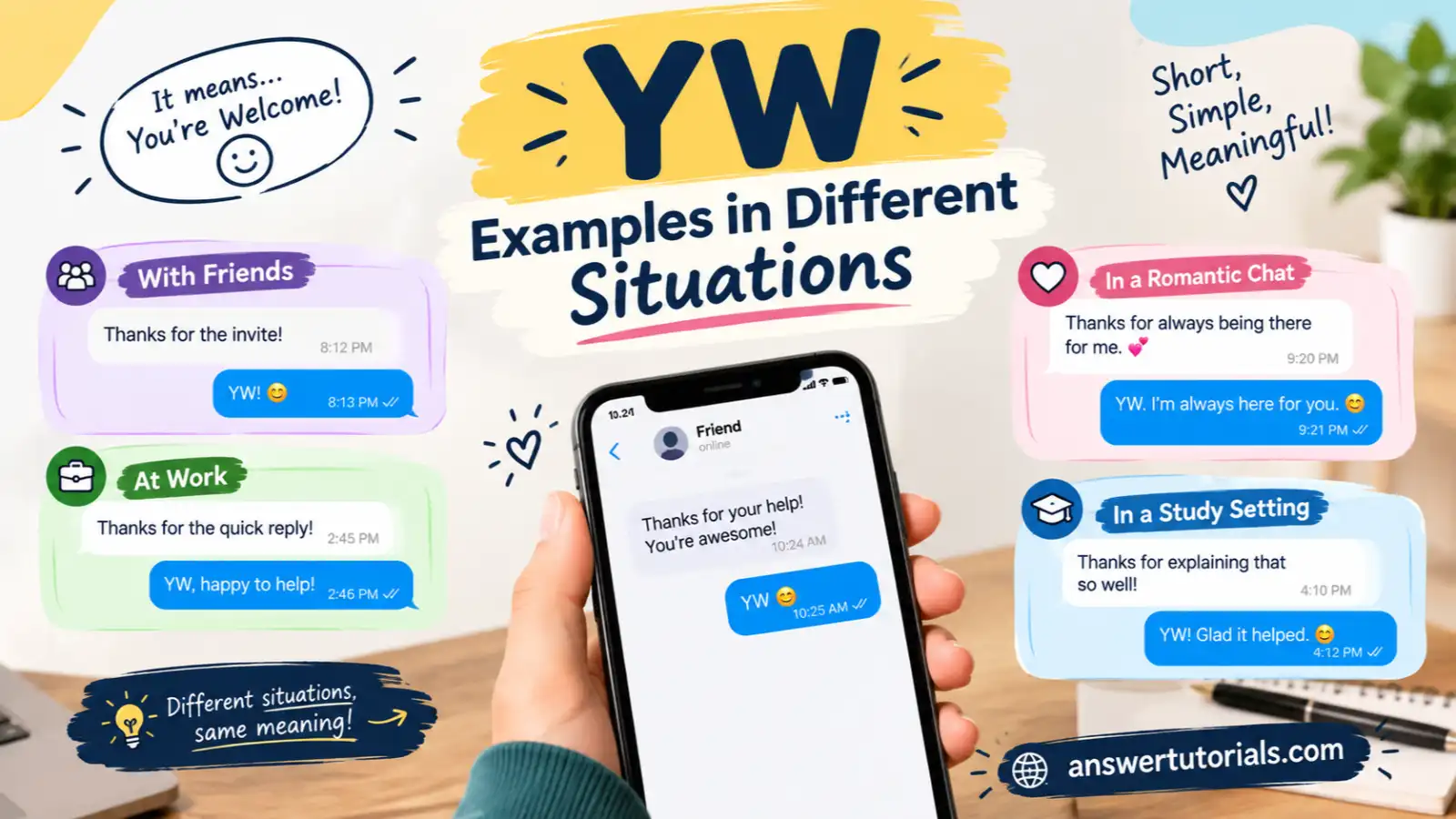
The meaning remains mostly the same, but the surrounding context can change the tone.
| Situation | Message | Meaning |
|---|---|---|
| Friend | “Thanks!” → “YW!” | You’re welcome |
| Group chat | “Thanks everyone!” → “YW!” | You’re welcome |
| Social media | “Thanks for sharing!” → “YW!” | You’re welcome |
| Casual favor | “Thanks for helping.” → “YW 😊” | You’re welcome |
| Quick reply | “Thank you!” → “YW” | You’re welcome |
| Warm conversation | “Thanks so much!” → “YW ❤️” | You’re very welcome |
The abbreviation itself is generally neutral. Punctuation, emojis, and the rest of the conversation can add emotional meaning.
Is YW Formal or Informal?
YW is informal.
That distinction is important.
You would normally use YW with people you already communicate with casually. It can work well in:
- Text messages
- Instagram DMs
- Snapchat
- Group chats
- Casual online conversations
- Conversations with friends
- Informal messages
However, you should usually avoid YW in formal professional communication.
For example, imagine your manager sends:
“Thank you for preparing the report.”
Replying:
“YW!”
might feel overly casual depending on your workplace culture.
A more professional response would be:
“You’re welcome.”
or:
“My pleasure.”
or:
“Happy to help.”
The important lesson is simple: match your language to the relationship and situation.
Does YW Sound Friendly or Rude?
Usually, YW is friendly or neutral, not rude.
Still, texting does not contain the same vocal cues as face-to-face communication. A short response can sometimes be interpreted differently depending on the relationship.
Compare these:
“YW 😊”
This feels warm and friendly.
“YW!”
This feels energetic and casual.
“yw”
This feels relaxed and understated.
“YW.”
The period can make the response feel more serious or abrupt to some readers, although punctuation preferences vary greatly.
The surrounding conversation matters more than the abbreviation itself.
For example:
Friend: “Thanks for staying late to help me!”
You: “YW 😊”
This clearly feels positive.
But if someone is already having an argument and suddenly responds with:
“YW.”
the same two letters might feel colder.
That does not mean the abbreviation itself is rude. It means context influences interpretation.
What Is the Difference Between YW, TY, and NP?
Texting abbreviations often appear together, which can make them confusing at first.
Here is the difference:
| Abbreviation | Meaning | Common Use |
|---|---|---|
| YW | You’re welcome | Reply to thanks |
| TY | Thank you | Express gratitude |
| TYSM | Thank you so much | Stronger gratitude |
| NP | No problem | Respond to thanks |
| NVM | Never mind | Withdraw or dismiss something |
| TYIA | Thank you in advance | Gratitude before receiving help |
Think of the conversation as a simple exchange:
Person A: TY!
Person B: YW!
Or:
Person A: Thanks!
Person B: NP!
Both YW and NP can respond to gratitude, but they are not exactly the same phrase.
YW directly means “You’re welcome.”
NP means “No problem.”
YW vs. “You’re Welcome”: Is There a Difference?
There is no major difference in basic meaning.
The biggest difference is style and tone.
| “You’re welcome” | “YW” |
|---|---|
| Full phrase | Abbreviation |
| More polished | More casual |
| Works in formal situations | Mostly informal |
| Clear to almost everyone | Familiar to texting users |
| Takes longer to type | Quick and convenient |
For example:
Formal:
“Thank you for your assistance.”
“You’re welcome.”
Casual:
“Thanks for helping!”
“YW!”
Both communicate essentially the same idea.
The choice depends on the setting.
How to Respond When Someone Sends YW
If someone sends you YW, you do not always need to reply.
In many conversations, the exchange naturally ends there.
For example:
You: Thanks for sending that!
Them: YW!
The conversation can simply stop.
However, if you want to continue talking, you could respond naturally:
- “😊”
- “Appreciate it!”
- “Of course!”
- “Thanks again!”
- “Haha, anytime!”
- “You’re the best!”
- “I appreciate you!”
Your response should depend on the relationship and the reason you originally said thank you.
Friendly example
You: Thanks for picking me up!
Friend: YW!
You: Seriously, you saved me today 😂
Professional-casual example
You: Thanks for sending the file.
Coworker: YW!
You: Appreciate it!
You do not need to overthink a simple YW.
Can YW Have Other Meanings? 🤔
Although “You’re welcome” is the dominant meaning in ordinary texting, abbreviations can sometimes have different meanings depending on the community or context.
For example, someone could use the letters YW as initials, a username abbreviation, a name abbreviation, or another phrase specific to their conversation.
That is why you should not automatically assume every occurrence has exactly the same meaning.
Context provides the clue.
Ask yourself:
- Did someone just say thank you?
- Is YW being used as a reply?
- Does the conversation involve gratitude?
- Does the surrounding sentence make sense with “you’re welcome”?
If the answer is yes, YW almost certainly means “you’re welcome.”
If YW appears without a thank-you message, another interpretation may be possible.
How to Tell What YW Means From Context
Context is one of the most useful tools for understanding texting slang.
Consider these examples.
Context A
“Thanks for explaining that!”
“YW!”
Clearly, YW means “You’re welcome.”
Context B
“Can you send me the photo?”
“YW?”
This does not naturally fit the usual meaning. You may need more context.
Context C
“Thanks for covering my shift.”
“YW 😊”
Again, the meaning is obvious.
Context D
“What does YW stand for?”
Here, YW is being discussed as an abbreviation rather than being used as a response.
This is why reading the entire conversation is often more useful than looking at the abbreviation alone.
Common Mistakes People Make With YW
Even simple texting abbreviations can cause misunderstandings.
Here are a few common mistakes to avoid.
1. Using YW in every situation
YW is casual. It may not be suitable for a formal email, business letter, or serious professional conversation.
2. Assuming YW is always warm
The abbreviation itself does not guarantee warmth. A one-word response can sometimes feel brief.
3. Overanalyzing a normal reply
If you said “Thanks!” and someone answered “YW,” there is usually no hidden message.
4. Confusing YW with TY
These abbreviations work in opposite directions.
TY = Thank you.
YW = You’re welcome.
5. Ignoring context
If YW appears somewhere unrelated to gratitude, do not immediately force the “you’re welcome” interpretation.
YW in Social Media and Online Chats 🌐
The YW meaning in text also applies to many social media conversations.
You may see it in:
- Instagram DMs
- Snapchat chats
- Facebook Messenger
- TikTok messages
- Discord conversations
- Gaming chats
- Group messaging apps
- Online communities
For example:
“Thanks for liking my post!”
“YW!”
Or:
“Thanks for sending that meme 😂”
“YW 😂”
In these settings, people often prefer short expressions because conversations move quickly.
Emojis can also change the emotional feel:
- YW 😊 → friendly
- YW 😂 → playful
- YW ❤️ → warm or affectionate
- YW! → enthusiastic
- YW lol → relaxed
The abbreviation stays the same, but the surrounding elements can influence how it feels.
Is YW Still Common in Texting? 📲
Yes, YW remains recognizable as texting shorthand, especially in casual digital conversations.
However, individual texting habits vary. Some people prefer abbreviations, while others type complete phrases even in casual chats.
You might receive:
“YW!”
from one person and:
“You’re welcome!”
from another.
Neither style is necessarily better. Digital communication constantly changes, and people develop their own messaging habits.
The important point is that YW remains easy to understand when it appears as a response to “thank you.”
Quick YW Conversation Examples
Here are several realistic examples you can use to understand the abbreviation quickly.
Example 1
A: Thanks for the notes!
B: YW!
Meaning: You’re welcome.
Example 2
A: Thank you so much for helping me.
B: YW 😊
Meaning: You’re welcome, expressed warmly.
Example 3
A: Thanks for sending the link.
B: YW!
Meaning: You’re welcome.
Example 4
A: I really appreciate it!
B: YW!
Meaning: No problem; you’re welcome.
Example 5
A: Thanks for waiting for me.
B: YW ❤️
Meaning: You’re welcome, with a warm or affectionate tone.
Example 6
A: Thanks for explaining that.
B: YW!
Meaning: You’re welcome.
FAQs:
What does YW mean in text?
YW usually means “you’re welcome” in text messages. People use it as a quick response after someone says thank you.
Is YW rude?
Usually, no. YW is generally a casual and neutral way to say “you’re welcome.” However, the tone can depend on punctuation, emojis, and the overall conversation.
What does YW mean on social media?
On social media, YW commonly means “you’re welcome.” It can appear in DMs, comments, group chats, and other casual conversations.
Should I use YW in a professional message?
It is usually better to write “You’re welcome,” “Happy to help,” or “My pleasure” in formal professional communication. YW is more appropriate for casual conversations.
What is the difference between YW and NP?
YW means “you’re welcome,” while NP means “no problem.” Both can be used after someone thanks you, but they are different phrases.
Final Thoughts:
Understanding texting abbreviations can make digital conversations much easier. The most common YW meaning in text is simple: “You’re welcome.” 💬
People typically use YW as a quick response after someone says “thank you.” It is especially common in casual texts, DMs, group chats, and social media conversations.
Remember these key points:
- YW = You’re welcome
- It is mainly informal texting shorthand.
- It commonly follows “thanks” or “thank you.”
- It is generally friendly or neutral.
- Emojis and punctuation can influence the perceived tone.
- YW is different from TY, which means “thank you.”
- NP is another casual response to gratitude and means “no problem.”
- Context matters if YW appears outside a normal thank-you exchange.
So, the next time someone replies “YW!” after you thank them, you can confidently understand it as a quick digital “You’re welcome!” 😊

Ayan Zaman is a content writer and researcher at answertutorials.com, specializing in text meanings, slang, abbreviations, and everyday communication. He creates clear, practical, and easy-to-understand guides to help readers communicate with confidence. His content focuses on accurate explanations, real-world examples, and useful answers for modern digital conversations.