

Have you ever received a text that simply says “MHM” and wondered what the person actually meant? 🤔 It looks short and simple, but MHM can communicate several different feelings depending on the conversation, punctuation, and relationship between the people texting.
So, what does MHM mean in text? In most everyday conversations, “MHM” means “yes,” “yeah,” “I agree,” or “I’m listening.” It often works like a casual version of “uh-huh.”
However, there is more to it than that. Someone can use MHM to show agreement, acknowledge a message, confirm something, or keep a conversation moving. In some situations, it can even sound annoyed, sarcastic, distracted, or uninterested.
Understanding the context is the key. 🔑
What Does MHM Mean in Text?
MHM usually means “yes,” “yeah,” “uh-huh,” or “I agree.” It is an informal texting expression used to acknowledge what someone has said.
Think of MHM as the written version of a small nod.
For example:
Person A: Are you coming with us tonight?
Person B: Mhm.
Here, MHM most likely means “Yes, I am.”
It can also mean that someone is listening:
Person A: I called the shop, and they said my order is ready.
Person B: Mhm.
In this situation, the person may simply be saying “I hear you” or “I’m following.”
Unlike abbreviations such as “LOL” or “BRB,” MHM is not always an acronym with a fixed phrase behind every letter. It is better understood as a written representation of a conversational sound.
Quick Meaning of MHM
| Text | Common meaning | Possible tone |
|---|---|---|
| MHM | Yes / Yeah | Neutral |
| mhm | Uh-huh / I agree | Casual |
| MHM! | Definitely / Yes! | Enthusiastic |
| mhmm | Yes / Keep going | Warm or attentive |
| mHm | Context-dependent | Playful or unusual |
| mhm… | Maybe / I’m unsure | Hesitant |
| mhm, sure | Okay / Fine | Potentially reluctant |
The surrounding words are important because the same expression can carry different emotional meanings.
Where Did MHM Come From? 🗣️
The expression MHM comes from the way people naturally make short sounds during spoken conversations.
When someone says “mm-hm” or “uh-huh,” they may be signaling agreement, acknowledgment, or attention without giving a full verbal response.
Texting gradually turned these conversational sounds into written expressions.
That is why MHM does not have to be interpreted as a traditional abbreviation. Instead, it represents a sound people already use in face-to-face communication.
You may see several forms, including:
- mhm
- MHM
- mm-hm
- mmhm
- mhmm
- mmhmm
They can overlap in meaning, although people sometimes use different spellings to create different tones.
For example, “mhm” can feel quick and casual, while “mhmm” may feel slightly warmer or more drawn out.
The exact interpretation still depends on context.
What Does MHM Mean in Different Texting Situations? 💬
The meaning of MHM in text changes according to what happened immediately before it.
Here are some common situations.
1. MHM Means “Yes”
This is probably the most straightforward use.
Example:
You: Did you finish your homework?
Them: Mhm.
Meaning: “Yes, I finished it.”
Here, MHM functions almost exactly like yes.
2. MHM Means “I Agree”
Someone may use MHM to agree with an opinion.
Example:
You: That movie was surprisingly good.
Them: Mhm.
Meaning: “I agree.”
The person does not necessarily need to write a complete sentence.
3. MHM Means “I’m Listening”
MHM can also acknowledge that someone is talking.
Example:
You: First I went to the store, then I met Sarah, and after that we grabbed coffee.
Them: Mhm.
Here, the person may simply be saying “I’m listening.”
It does not necessarily mean they strongly agree with everything you said.
4. MHM Means “Okay”
Sometimes MHM works like okay or got it.
Example:
You: Send me the address when you get a chance.
Them: Mhm.
This may mean:
“Okay, I will.”
5. MHM Can Mean “Go On”
During an ongoing conversation, someone might send MHM to encourage you to continue.
Example:
You: And then you won’t believe what happened…
Them: Mhm 👀
In this context, the message can mean:
“I’m listening. Continue.”
That interpretation becomes especially likely when the person adds an emoji or follows up with another question.
MHM vs. MHMM vs. MM-HM: What’s the Difference?
Texting has no official rulebook for spelling conversational sounds. Therefore, mhm, mhmm, and mm-hm can overlap heavily.
Still, people sometimes use them to create slightly different impressions.
| Expression | Common impression |
|---|---|
| mhm | Short, casual acknowledgment |
| mhmm | Slightly longer or warmer acknowledgment |
| mm-hm | More closely represents spoken “yes” |
| mmhm | Informal and conversational |
| MHM | Stronger visual emphasis or simple acknowledgment |
| mhm… | Hesitation, uncertainty, or possible skepticism |
For example:
“mhm”
can sound neutral.
But:
“mhm…”
may suggest that the person is thinking, doubtful, or not completely convinced.
Likewise:
“MHM!”
can feel much more enthusiastic than a lowercase “mhm.”
The punctuation and surrounding conversation can therefore change the emotional tone.
Is MHM Positive, Negative, or Neutral? 🤔
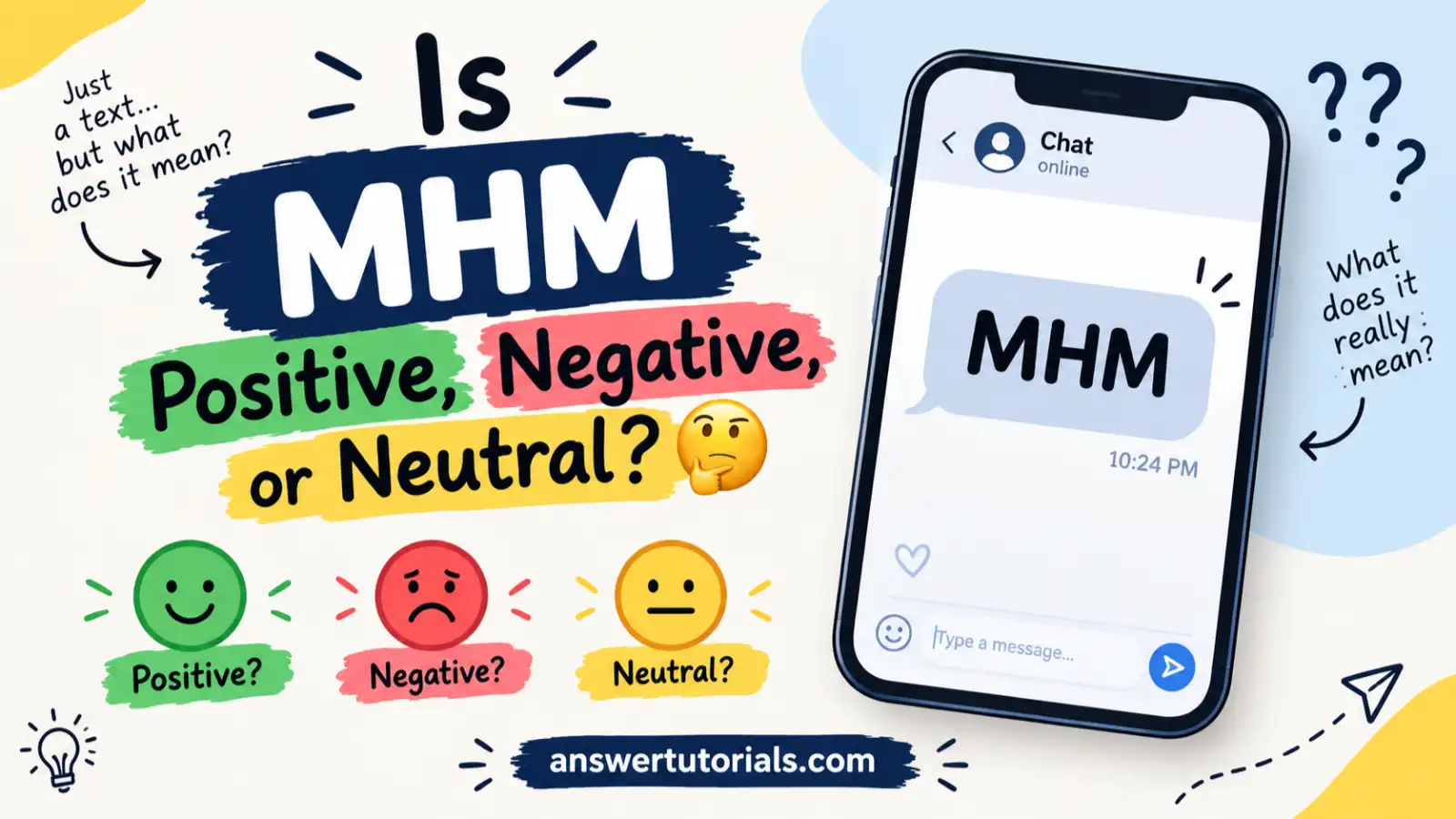
There is no single emotional tone attached to MHM.
Most commonly, it is neutral or mildly positive because it acknowledges something.
However, tone can shift depending on context.
MHM can sound positive when:
- The person agrees with you.
- They are actively listening.
- They are confirming information.
- They use an enthusiastic emoji.
- They continue the conversation afterward.
Example:
“MHM! Exactly 😂”
This clearly sounds positive and engaged.
MHM can sound neutral when:
- It is used as a quick acknowledgment.
- The conversation is casual.
- The person is confirming a simple fact.
Example:
“You got home?”
“Mhm.”
That is simply confirmation.
MHM can sound negative when:
- It appears after an argument.
- The person gives no additional response.
- It is paired with dismissive language.
- The context suggests irritation or sarcasm.
Example:
You: You never listen to me.
Them: Mhm.
Depending on the relationship and previous messages, that could sound dismissive rather than supportive.
So, never judge MHM from the word alone. Read the conversation around it.
What Does “MHM” Mean From a Guy? 👨💬
If a guy texts “mhm,” the basic meaning is still usually “yes,” “yeah,” or “I understand.”
It does not automatically indicate romantic interest, annoyance, boredom, or excitement.
For example:
You: Are you free this weekend?
Him: Mhm.
He is probably confirming that he is free.
However, the next message matters.
If he says:
“Mhm, what did you have in mind?”
he is clearly participating in the conversation.
If he repeatedly responds with only:
“mhm”
without asking questions or adding information, the conversation may simply be low-energy.
That does not prove a particular emotion or intention. It only tells you that his responses are brief.
Look at the Conversation, Not Just MHM
Consider:
- What did you say before he replied?
- Did he ask another question?
- Did he use emojis?
- Is he normally a short texter?
- Is the conversation serious or casual?
- Did his texting style suddenly change?
These clues provide much more information than the three letters themselves.
What Does MHM Mean From a Girl? 👩💬
When a girl texts MHM, it usually has the same basic meanings: yes, yeah, uh-huh, okay, or I’m listening.
For example:
You: You still want to go shopping later?
Her: Mhm.
That most naturally means yes.
But context can change the tone.
Compare:
“mhm 😊”
with:
“mhm…”
The first may feel warm or friendly. The second could indicate hesitation or uncertainty.
Again, MHM by itself is not enough to determine romantic interest or emotional intent.
How to Tell What MHM Means From Context 🔍
When someone sends MHM, use the surrounding conversation to interpret it.
Check the message before it
Ask yourself what the person is responding to.
If you asked:
“Did you eat?”
and they replied:
“mhm”
the likely meaning is yes.
If you shared a story and they replied:
“mhm”
they may mean “I’m listening.”
Check what comes after it
A follow-up message can reveal the intention.
“Mhm. What happened next?”
This suggests engagement.
By contrast:
“Mhm.”
with no further conversation could simply be a brief acknowledgment.
Check punctuation
Punctuation can influence tone.
- mhm → casual
- MHM! → enthusiastic or emphatic
- mhm? → questioning
- mhm… → hesitant or uncertain
- Mhm. → potentially firm, neutral, or slightly serious
Punctuation is not a guaranteed emotional code, but it can provide a useful clue.
MHM Text Examples You Can Understand Instantly 📱
Here are realistic examples of how MHM in text can work.
Example 1: Simple Confirmation
A: Are you at home?
B: Mhm.
Meaning: Yes, I am.
Example 2: Agreement
A: We should probably leave early.
B: Mhm.
Meaning: I agree.
Example 3: Listening
A: So I talked to my manager today…
B: Mhm.
Meaning: I’m listening.
Example 4: Confirmation
A: I’ll send it tonight.
B: Mhm.
Meaning: Okay / understood.
Example 5: Enthusiasm
A: Want pizza tonight?
B: MHM! 🍕
Meaning: Absolutely!
Example 6: Hesitation
A: You really think that’s a good idea?
B: Mhm…
Meaning: Possibly yes, but the hesitation matters.
Example 7: Conversation Encouragement
A: Wait until you hear the rest.
B: Mhm 👀
Meaning: Go ahead, I’m listening.
Example 8: Possible Dismissiveness
A: I already explained why I’m upset.
B: Mhm.
Meaning: Potentially “okay” or “I hear you,” but the tone depends heavily on the conversation.
How Should You Respond to MHM? 💡
Your response should match the context.
If someone uses MHM as a simple confirmation, you may not need to reply at all.
For example:
You: Are you coming at 7?
Them: Mhm.
You can simply continue:
“Perfect!”
If they seem engaged, continue naturally.
Them: Mhm, tell me what happened.
You: Okay, so here’s the funny part…
Casual Responses
Try:
- “Cool 😄”
- “Perfect!”
- “Gotcha.”
- “Okay!”
- “Sounds good.”
- “Awesome.”
Playful Responses
If your relationship is casual:
- “That’s a very confident mhm 😂”
- “Mhm? I’ll take that as a yes.”
- “Okayyy, I hear you 👀”
- “That was a serious mhm.”
When You Need Clarification
If you cannot tell what they mean, ask directly:
“Is that a yes?”
or:
“Mhm as in yes? 😂”
A simple question is often better than trying to decode a short text for hours.
Common Mistakes When Interpreting MHM 🚫
Short texts are easy to overanalyze.
One common mistake is assuming that MHM always means someone is annoyed. It does not.
Another mistake is assuming it always means enthusiasm. It does not.
People have different texting habits. One person might use mhm frequently, while another person might use it only when they want to give a quick acknowledgment.
Avoid interpreting the message based only on capitalization.
For example, MHM does not automatically mean anger. Someone may simply have their keyboard set to uppercase or intentionally emphasize the response.
Similarly, lowercase mhm does not automatically mean boredom.
Avoid These Assumptions
Don’t automatically conclude:
- “They are angry.”
- “They are flirting.”
- “They don’t care.”
- “They definitely agree.”
- “They are being sarcastic.”
- “They want to end the conversation.”
Instead, consider the full conversational context.
MHM vs. Other Common Text Expressions 📲
Understanding similar expressions can make MHM easier to interpret.
| Text expressionTypical meaning | |
|---|---|
| MHM | Yes / uh-huh / I agree |
| Yeah | Yes |
| Yep | Yes, often casual |
| Yup | Casual yes |
| Uh-huh | Yes / listening |
| Okay | Acknowledgment or acceptance |
| Sure | Agreement or willingness |
| Ikr | I know, right |
| Mm-hmm | Yes / agreement |
| Nah | No / not really |
There is overlap between many of these expressions.
The difference often comes down to tone and conversational style.
For example, “Yep” can sound more direct, while “mhm” can feel more like a conversational nod.
Why Do People Use MHM Instead of Yes? ✨
There are several practical reasons.
It feels natural
MHM resembles a sound people make in everyday speech.
It is quick
Typing mhm takes less effort than writing a full sentence.
It keeps the conversation flowing
Someone can acknowledge you without interrupting the conversational rhythm.
It can sound softer
Depending on the context, MHM may feel less formal than “yes.”
Compare:
“Yes, I understand.”
with:
“Mhm.”
The first sounds more complete and formal. The second feels casual and conversational.
It works well in informal messaging
Friends, couples, family members, and casual acquaintances may all use MHM because texting often favors short, natural responses.
FAQs:
What does MHM mean in text?
MHM usually means “yes,” “yeah,” “uh-huh,” or “I agree.” It can also mean that someone is listening or acknowledging what you said.
Is MHM rude?
Not necessarily. MHM is normally a casual acknowledgment. It can sound rude or dismissive in certain contexts, especially if the conversation is tense, but the word itself is not inherently rude.
Does MHM mean yes?
Yes. In many conversations, MHM is simply an informal way to say yes or confirm something.
Does MHM mean “I’m listening”?
It can. When someone is telling a story or explaining something, MHM may mean “I hear you,” “I’m following,” or “go on.”
What is the difference between MHM and MHMM?
Both usually communicate agreement or acknowledgment. MHMM can sometimes feel slightly more drawn out or expressive, but there is no universal rule separating the two.
Final Thoughts:
So, what does MHM mean in text? Most of the time, it means “yes,” “yeah,” “uh-huh,” “I agree,” or “I’m listening.” 👍
The expression comes from ordinary conversational sounds rather than functioning like a strict acronym. That is why its meaning can shift slightly from one conversation to another.
The most important thing to remember is context. A simple “mhm” after a question may mean yes. The same “mhm” during a long story may mean “I’m listening.” Add punctuation, emojis, or a tense conversation, and the tone can change again.
In short, don’t overthink the three letters alone. Look at what was said before MHM, what comes after it, and how the person normally texts. That gives you a much clearer picture of what they intended. 🔍

Ayan Zaman is a content writer and researcher at answertutorials.com, specializing in text meanings, slang, abbreviations, and everyday communication. He creates clear, practical, and easy-to-understand guides to help readers communicate with confidence. His content focuses on accurate explanations, real-world examples, and useful answers for modern digital conversations.