

If someone suddenly texts you “TMI 😂”, you might wonder whether they are joking, annoyed, embarrassed, or actually asking you to stop sharing details. The good news is that TMI is one of the most common internet and texting abbreviations, and its meaning is usually easy to understand once you know the context.
So, what does TMI mean in text? TMI stands for “Too Much Information.” People use it when someone shares more personal, embarrassing, private, graphic, or unnecessary information than the listener wanted to hear.
For example, if your friend texts, “I’m going to be late because my stomach is destroying me today,” you might jokingly reply, “TMI 😂.”
However, TMI is not always rude. Friends often use it playfully, especially when someone shares an awkward story. Understanding the tone, relationship, and situation can help you know whether TMI is being used as a joke, a gentle warning, or a serious request for fewer details.
What Does TMI Mean in Text? 🤔
TMI means “Too Much Information.”
In texting, people commonly use TMI when another person provides details that feel overly personal, unnecessary, awkward, embarrassing, or uncomfortable.
The abbreviation is especially common in casual conversations, group chats, social media comments, and messaging apps.
Simple definition
TMI = Too Much Information
In everyday texting, it can communicate something like:
- “I didn’t need to know that.”
- “That’s more detail than I wanted.”
- “Okay, that’s a little too personal.”
- “You definitely overshared.”
- “I could have lived without knowing that.” 😂
The exact meaning depends heavily on tone and context.
For example:
Friend: “I spent all night in the bathroom because of that spicy food.”
You: “TMI 😂”
Here, TMI is probably playful.
But if someone repeatedly discusses private information after you have asked them to stop, saying “TMI” may be a more direct way of setting a conversational boundary.
What Does TMI Stand For? 🔤
TMI stands for “Too Much Information.”
Each letter represents one word:
| Letter | Word |
|---|---|
| T | Too |
| M | Much |
| I | Information |
Unlike some slang terms that have several unrelated meanings, TMI has a very established meaning in everyday English.
People use the shortened version because texting is fast and informal. Typing “TMI” is much quicker than writing “That is way more information than I needed.”
You may also see variations such as:
- TMI 😂
- TMI bro
- Okay, TMI
- That’s TMI
- Lol, TMI
- Girl, TMI 😭
- Bro… TMI
- Definitely TMI
The abbreviation works particularly well because the reader can understand the reaction immediately.
The Origin of TMI 📖
The expression “too much information” existed in everyday English before texting and social media became popular. People have long used the phrase when someone gives unnecessary or overly personal details.
The abbreviation TMI later became popular in informal communication, particularly online conversations, forums, instant messaging, and eventually mobile texting and social media.
As digital communication became faster, abbreviations became an easy way to express an entire reaction using only a few letters.
Today, TMI is widely recognized in casual online communication.
Its popularity also comes from how flexible it is. You can use it seriously, sarcastically, jokingly, or affectionately depending on your relationship with the person.
For example:
“I just found out what happened at the doctor’s appointment.”
“TMI 😭”
The second person may not literally be offended. They may simply be reacting humorously to an unexpectedly personal detail.
How Is TMI Used in Texting? 💬
People usually use TMI in texting as a reaction to something someone else has said.
It often appears immediately after a message containing unnecessary personal information.
For example:
Person A: “I couldn’t sleep because my neighbor’s dog kept barking all night.”
Person B: “That’s annoying.”
Now compare:
Person A: “I couldn’t sleep because my neighbor’s dog kept barking, and then I had to spend an hour cleaning up after my dog got sick.”
Person B: “TMI 😭”
In the second example, the speaker may have crossed from ordinary information into uncomfortable detail.
TMI can also be used when someone tells an embarrassing story.
Friend: “I accidentally waved back at someone who wasn’t waving at me.”
You: “That’s not TMI 😂”
This shows an important point: TMI is subjective. What feels like too much information to one person may be completely normal to another.
TMI Meaning in Different Contexts 🌐
The meaning of TMI stays basically the same, but the tone can change depending on where and how it is used.
TMI in Text Messages
In regular text messages, TMI usually means:
“You gave me more personal information than I needed.”
Example:
“I haven’t showered since Monday.”
“TMI bro 😂”
The response is likely humorous among friends.
TMI on Social Media
On social media, TMI can appear in comments or replies.
For example:
“I just posted every detail about my breakup.”
Someone might comment:
“TMI 😭”
Here, the commenter may be suggesting that the post contains more personal information than necessary.
TMI in Group Chats
Group chats can produce especially funny TMI moments.
Someone might send a highly personal story to a group of friends, and another person responds:
“Bro, TMI 💀”
The response usually signals surprise or amusement.
TMI Between Close Friends
Close friends often use TMI without intending to offend.
For example:
“I can’t come tonight. My stomach is acting shocking.”
“TMI 😂 but okay, feel better!”
The abbreviation can actually make the conversation feel more casual.
TMI Examples in Text Conversations 💬😂
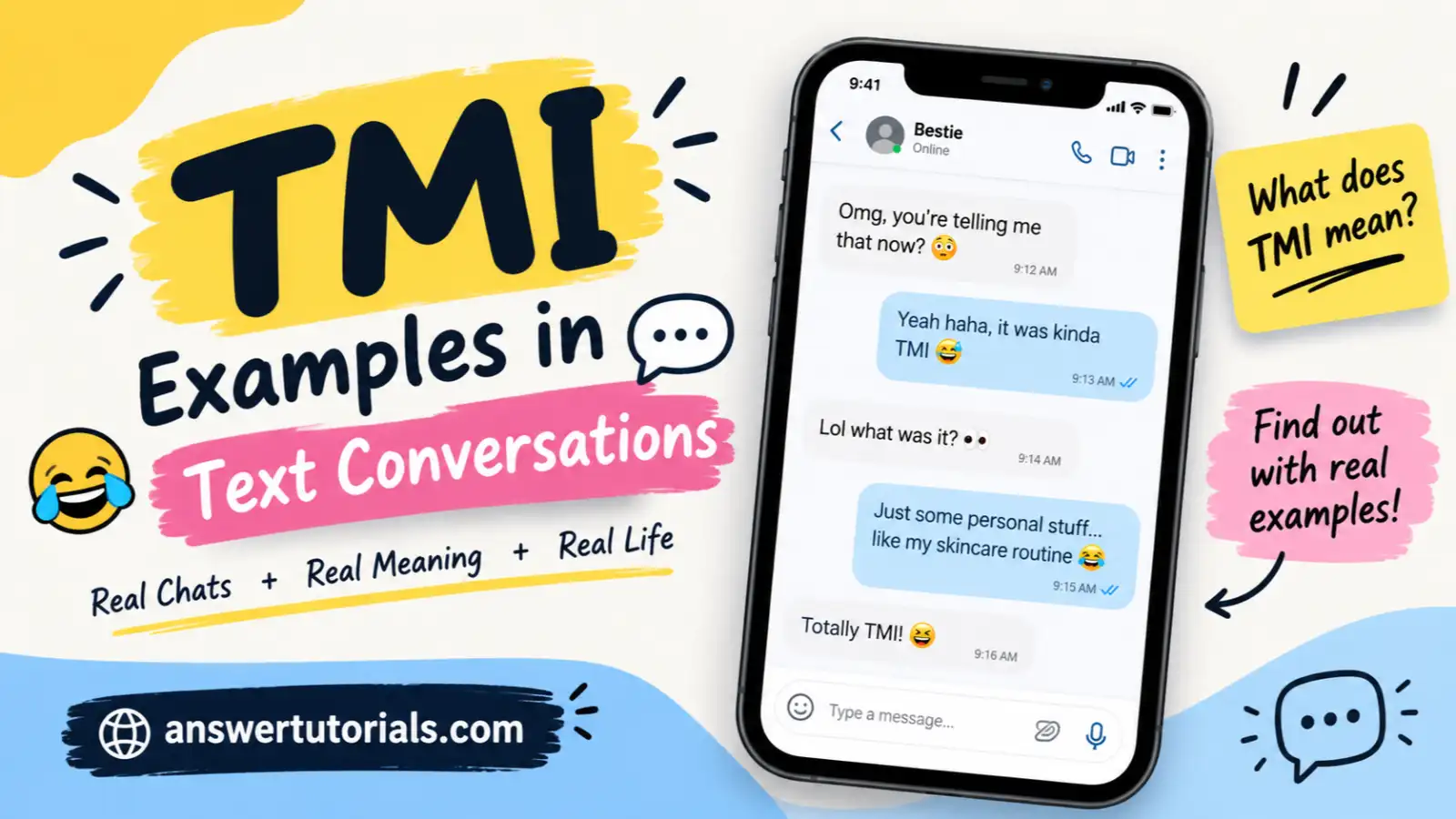
Seeing real-style examples is one of the easiest ways to understand what TMI means in text.
Example 1: Funny TMI
Alex: “I ate an entire pizza by myself and now I regret everything.”
Sam: “TMI 😂”
Here, TMI is clearly playful.
Example 2: Embarrassing Story
Alex: “I tried to impress my crush and accidentally called them by my ex’s name.”
Sam: “OMG TMI 😭”
The phrase emphasizes how awkward the story is.
Example 3: Personal Information
Alex: “I have to cancel because I’m dealing with a private health issue.”
Sam: “You don’t have to explain. TMI 😂”
This can gently signal that the person does not need to provide additional details.
Example 4: Group Chat
Friend 1: “Guys, I just told my entire family about my dating life.”
Friend 2: “TMI 💀”
The reaction suggests that the information was perhaps too personal for the group.
Example 5: Playful TMI
Friend: “Guess what? I finally got the courage to ask my crush out!”
You: “Okayyy, TMI about your love life 😂”
Here, TMI is being used jokingly rather than as a serious criticism.
Is TMI Rude? 😬
TMI is not automatically rude.
Its tone depends on several factors:
- Your relationship with the person
- What information they shared
- The way you write TMI
- Emojis surrounding it
- The seriousness of the conversation
- Whether the person intended to share something personal
For example:
“TMI 😂”
usually sounds playful.
But:
“TMI. Stop telling me this stuff.”
sounds much more serious.
Similarly:
“Okayyy TMI 😭”
can sound humorous and friendly.
The abbreviation itself is neutral. The surrounding context creates the tone.
If you are talking to someone you do not know well, be careful. A short “TMI” may sound dismissive or judgmental.
When Should You Use TMI? ✅
You can use TMI when someone shares information that is:
- Extremely personal
- Embarrassing
- Graphic
- Unnecessary
- Intimate
- Awkward
- Excessively detailed
- Unexpectedly private
For example:
“My roommate told me every detail about their breakup.”
A friend might respond:
“TMI 😭”
You can also use TMI when someone is jokingly oversharing.
However, avoid using it when someone is genuinely discussing a serious problem and may need support.
If someone is sharing something important about their health, grief, abuse, or another difficult experience, responding with “TMI” could make them feel dismissed.
In those situations, empathy matters more than slang.
When Should You Avoid Saying TMI? 🚫
Although TMI is common, it is not appropriate for every situation.
Avoid using it when someone is:
- Asking for emotional support
- Discussing a serious personal problem
- Sharing important medical information
- Talking about grief or loss
- Describing a difficult experience
- Seeking genuine advice
- Clearly uncomfortable or vulnerable
For example, if a friend says:
“I’ve been struggling emotionally lately and don’t know who to talk to.”
Replying “TMI” would probably feel insensitive.
A better response would be:
“I’m sorry you’re dealing with that. I’m here if you want to talk.”
This distinction is important because TMI is usually playful slang, not a replacement for empathy.
How to Respond When Someone Says “TMI” 😂
If someone texts “TMI” after you share something, don’t panic.
In many cases, they are joking.
Here are some possible responses depending on the tone.
Funny Replies
- “You asked! 😂”
- “Too late now.”
- “You can’t unhear it.”
- “I had to share the details.”
- “My bad 😂”
- “Okay, I’ll stop.”
- “You brought this on yourself.”
- “Information successfully delivered.”
Playful Replies
- “You know me too well.”
- “Just keeping you informed.”
- “Fine, I’ll save the details for later 😂.”
- “Consider yourself educated.”
- “I overshare. It’s a talent.”
Polite Reply
If you think they genuinely feel uncomfortable:
“Haha, sorry! I probably gave you more detail than necessary.”
That response acknowledges their reaction without making the situation awkward.
TMI vs. Oversharing: What’s the Difference? 🧠
TMI and oversharing are closely related, but they are not exactly the same.
TMI is usually the reaction.
Oversharing is the behavior.
For example:
Someone tells a group of coworkers every private detail about their relationship.
That person may be oversharing.
A coworker might respond:
“TMI.”
So the relationship can be summarized like this:
| Term | Meaning |
|---|---|
| TMI | A reaction to receiving excessive information |
| Oversharing | Giving more personal information than appropriate |
| Private information | Details someone may reasonably want to keep personal |
| Personal disclosure | Sharing information about yourself with others |
Not every personal disclosure is oversharing. Healthy communication often involves sharing personal information with people you trust.
The issue is usually whether the amount, detail, audience, or timing feels inappropriate.
TMI, Too Much Information, and Similar Expressions 🔎
People have several ways to express the same general idea.
| Expression | Typical meaning | Tone |
|---|---|---|
| TMI | Too much information | Casual |
| I didn’t need to know that | That was unnecessary information | Playful or serious |
| That’s a little personal | The information feels private | Polite |
| Okay, that’s enough | Stop providing details | Direct |
| You overshared | You gave too many personal details | Casual |
| Way too much detail | Excessive explanation | Casual |
| I could’ve gone without knowing that | The information wasn’t necessary | Humorous |
Among these expressions, TMI is one of the shortest and most recognizable options in casual digital communication.
Common TMI Mistakes to Avoid ⚠️
Using slang naturally is more than knowing its definition. You also need to understand the social context.
Mistake 1: Using TMI During a Serious Conversation
If someone is discussing something painful, don’t automatically respond with TMI.
Consider the emotional situation first.
Mistake 2: Assuming TMI Always Means Anger
Usually, it doesn’t.
A message like:
“TMI 😂”
can be completely playful.
Mistake 3: Using It With Everyone
Friends may understand your humor. A coworker, manager, customer, or unfamiliar person may interpret it differently.
Mistake 4: Ignoring Tone
Compare:
“TMI 😂”
with:
“TMI.”
The first can feel humorous. The second may feel blunt or uncomfortable.
Mistake 5: Thinking Every Personal Detail Is TMI
Personal information isn’t automatically excessive.
Context matters.
Why Is TMI So Popular in Texting? 📱
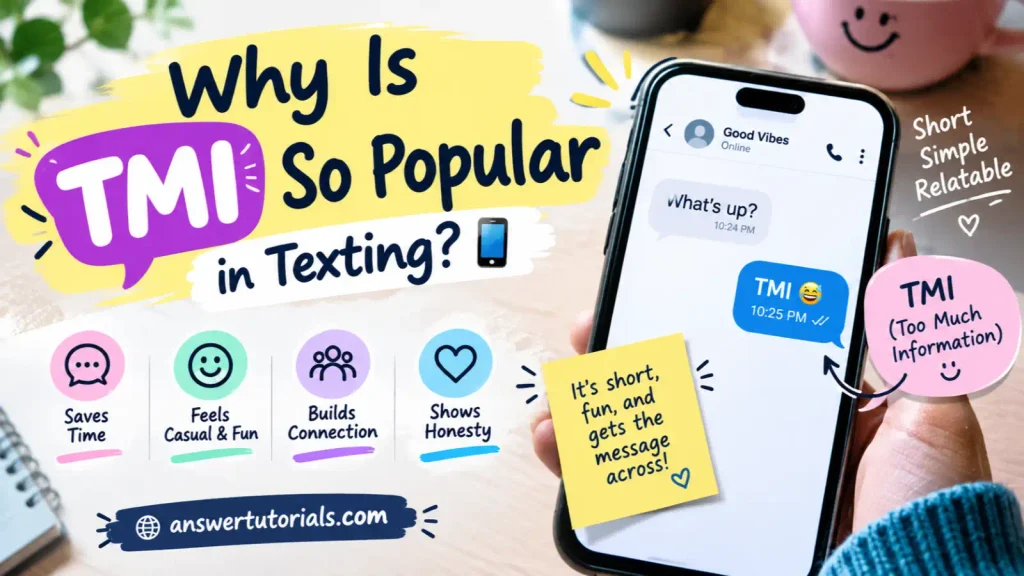
Texting favors short, expressive language.
People often communicate with:
- Abbreviations
- Emojis
- Acronyms
- Slang
- Reaction words
- Internet expressions
TMI fits this communication style perfectly because three letters can communicate a complete reaction.
Instead of typing:
“You just shared significantly more personal information than I expected to hear.”
someone can simply type:
“TMI 😂”
That makes the conversation faster and more natural.
The abbreviation also leaves room for humor. An emoji can completely change the emotional feel of the message.
For example:
😂“TMI ” → probably playful
😭“TMI” → surprised or amused
💀“TMI” → jokingly shocked
“TMI.” → potentially serious or annoyed
Therefore, when interpreting TMI, look at the whole message, not just the three letters.
FAQs:❓
What does TMI mean in text?
TMI means “Too Much Information.” It is commonly used when someone shares overly personal, embarrassing, graphic, or unnecessary details.
What does TMI mean on social media?
On social media, TMI usually means “Too Much Information.” Someone may use it when a post or comment contains more personal information than they wanted to see.
Is TMI a bad word?
No. TMI is not a swear word. It is a casual abbreviation meaning “Too Much Information.” However, the way you use it can sometimes sound rude or dismissive.
How do you respond to TMI?
You can respond humorously with phrases such as “You asked! 😂”, “My bad!”, or “Too late now.” If the person seems genuinely uncomfortable, a simple “Sorry, I overshared” works well.
Does TMI always mean someone is annoyed?
No. TMI does not always indicate annoyance. Friends frequently use it as a joke when someone shares an embarrassing or overly detailed story.
Final Thoughts 💡
So, what does TMI mean in text? It means “Too Much Information.” People use this abbreviation when someone shares more personal, embarrassing, intimate, graphic, or unnecessary information than they expected.
The meaning is simple, but the tone can vary. Among close friends, “TMI 😂” may be nothing more than a funny reaction. In a more serious conversation, however, it can signal that someone feels uncomfortable with the amount of information being shared.
Remember the key points:
- TMI = Too Much Information
- It is common in texts, chats, comments, and social media
- It can be funny, playful, surprised, or serious
- Context determines the tone
- TMI is closely connected to oversharing
- Avoid using it when someone is sharing something genuinely serious or vulnerable
- If someone tells you “TMI,” you can respond with humor or simply acknowledge that you shared too much
Once you understand the context, TMI is one of the easiest texting abbreviations to recognize. The next time someone sends you “TMI 😂,” you’ll know exactly what they mean and how to respond naturally. 📱✨

Ayan Zaman is a content writer and researcher at answertutorials.com, specializing in text meanings, slang, abbreviations, and everyday communication. He creates clear, practical, and easy-to-understand guides to help readers communicate with confidence. His content focuses on accurate explanations, real-world examples, and useful answers for modern digital conversations.