

If someone sends you “IDM” in a text message, you might pause and wonder what they actually mean. Is it agreeing with you? Saying they do not care? Or simply giving a quick response?
In most texting and social-media conversations, IDM means “I Don’t Mind.” People use it to show that they are okay with something, have no strong preference, or are comfortable with either option.
For example:
“Do you want pizza or burgers?”
“IDM.”
Here, the person means “I don’t mind” or “Either one is fine with me.”
The meaning is simple, but the tone can change depending on the conversation. So, let’s explore IDM meaning in text, its origin, examples, variations, and the best ways to use it naturally. 📱
IDM Meaning in Text at a Glance
IDM = “I Don’t Mind.”
It is a common texting abbreviation used when someone wants to communicate that they have no particular preference.
| Term | Meaning | Typical Use |
|---|---|---|
| IDM | I Don’t Mind | Casual texting |
| I don’t mind | No strong preference | Everyday conversation |
| Either is fine | Both choices are acceptable | Making plans |
| Whatever works | Flexible about the choice | Scheduling |
| Up to you | Letting someone else decide | Casual chats |
For example:
Friend: “Should we watch a movie or play a game?”
You: “IDM, you choose.”
In this situation, IDM tells your friend that you are comfortable with either option.
What Does IDM Stand For? 🔤
IDM stands for “I Don’t Mind.”
Each letter comes from the first letter of a word:
- I = I
- D = Don’t
- M = Mind
The abbreviation makes texting faster and more casual. Instead of typing the complete phrase, someone can simply write “IDM.”
It is especially useful in quick conversations where both people already understand common texting abbreviations.
Simple Example
Person 1: “Tea or coffee?”
Person 2: “IDM.”
Meaning:
“I don’t mind. You can choose.”
The phrase usually communicates flexibility rather than excitement. That distinction matters because “IDM” does not necessarily mean that the person strongly likes both choices.
What Is the Origin of IDM? 📱
The exact point when IDM became popular in digital communication is difficult to establish. Like many internet abbreviations, it developed from the natural tendency to shorten frequently used phrases in online conversations.
Text messaging encouraged people to communicate quickly, especially when typing on small phone keyboards. Over time, abbreviations such as IDK, IMO, BTW, TBH, and IDM became familiar parts of casual digital language.
The full phrase “I don’t mind” existed long before texting. Digital communication simply gave people a convenient reason to shorten it.
Today, IDM can appear in text messages, group chats, social-media conversations, gaming chats, and other informal online communication. 💬
How Is IDM Used in Text Messages? 💬
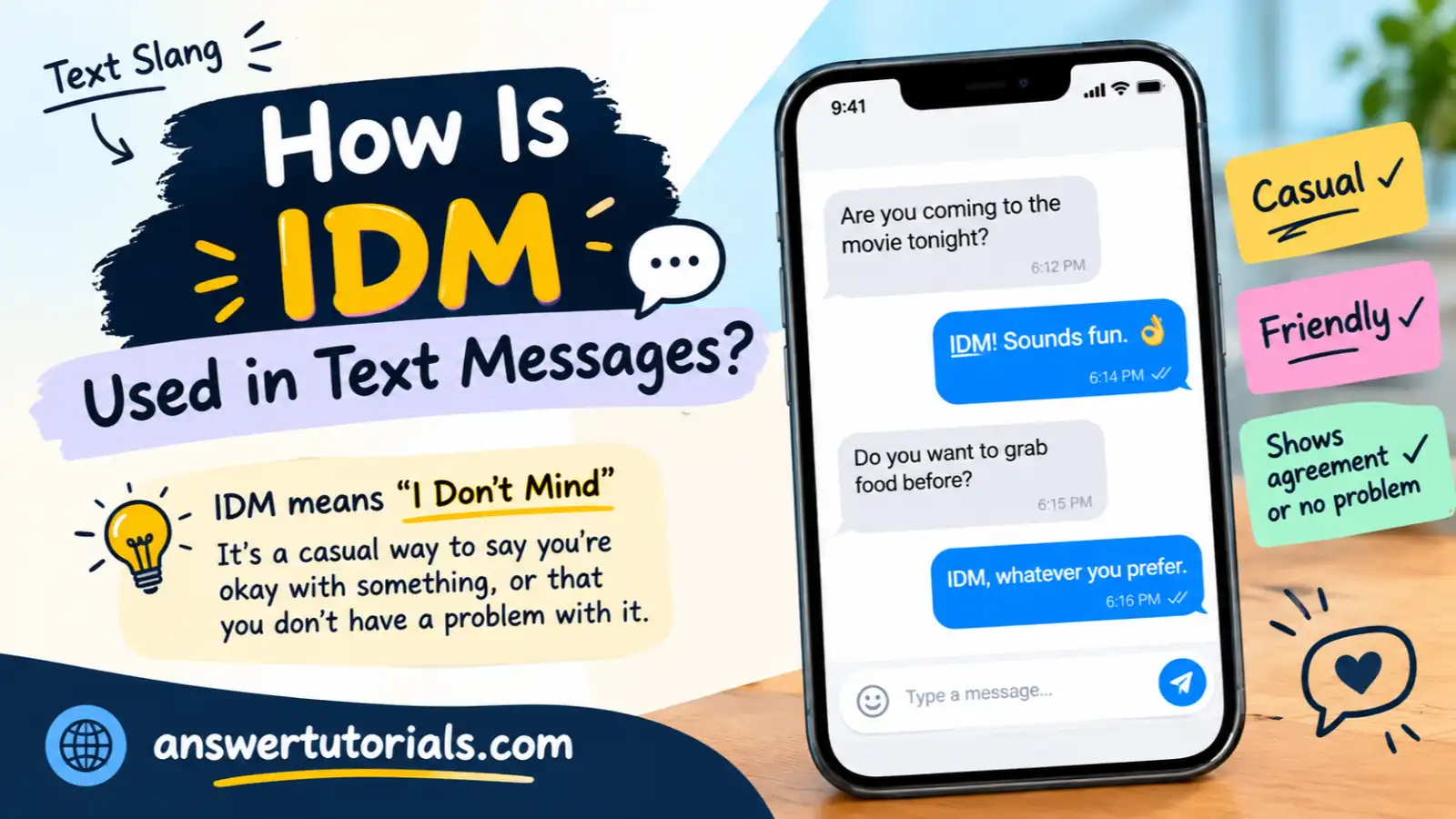
People generally use IDM when they do not have a strong preference.
Imagine your friend asks:
“Do you want to meet at 5 or 6?”
You might answer:
“IDM, 6 works.”
This means you are not opposed to 6 o’clock and are happy to go with that option.
Here are several common situations:
Choosing Food 🍕
Friend: “Pizza or Chinese food?”
Reply: “IDM.”
Meaning:
“Either one is okay with me.”
Choosing a Movie 🎬
Friend: “Comedy or action?”
Reply: “IDM. You pick.”
Meaning:
“I don’t have a preference, so you can decide.”
Choosing a Meeting Time ⏰
Friend: “Can we do 7 instead?”
Reply: “IDM.”
Meaning:
“Yes, that’s fine with me.”
Choosing a Location 📍
Friend: “Coffee shop A or B?”
Reply: “IDM, whichever is easier.”
Again, the person is communicating flexibility.
IDM Examples in Different Conversations
Understanding examples is one of the easiest ways to understand IDM text meaning.
| Conversation | IDM Response | What It Means |
|---|---|---|
| “Pizza or pasta?” | “IDM.” | Either is okay |
| “Morning or evening?” | “IDM.” | No preference |
| “Should I call you later?” | “IDM.” | Either option is acceptable |
| “Do you want blue or black?” | “IDM.” | You can choose |
| “Can we meet Friday?” | “IDM.” | Friday is fine |
| “Movie or series?” | “IDM 😂” | Either works |
| “Want to sit inside or outside?” | “IDM.” | No strong preference |
Example With Friends
Alex: “Where should we eat tonight?”
Sam: “IDM.”
Alex: “Okay, let’s try the new burger place.”
Sam: “Sounds good.”
Here, IDM allows Alex to make the decision.
Example in a Group Chat
🏬Friend 1: “Should we start at 7 or 8?”
😍Friend 2: “8 works for me.”
Friend 3: “IDM.”
Friend 1: “Cool, 8 it is!”
The person using IDM is showing that they do not object to the selected time.
Does IDM Always Mean “I Don’t Mind”? 🤔
In ordinary texting, IDM usually means “I Don’t Mind.” However, context still matters.
Text abbreviations can sometimes have different meanings in different communities, industries, or conversations. Therefore, you should consider what was being discussed before interpreting the abbreviation.
For example:
“Do you want to go now or later?”
“IDM.”
The meaning is almost certainly:
“I don’t mind. Either is okay.”
But if someone uses IDM in a specialized professional or technical conversation, the abbreviation could potentially mean something else.
Context Is the Key
Before interpreting any abbreviation, look at:
- What was discussed immediately before it?
- Is the conversation casual or professional?
- Is the person using other slang?
- Does the response make sense as “I don’t mind”?
- Is the conversation happening in a specialized community?
For normal texting and social media, “I Don’t Mind” is the most natural interpretation.
What Does IDM Mean From a Girl or Guy? 👩💬👨💬
If a girl or guy texts you “IDM,” the abbreviation itself usually does not automatically indicate romantic interest, rejection, excitement, or annoyance.
It generally means:
“I don’t mind.”
For example:
You: “Want to call tonight?”
Them: “IDM.”
That response indicates that calling is acceptable to them. However, the exact emotional tone depends on the broader conversation.
Compare these:
“IDM.”
This is short and neutral.
“IDM 😊”
The emoji can make it feel warmer or friendlier.
💏IDM, you decide 😂”
This sounds more relaxed and playful.
“IDM lol.”
This can sound casual and informal.
So, avoid assuming that IDM alone reveals someone’s feelings. Look at their complete message and the surrounding conversation.
IDM vs. Similar Texting Abbreviations 🔎
Several texting expressions can look similar but communicate slightly different ideas.
| Expression | Meaning | Difference |
|---|---|---|
| IDM | I Don’t Mind | No strong preference |
| IDK | I Don’t Know | Lack of knowledge |
| IDC | I Don’t Care | Can sound more indifferent |
| IMO | In My Opinion | Introduces an opinion |
| IK | I Know | Shows awareness |
| NVM | Never Mind | Withdraws or dismisses something |
| DW | Don’t Worry | Reassures someone |
| TBH | To Be Honest | Introduces honesty or an opinion |
IDM vs. IDC
This is an especially important distinction.
IDM means:
“I don’t have a preference.”
IDC means:
“I don’t care.”
Although these can overlap in some situations, IDC can sound much harsher or more dismissive.
For example:
“Tea or coffee?”
“IDM.”
This sounds flexible.
But:
“Tea or coffee?”
“IDC.”
Depending on the context, this could sound like the person is not interested in the decision.
Therefore, IDM is often the softer option.
Is IDM Casual or Formal? 🗣️
IDM is primarily casual.
You can comfortably use it in:
- Text messages
- Group chats
- Social media
- Gaming chats
- Messages with friends
- Informal conversations
However, it is usually better to avoid abbreviations such as IDM in formal communication.
For example, instead of:
“IDM what time.”
A professional message would be clearer as:
“I’m flexible with the time. Whatever works best for you is fine.”
Casual vs. Professional
Casual:
“IDM, you choose 😂”
Professional:
“I don’t have a preference. Either option works for me.”
The second version sounds more polished and appropriate for workplace communication.
How to Reply When Someone Says IDM 💬
If someone sends you “IDM,” you usually have permission to choose an option.
Here are natural responses:
Simple Replies
- “Okay, let’s do 7.”
- “Cool, I’ll choose.”
- “Sounds good!”
- “Let’s go with pizza.”
- “Alright, Friday works.”
- “Perfect, I’ll decide.”
Friendly Replies 😊
- “Haha, okay, I’ll pick!”
- “Cool, my choice then 😂”
- “Alright, leave it to me.”
- “Sounds good! I know just the place.”
- “Okay, we’re doing my favorite.”
If You Need More Information
Sometimes “IDM” may not completely answer your question.
You can ask:
“Okay, but if you had to choose, which one would you pick?”
Or:
“Either one really?”
This can help you discover whether the person truly has no preference or is simply letting you make the decision.
Common Ways People Use IDM Online 🌐
The abbreviation appears naturally in several types of online communication.
1. Text Messaging
“What time should I come?”
“IDM. Whenever you’re free.”
2. Social Media
“Should I post the first picture or the second?”
“IDM, both look good.”
3. Gaming
“Which map should we play?”
“IDM.”
4. Group Chats
“Saturday or Sunday?”
“IDM.”
5. Dating Conversations
“Coffee or dinner?”
“IDM, you choose 😊.”
In each example, the abbreviation communicates flexibility or a lack of preference.
Common Mistakes When Using IDM ⚠️
Although IDM is simple, there are a few ways it can be misunderstood.
Mistake 1: Assuming It Means Excitement
IDM does not automatically mean “I really want that.”
If someone says:
“Want pizza?”
and you reply:
“IDM.”
You are saying pizza is acceptable, not necessarily that pizza is your favorite.
Mistake 2: Confusing IDM With IDC
These expressions can carry different tones.
IDM: “Either is fine.”
IDC: “I don’t care.”
If you want to sound cooperative, IDM is usually clearer and friendlier.
Mistake 3: Using IDM in Formal Writing
Abbreviations are not always appropriate in professional communication.
Instead of:
“IDM when you schedule it.”
Consider:
“I’m flexible about the schedule.”
Mistake 4: Using IDM Without Context
A one-word response can sometimes feel vague.
Instead of:
“IDM.”
You could write:
“IDM, either option works for me.”
That makes your meaning much clearer.
IDM in Different Tones: What Does It Sound Like? 🎭
The tone of IDM depends heavily on punctuation, emojis, and additional words.
| Message | Possible Tone |
|---|---|
| IDM. | Neutral |
| IDM! | Positive or energetic |
| IDM 😊 | Friendly |
| IDM 😂 | Playful |
| IDM lol | Relaxed |
| IDM, you choose. | Flexible |
| IDM either way. | Clearly neutral |
| IDM, whatever works. | Flexible but casual |
The surrounding conversation matters more than the three letters themselves.
For instance:
“IDM 😊”
may feel warmer than:
“IDM.”
But neither message alone proves a particular emotion or intention.
When Should You Use IDM? ✅
Use IDM when you genuinely have no strong preference and the conversation is informal.
It works well when:
- Either option is acceptable.
- You want the other person to choose.
- You are comfortable with a proposed plan.
- You want a quick response.
- The conversation is casual.
- You do not need to explain your preference.
Example
Friend: “Can we meet at 6 instead of 5?”
You: “IDM, 6 works.”
This is short, clear, and natural.
However, if you do have a preference, it is better to say it directly.
Instead of:
“IDM.”
You could say:
“I’d prefer 6, but 5 is okay too.”
That gives the other person more useful information.
FAQs:
What does IDM mean in text?
IDM usually means “I Don’t Mind” in text messages. People use it when they have no strong preference between choices or are comfortable with a suggestion.
What does IDM mean on social media?
On social media, IDM generally means “I Don’t Mind.” Its meaning is usually the same as in ordinary texting, although context should always be considered.
Is IDM the same as IDC?
No. IDM means “I Don’t Mind,” while IDC means “I Don’t Care.” IDM often communicates flexibility, whereas IDC can sound more indifferent depending on the situation.
Is IDM a positive or negative response?
IDM is usually neutral. It indicates that someone is comfortable with an option but does not necessarily show strong excitement or enthusiasm.
Can I use IDM in professional messages?
It is better to use the full phrase “I don’t mind” or a clearer professional expression such as “I’m flexible” in formal communication.
Final Thoughts:
So, what does IDM mean in text? In most casual conversations, IDM means “I Don’t Mind.” It is a convenient abbreviation used to show that someone has no strong preference or is comfortable with either option.
Whether you’re choosing a restaurant, deciding when to meet, picking a movie, or making plans with friends, IDM can quickly communicate flexibility. 📱
Remember the key distinction:
IDM = I Don’t Mind = Either option is okay.
It is different from IDC, which can sound more indifferent. And while IDM works naturally in casual chats, the full phrase is usually better for professional communication.
Once you understand the context, IDM is one of the easiest texting abbreviations to recognize and use naturally.

Ayan Zaman is a content writer and researcher at answertutorials.com, specializing in text meanings, slang, abbreviations, and everyday communication. He creates clear, practical, and easy-to-understand guides to help readers communicate with confidence. His content focuses on accurate explanations, real-world examples, and useful answers for modern digital conversations.
1 thought on “What Does IDM Mean in Text Must Know”