

Ever received a text containing “STG” and wondered what the person actually meant? If you’re asking what does stg mean in text, you’re not alone. This popular texting abbreviation can appear in casual chats, social media posts, comments, and everyday messages, sometimes carrying more emphasis than its short form suggests.
In most conversations, STG means “swear to God.” People commonly use it to show that they are being serious, telling the truth, or strongly emphasizing what they just said. However, the exact tone can change depending on the conversation, relationship, and context.
In this guide, you’ll discover what does stg mean in text, how people use it, what it means in different situations, and real examples that make its meaning easy to understand.
Whether you’re decoding a message from a friend, interpreting social media slang, or simply keeping up with modern texting language, this guide will help you understand STG clearly and use it naturally.
So, what does STG mean in text?
In most texting and social media conversations, STG means “swear to God.” People commonly use it to emphasize that they are being honest, serious, or sincere. Depending on the conversation, it can sound surprised, frustrated, dramatic, funny, or completely serious.
For example:
“STG, I didn’t take your charger.”
Here, the person is strongly insisting that they did not take it.
In this guide, you’ll learn exactly what STG means in text, where it came from, how people use it, what its tone can mean, and how to respond naturally. 📱
What Does STG Mean in Text?
STG usually stands for “swear to God.”
It is a texting abbreviation people use when they want to emphasize honesty, seriousness, frustration, surprise, or a strong promise.
Instead of typing:
“I swear to God, I’m telling you the truth.”
Someone might simply write:
“STG, I’m telling you the truth.”
The meaning stays almost the same, but the shortened version feels faster and more natural in casual digital conversations.
Quick meaning at a glance
| Text Slang | Meaning | Common Use |
|---|---|---|
| STG | Swear to God | Emphasizing honesty |
| STG! | Swear to God! | Strong emotion |
| STG I did | I swear to God I did | Defending yourself |
| STG I’m serious | I swear I’m serious | Showing sincerity |
The abbreviation is especially common in texts, DMs, group chats, comments, and social media conversations.
However, context matters. The same abbreviation can communicate different emotions depending on the sentence surrounding it.
What Does “Swear to God” Mean?
To understand STG meaning in text, it helps to understand the phrase behind the abbreviation.
“Swear to God” is traditionally a strong way of saying that you are telling the truth or making a serious statement.
In everyday texting, however, people do not always use it as a literal religious statement. Many people use STG as casual slang to add emphasis.
For example:
“STG, that was the funniest thing I’ve ever seen.”
The person may not literally be making a religious oath. Instead, they are saying:
“I seriously mean it!”
That distinction is important.
The meaning of STG often depends more on emotion and context than on the literal words themselves.
STG Meaning in Texting and Social Media 📱
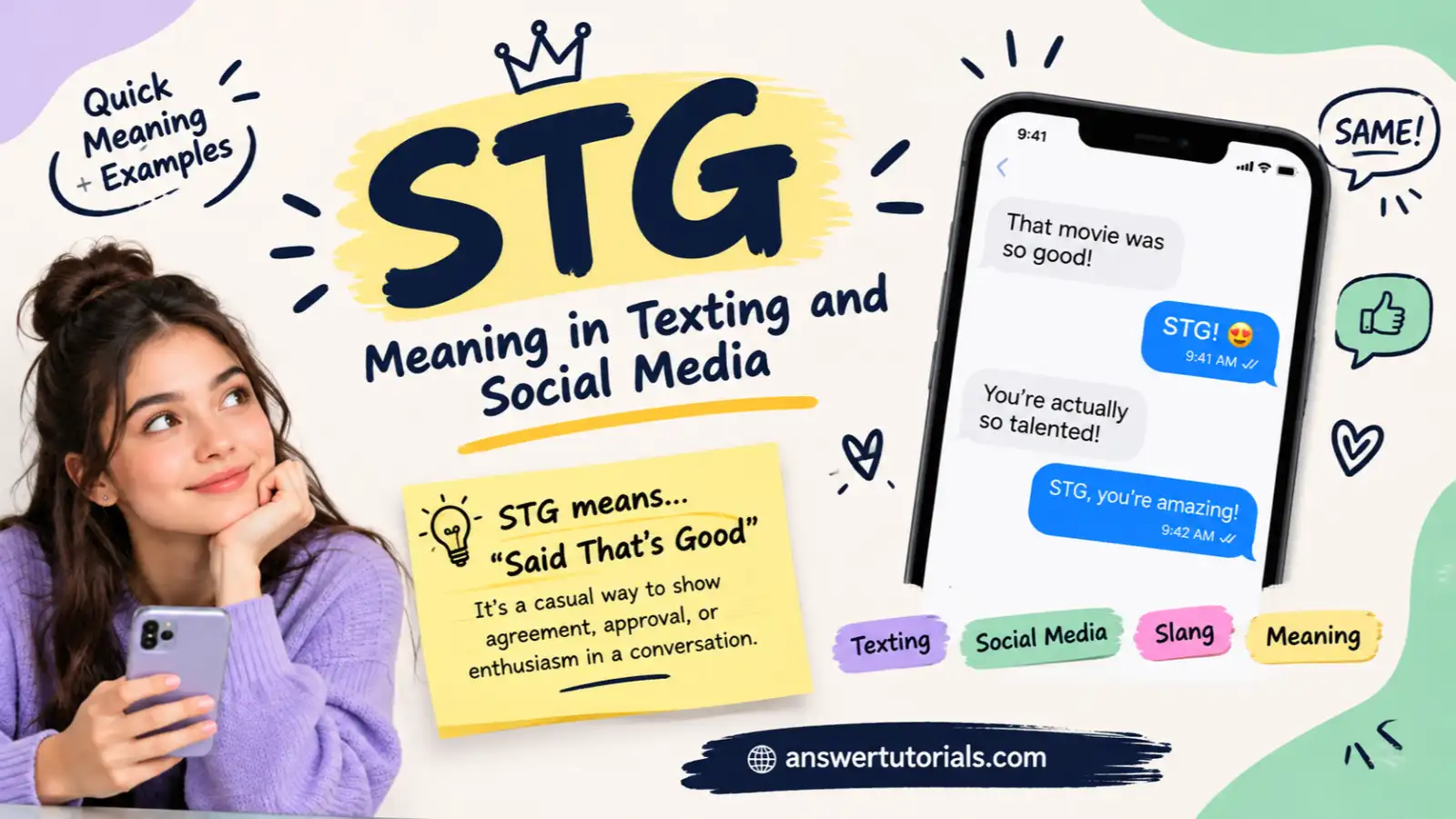
The abbreviation STG appears across many online platforms.
You may see it in:
- Text messages
- Instagram DMs
- Snapchat chats
- TikTok comments
- Discord conversations
- Group chats
- Gaming chats
- Facebook Messenger
- Casual online conversations
People usually choose STG because it is short, expressive, and easy to understand among people familiar with texting slang.
For example:
“STG this homework never ends 😭”
Here, STG adds frustration and exaggeration.
Another example:
“STG you look amazing today.”
Here, it emphasizes sincerity.
And:
“STG I thought today was Saturday.”
In this case, STG adds surprise and disbelief.
So, although STG means “swear to God,” the emotional meaning can change from one message to another.
Where Did STG Come From? 🕰️
The phrase “swear to God” existed long before texting, smartphones, and social media.
People have historically used expressions involving an oath to emphasize that they are telling the truth or making a serious promise. As informal communication evolved, especially through texting and online messaging, longer phrases naturally became shortened.
Texting culture encouraged abbreviations such as:
- LOL
- OMG
- IDK
- TBH
- IMO
- BTW
- STG
STG developed as a convenient abbreviation for “swear to God.”
There is no need to treat it as a completely new phrase. The modern difference is mainly the shortened digital form.
Today, STG is most often associated with casual communication. Younger internet users may use it to add emphasis, while older users may understand it without necessarily using it themselves.
What Does STG Mean Depending on Context?
One of the most important things to understand about STG meaning in text is that context controls the tone.
Here are several common situations.
STG to Show Honesty
Someone might use STG when they want you to believe them.
Example:
“STG, I didn’t send that message.”
Meaning:
“I swear I’m telling the truth. I didn’t send it.”
STG to Show Frustration
STG can also introduce a complaint.
Example:
“STG, this app keeps crashing.”
The person is expressing strong frustration.
STG to Emphasize Excitement
Sometimes STG appears before something positive or surprising.
Example:
“STG, that concert was incredible!”
The person is emphasizing how strongly they feel.
STG to Make a Dramatic Statement
People often use slang dramatically for entertainment.
Example:
“STG, if he sends one more meme, I’m leaving the group chat.”
This may be playful rather than a literal threat to leave.
STG to Defend Yourself
It can also appear during disagreements.
Example:
“STG, I never said that about you.”
Here, STG reinforces the person’s denial.
STG Text Examples You Can Actually See 💬
Understanding examples is often easier than memorizing a definition.
Here are realistic examples of how someone might use STG in text.
| Example | Likely Meaning |
|---|---|
| “STG I’m not lying.” | Strongly emphasizing honesty |
| “STG, you’re hilarious.” | Strongly emphasizing an opinion |
| “STG this is so annoying.” | Showing frustration |
| “STG I saw him there.” | Insisting something is true |
| “STG I forgot your birthday 😭” | Emphasizing an admission |
| “STG that movie was terrible.” | Strongly expressing an opinion |
| “STG I’m exhausted.” | Strong emphasis |
| “STG you scared me.” | Emphasizing a reaction |
| “STG I didn’t know!” | Defending a lack of knowledge |
| “STG, no way!” | Expressing disbelief or surprise |
Notice that STG does not completely change the sentence’s meaning. Instead, it usually makes the statement sound stronger.
What Tone Does STG Have? 😅
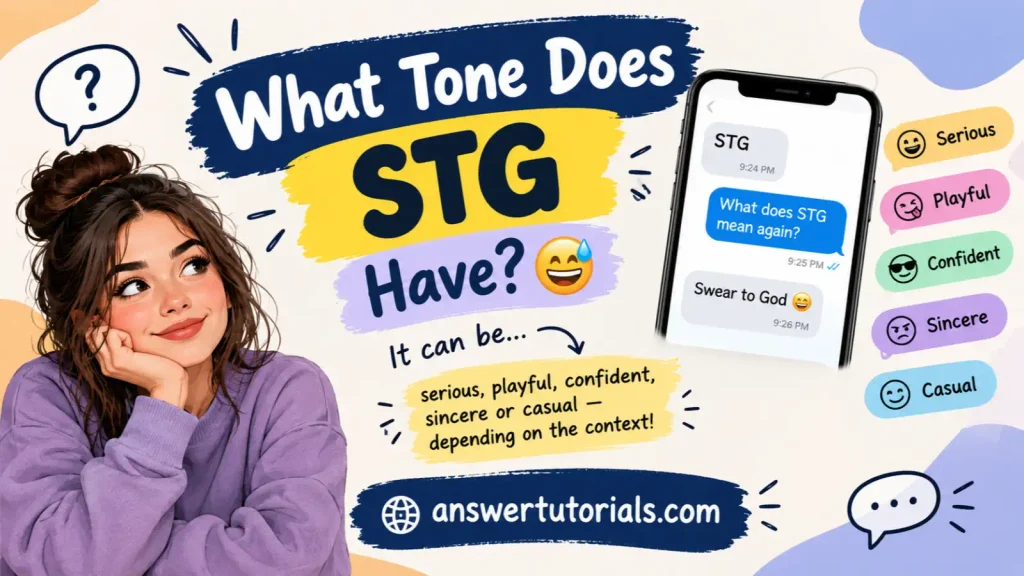
The tone of STG can range from serious to playful.
That’s why reading the entire message is important.
Serious
“STG, I am telling you the truth.”
The sender probably wants to be believed.
Frustrated
“STG, I’ve explained this five times.”
The sender sounds annoyed.
Playful
“STG, you eat more snacks than anyone I know 😂”
The sender is probably joking.
Excited
“STG, that was the best game ever!”
The abbreviation adds enthusiasm.
Dramatic
“STG, I’m never watching another horror movie.”
The person may be exaggerating for comedic effect.
Tip: Emojis, punctuation, and surrounding words often reveal the intended tone.
For example:
😭“STG ” may feel dramatic or humorous.
“STG.” may sound much more serious.
“STG!!!” usually feels highly emotional.
Is STG Rude or Offensive?
Generally, STG is not automatically rude or offensive.
However, it can sound intense because the phrase behind it includes an oath.
Consider these two messages:
“I think you’re wrong.”
versus:
“STG, you’re wrong.”
The second one sounds stronger and more emotional.
Whether it feels rude depends on the relationship between the people and the situation.
With close friends, STG may sound completely normal.
During a serious disagreement, however, it can make the message feel more forceful.
If you are speaking with someone professionally, it is usually better to avoid texting abbreviations such as STG. A clear phrase like “I assure you” or “I’m being honest” is more appropriate.
How to Respond When Someone Says STG
Your response should depend on what the person is trying to communicate.
If They Are Proving They Are Honest
You could say:
- “Okay, I believe you.”
- “Fair enough.”
- “I trust you.”
- “Got you.”
- “Alright, I’ll take your word for it.”
If They Are Complaining
Try:
- “I know, it’s so annoying.”
- “Honestly, same.”
- “Tell me about it.”
- “I completely understand.”
- “That sounds frustrating.”
If They Are Joking
You can match their energy:
- “😂 You’re so dramatic.”
- “I believe you!”
- “No way!”
- “You’re actually hilarious.”
- “Okay, okay, I get it 😂”
If You Are Not Sure What They Mean
Ask:
“Wait, STG means swear to God, right?”
There is nothing wrong with asking. Slang changes quickly, and context can always affect meaning.
STG vs Similar Text Abbreviations
STG is related to several other expressions that people use to show honesty or emphasis.
| Abbreviation/Phrase | Meaning | Main Purpose |
|---|---|---|
| STG | Swear to God | Strong emphasis |
| ISTG | I swear to God | Personal emphasis |
| TBH | To be honest | Showing honesty |
| FR | For real | Showing agreement or seriousness |
| NGL | Not gonna lie | Introducing an honest opinion |
| OMG | Oh my God | Surprise or excitement |
| IDK | I don’t know | Expressing uncertainty |
| I swear | I swear | Emphasizing truth |
One particularly similar abbreviation is ISTG, which means “I swear to God.”
The difference is simple:
STG: Swear to God
ISTG: I swear to God
Both can communicate strong emotion or sincerity.
STG vs ISTG: What’s the Difference?
If you see ISTG in a message, don’t confuse it with STG.
For example:
“ISTG, you never listen to me.”
This means:
“I swear to God, you never listen to me.”
Meanwhile:
“STG, you never listen to me.”
means essentially the same thing.
The difference is grammatical.
ISTG includes the subject “I.”
STG leaves it implied.
In fast-moving conversations, both abbreviations can serve nearly the same purpose.
Common Mistakes People Make With STG
Even though STG meaning in text is fairly simple, people sometimes misunderstand the abbreviation.
Mistake 1: Assuming It Is Always Serious
STG can be serious, but it can also be playful.
Look at the surrounding message and emojis before deciding how seriously to take it.
Mistake 2: Treating Every STG as Religious
The phrase comes from an oath involving God, but many people use STG casually as an emphasis phrase.
Its use does not necessarily tell you anything about the sender’s religious beliefs.
Mistake 3: Using STG in Formal Communication
STG works best in casual conversations.
Avoid it in:
- Job applications
- Professional emails
- Academic writing
- Formal customer messages
- Official documents
Use clear, standard language instead.
Mistake 4: Ignoring the Context
“STG I’m exhausted 😭”
and
“STG, I didn’t do it.”
have very different emotional situations.
The abbreviation stays the same, but the meaning of the entire message changes.
When Should You Use STG?
You can use STG when talking casually with people who understand texting slang.
It works especially well when you want to:
- Emphasize that you’re honest
- Make a strong statement
- Express frustration
- Show surprise
- Add dramatic emphasis
- Make a casual conversation more expressive
For example:
“STG, that was the funniest thing ever 😂”
That’s natural in a casual chat.
However, consider your audience first. If you are unsure whether someone understands texting abbreviations, spelling out the phrase or using plain English is safer.
FAQs:
What does STG mean in text?
STG usually means “swear to God” in text messages. People use it to emphasize honesty, seriousness, frustration, surprise, or a strong opinion.
What does STG stand for?
STG stands for “swear to God.” It is a common abbreviation used in casual texting and online conversations.
What does STG mean on Snapchat?
On Snapchat, STG generally means “swear to God.” Someone may use it when insisting that something is true or emphasizing a strong reaction.
Is STG the same as ISTG?
They are very similar. STG means “swear to God,” while ISTG means “I swear to God.” Both are commonly used to emphasize a statement.
Is STG appropriate for formal messages?
Usually, no. STG is informal texting slang. In professional or formal communication, phrases such as “I assure you,” “I’m being honest,” or “I can confirm” are more appropriate.
Final Thoughts:
So, what does STG mean in text? In most casual conversations, STG means “swear to God.” It is used to add emphasis and show that someone feels strongly about what they are saying.
The exact emotional tone depends on the context. STG can communicate honesty, frustration, excitement, disbelief, seriousness, or playful exaggeration. Emojis, punctuation, and the rest of the sentence can help you understand the intended meaning.
If someone texts “STG, I’m not lying,” they are strongly insisting that they are telling the truth. If they write “STG, that was hilarious 😂,” they are simply adding extra emphasis to their reaction.
The key takeaway is simple:
STG = “swear to God.”
Once you recognize that abbreviation, you’ll be able to understand it quickly in texts, DMs, group chats, and social media conversations. 📱

Ayan Zaman is a content writer and researcher at answertutorials.com, specializing in text meanings, slang, abbreviations, and everyday communication. He creates clear, practical, and easy-to-understand guides to help readers communicate with confidence. His content focuses on accurate explanations, real-world examples, and useful answers for modern digital conversations.
1 thought on “What Does STG Mean in Text? 🔥 Quick Guide”