

When someone sends you “STG” in a text, you might pause and wonder what they actually mean. Is it serious? Is it slang? Are they annoyed, surprised, or simply trying to emphasize what they just said? 🤔
The STG meaning in text is usually “Swear to God.” People use it to show that they are being completely honest, strongly emphasize a statement, or express frustration and disbelief.
For example, someone might text:
“STG, I left my keys on the table.”
Here, STG adds emphasis. The person is essentially saying, “I swear to God, I left my keys on the table.”
However, the meaning can change slightly depending on the conversation, relationship, and tone.
Understanding that context is important because texting removes many of the facial expressions and vocal cues we normally use in conversation.
What Does STG Mean in Text? 📲
STG usually means “Swear to God” in texting.
It is an informal abbreviation commonly used in casual digital conversations. A person may write STG when they want to emphasize that something is true, insist that they are telling the truth, or express strong emotion.
Quick meaning
| Text abbreviation | Meaning | Common purpose |
|---|---|---|
| STG | Swear to God | Emphasis or honesty |
| STG | I swear | Strong assurance |
| STG | Seriously | Emotional emphasis |
| STG | I promise | Informal reassurance |
For example:
“STG I didn’t take your charger.”
This means:
“I swear to God I didn’t take your charger.”
The abbreviation makes the message shorter while preserving the emotional emphasis.
STG Meaning in Text: The Simple Definition 🔎
The easiest way to understand STG is to think of it as a digital version of saying “I swear.”
People often use it when they want another person to believe them.
For example:
- “STG, that movie was amazing.”
- “STG I saw him at the store.”
- “STG I’m telling the truth.”
- “STG, this is the funniest thing ever.”
In each case, STG adds extra weight to the statement.
It does not necessarily mean that the person is literally making a religious oath. In casual texting, it often functions as an emotional emphasis phrase.
That distinction matters.
Someone saying “STG this happened” may simply be communicating, “I seriously promise this happened.”
What Does STG Stand For? 💬
STG stands for “Swear to God.”
The three letters come from the first letters of the three words:
- S = Swear
- T = To
- G = God
Like many texting abbreviations, STG saves typing time while keeping the meaning recognizable.
Instead of writing:
“I swear to God, I didn’t know.”
Someone can simply write:
“STG I didn’t know.”
This makes STG especially useful in fast-moving conversations, group chats, comments, and social media messages.
The Origin and Evolution of STG 🕰️
The phrase “swear to God” existed long before smartphones, social media, or texting.
People have traditionally used expressions involving swearing or promising to emphasize sincerity. As online communication became more informal, longer expressions were increasingly shortened into abbreviations.
This is how many digital expressions developed.
Texting encouraged people to communicate quickly. Instead of typing a complete phrase repeatedly, users began shortening common expressions into recognizable letter combinations.
STG fits naturally into that pattern.
The abbreviation became particularly useful in casual online communication because it can communicate several emotions at once:
- Honesty
- Frustration
- Excitement
- Surprise
- Insistence
- Disbelief
So while the literal phrase is “Swear to God,” the practical meaning can depend heavily on context.
How Is STG Used in Texting? 📱
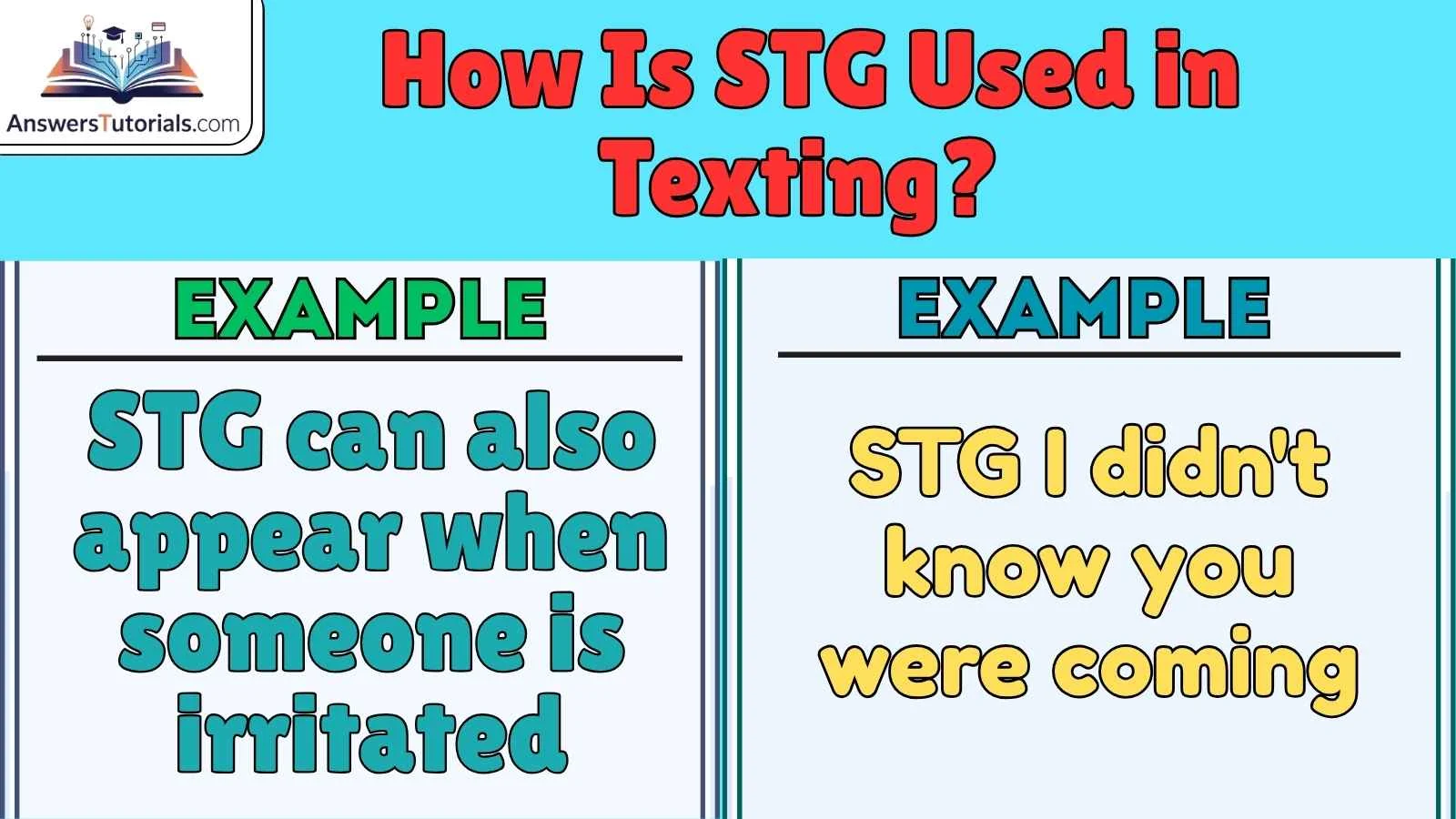
The STG meaning in text becomes clearer when you look at the different ways people actually use it.
1. To Show Honesty
Someone might use STG when they strongly want you to believe them.
Example:
“STG I didn’t know you were coming.”
The speaker wants to make it clear that they are telling the truth.
2. To Emphasize a Statement
STG can make an ordinary statement sound much stronger.
“STG, this pizza is incredible.”
The person isn’t necessarily making a serious oath. They are emphasizing how strongly they feel.
3. To Express Frustration
STG can also appear when someone is irritated.
“STG, if my Wi-Fi disconnects one more time…”
Here, STG helps communicate emotional frustration.
4. To Show Surprise
A person may use it after experiencing something unexpected.
“STG, he actually showed up!”
The abbreviation adds excitement and emphasis.
5. To Defend Yourself
STG can be useful when someone doubts you.
“STG, I sent the message yesterday.”
The person is insisting that their statement is true.
STG Examples in Everyday Text Conversations 💡
Here are realistic examples that show how the abbreviation can work in different situations.
Example 1: Between Friends
Alex: “Did you eat my fries?”
Sam: “STG, I didn’t!”
Here, STG reinforces Sam’s denial.
Example 2: Talking About a Movie
Alex: “Was the movie actually good?”
Sam: “STG, it was amazing.”
The abbreviation adds enthusiasm.
Example 3: Making a Promise
Alex: “Are you really coming tomorrow?”
Sam: “STG, I’ll be there.”
Here, STG works as a strong informal assurance.
Example 4: Expressing Frustration
Alex: “Why are you still awake?”
Sam: “STG, I tried sleeping for two hours.”
The speaker uses STG to emphasize their frustration.
Example 5: Sharing Something Funny
Alex: “What happened at school?”
Sam: “STG, the teacher walked into the wrong classroom 😂”
The abbreviation adds emphasis to the story.
STG Meaning Depending on Context 🎯
One of the biggest mistakes people make with texting slang is assuming that every abbreviation has exactly one emotional meaning.
STG generally means “Swear to God,” but the tone can change.
Consider these examples:
| Message | Likely tone |
|---|---|
| “STG I didn’t do it.” | Defensive |
| “STG that’s hilarious 😂” | Excited |
| “STG I’m exhausted.” | Frustrated |
| “STG you’re amazing.” | Strong appreciation |
| “STG, stop doing that.” | Annoyed |
| “STG I’ll help you.” | Reassuring |
The words around STG often tell you more about the speaker’s emotion than the abbreviation itself.
That is why you should always consider the whole conversation before interpreting it.
STG Meaning From a Girl 👩
If a girl sends you STG, the abbreviation itself does not automatically have a romantic meaning.
She is most likely using it in its normal texting sense: “Swear to God.”
For example:
“STG you’re so funny 😂”
This probably means she strongly thinks you’re funny.
Another example:
“STG I wasn’t ignoring you.”
Here, she is emphasizing that she genuinely wasn’t ignoring you.
Could STG Be Flirty?
Sometimes, yes—but the context creates the flirtiness, not STG itself.
For example:
“STG you looked really good today.”
That message could feel flirty because of the compliment. However, STG by itself is not a romantic abbreviation.
Look at the surrounding messages, emojis, compliments, and overall relationship before drawing conclusions.
STG Meaning From a Guy 👨

When a guy uses STG, it generally has the same basic meaning: “Swear to God.”
For example:
“STG I wasn’t trying to ignore you.”
He is emphasizing that his explanation is genuine.
Or:
“STG that was the best game ever.”
Here, he is simply showing strong enthusiasm.
Again, STG itself does not indicate whether someone likes you romantically.
The context and behavior around the message matter much more.
Is STG Rude or Offensive? ⚠️
Usually, STG is not automatically rude.
However, it can sound intense depending on how someone uses it.
Compare:
“STG that’s hilarious 😂”
with:
“STG, don’t do that again.”
The first sounds excited and playful.
The second sounds more serious and possibly irritated.
There is also a religious element in the literal phrase “Swear to God.” Because of that, some people may prefer not to use the expression. Others use it casually without intending religious significance.
So the safest interpretation depends on the speaker, audience, and situation.
In professional communication, it is generally better to avoid STG unless the environment is extremely informal.
🔤 STG vs Similar Texting Abbreviations
STG is sometimes confused with other expressions that communicate honesty, emphasis, or emotion.
| Abbreviation | Meaning | Main use |
|---|---|---|
| STG | Swear to God | Strong emphasis |
| ISTG | I Swear to God | Stronger personal emphasis |
| TBH | To Be Honest | Sharing an honest opinion |
| NGL | Not Gonna Lie | Introducing honesty |
| FR | For Real | Agreement or emphasis |
| ONG | On God | Strong assurance |
| IKR | I Know, Right? | Agreement |
| IMO | In My Opinion | Giving an opinion |
STG vs ISTG
These are especially similar.
STG means:
“Swear to God.”
ISTG means:
“I Swear to God.”
ISTG can feel slightly more direct because it explicitly includes “I.”
For example:
“STG this happened.”
versus:
“ISTG this happened.”
Both can communicate strong insistence.
Common Ways People Write STG ✍️
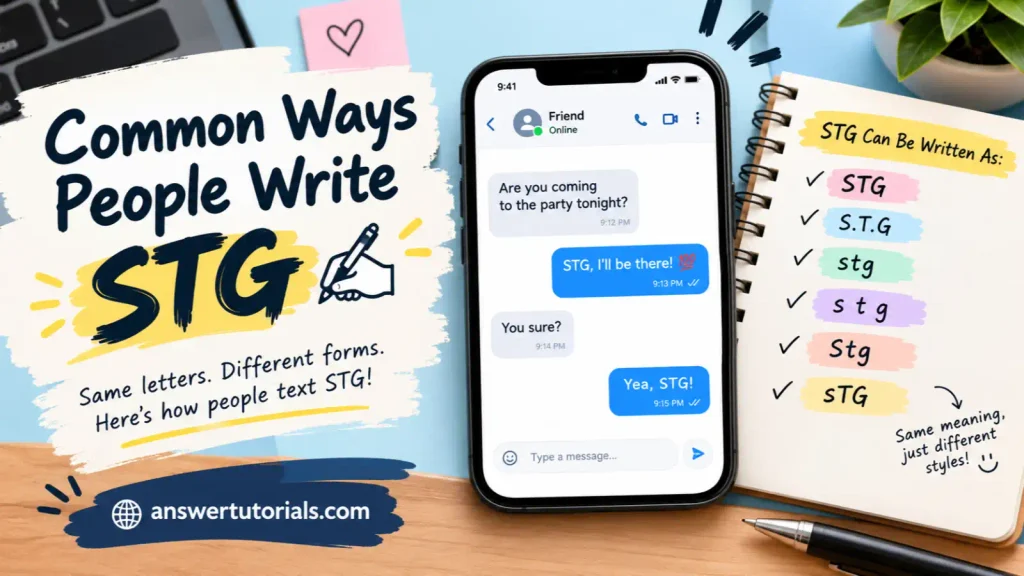
You may see STG written in several different ways.
Uppercase
STG
This is the most recognizable form.
Lowercase
stg
Lowercase texting is also common and usually does not change the meaning.
With punctuation
STG!
The exclamation mark can increase emotional intensity.
With emojis
STG 😂
😭STG
STG omg
Emojis help communicate the emotional tone that plain text may not provide.
For instance, “STG 😂” may sound playful, while “STG 😭” can indicate frustration, embarrassment, or overwhelming emotion.
When Should You Use STG? ✅
STG works best in casual communication.
You might use it with:
- Close friends
- Family members you text casually
- Online friends
- Social media contacts
- Group chats
- Informal conversations
- Gaming communities
For example:
“STG, you need to watch this video 😂”
That sounds natural in a casual conversation.
However, consider avoiding it in:
- Job applications
- Formal emails
- Business proposals
- Academic assignments
- Professional messages
- Customer service conversations
Instead, use clearer phrases such as “I assure you,” “I promise,” or “To be completely honest.”
When You Should Avoid STG 🚫
Although STG is common in informal conversations, not every situation calls for slang.
If you’re speaking with someone you don’t know well, a more neutral phrase may be better.
For example, instead of:
“STG I completed the report.”
A professional message could say:
“I can confirm that I completed the report.”
The second version sounds more appropriate in a workplace.
Likewise, if you are speaking with someone who may interpret religious expressions seriously, using “I promise” may avoid unnecessary confusion.
The goal of good communication is not simply to use popular slang. It is to use language that fits the relationship and situation.
How to Respond When Someone Says STG 💬
Your response depends on what the person is trying to communicate.
If They’re Making a Promise
You could say:
- “Okay, I believe you.”
- “Alright, I trust you.”
- “Got it.”
- “Okay, deal.”
If They’re Defending Themselves
Try:
- “Alright, I understand.”
- “Okay, I’m listening.”
- “Fair enough.”
- “I believe you.”
If They’re Excited
You can match their energy:
- “For real? 😂”
- “No way!”
- “That’s shocking!”
- “Seriously?!”
If You’re Unsure
Ask directly:
“Wait, what happened?”
This keeps the conversation moving instead of guessing what they mean.
Why STG Is Popular in Digital Communication 📲
Texting encourages speed, brevity, and emotional shorthand.
People often want to communicate an entire emotional reaction in just a few characters. Abbreviations make that possible.
STG is useful because three letters can communicate:
“I strongly insist that what I’m saying is true.”
That saves time while still adding emotional weight.
It also fits naturally with the conversational style of social media and messaging apps, where people frequently combine abbreviations, emojis, memes, and informal language.
Another reason slang survives is familiarity. Once a group understands an abbreviation, it becomes an efficient form of communication.
STG in Social Media and Online Chats 🌐
You may encounter STG in more places than private text messages.
It can appear in:
- Social media comments
- Direct messages
- Group chats
- Gaming conversations
- Online communities
- Short-form posts
- Meme conversations
For example:
“STG this is the funniest comment I’ve seen today 😂”
Or:
“STG I thought today was Friday.”
The meaning remains essentially the same: the speaker is strongly emphasizing what they just said.
However, online communities can develop their own slang. Therefore, context is still important.
Common Mistakes When Understanding STG ❌
When people first encounter STG, they sometimes interpret it incorrectly.
Mistake 1: Assuming It’s Always Serious
STG can be serious, but it can also be playful.
“STG this cat is judging me 😂”
Clearly, the speaker isn’t making a formal oath.
Mistake 2: Assuming It’s Romantic
STG doesn’t automatically mean someone likes you.
A romantic meaning must come from the surrounding conversation.
Mistake 3: Ignoring the Context
The same abbreviation can express excitement in one message and frustration in another.
Mistake 4: Using It in Every Conversation
Popular slang does not automatically belong in professional communication.
Use STG where it naturally fits.
Quick STG Meaning Cheat Sheet 📝
If you need the answer quickly, remember this:
STG = Swear to God
STG usually communicates:
- Honesty
- Strong emphasis
- Insistence
- Frustration
- Excitement
- Surprise
- A strong informal promise
Example:
“STG I didn’t see your message.”
Meaning:
“I swear to God, I didn’t see your message.”
The exact emotional tone depends on the conversation.
FAQs ❓
What does STG mean in text?
STG usually means “Swear to God.” People use it in casual texting to emphasize that they are telling the truth, making a strong statement, or expressing an intense reaction.
What does STG stand for?
STG stands for “Swear to God.” It is a common informal texting abbreviation.
Does STG mean something romantic?
Not by itself. STG does not automatically indicate flirting or romantic interest. The surrounding conversation determines whether a message has a romantic tone.
What is the difference between STG and ISTG?
STG means “Swear to God,” while ISTG means “I Swear to God.” Both are used to strongly emphasize a statement or show that someone insists they are being truthful.
Is STG appropriate for professional messages?
Generally, no. STG is informal slang and is better suited to casual conversations. In professional settings, phrases such as “I assure you,” “I can confirm,” or “I promise” are usually more appropriate.
Final Thoughts 💭
Understanding the STG meaning in text is simple once you know the abbreviation: STG means “Swear to God.”
People typically use it to emphasize honesty, strengthen a statement, express frustration, or show excitement. The abbreviation can appear in texts, social media messages, group chats, and other informal online conversations.
The most important thing to remember is that STG does not have one fixed emotional tone. Context matters. A message like “STG that’s hilarious 😂” sounds playful, while “STG, don’t do that again” may sound frustrated or serious.
So, whenever you see STG, look at the words around it and consider the relationship between the people talking. That small bit of context will usually tell you exactly what the sender intended.

Ayan Zaman is a content writer and researcher at answertutorials.com, specializing in text meanings, slang, abbreviations, and everyday communication. He creates clear, practical, and easy-to-understand guides to help readers communicate with confidence. His content focuses on accurate explanations, real-world examples, and useful answers for modern digital conversations.