

If you received a text that simply said “NP”, you may have wondered what the person actually meant. Is it friendly? Dismissive? Is there another hidden meaning? 🤔
In everyday texting, NP usually means “No Problem.” People use it as a quick, casual way to say that something is okay, that they do not mind, or that they are happy to help.
For example, if someone texts, “Thanks for helping me with that!”, replying “NP!” generally means “No problem!” It can also appear after an apology, a request, or a small favour.
However, like most texting abbreviations, context matters. The same two letters can feel slightly different depending on the conversation, relationship, punctuation, and situation.
This guide explains what NP means in text, where it comes from, how people use it, and what it can communicate in different situations.
What Does NP Mean in Text? 📱
NP means “No Problem” in text messages and online conversations.
It is an informal abbreviation that people commonly use to respond to:
- Thank-you messages
- Small requests
- Apologies
- Favors
- Questions
- Minor inconveniences
Instead of typing “No problem,” someone can simply type “NP.”
Quick example
Person A: “Thanks for sending that file!”
Person B: “NP 😊”
Here, NP means that Person B does not consider sending the file a burden.
The abbreviation is especially common in casual digital communication because texting encourages short, fast responses.
NP = No Problem
In most ordinary conversations, that is the meaning you should assume first.
NP Meaning in Text at a Glance 🔎
Here is a quick overview of the abbreviation:
| Text | Meaning | Typical Tone |
|---|---|---|
| NP | No Problem | Casual |
| NP! | No Problem! | Friendly |
| np | no problem | Relaxed |
| NP 😊 | No Problem | Warm/Friendly |
| np lol | No problem | Very casual |
| NP, anytime | No problem, anytime | Helpful |
The capitalization usually does not change the meaning.
Someone may write NP, np, or Np simply because of their keyboard habits.
Is NP positive or negative?
Most of the time, NP is neutral to positive.
It generally communicates:
- “It’s okay.”
- “Don’t worry about it.”
- “That’s fine.”
- “You’re welcome.”
- “I don’t mind.”
- “Happy to help.”
Still, tone can change depending on the surrounding conversation. A short “np” after a serious or emotional message might feel less warm than “No problem 😊.”
What Does NP Stand For? 💬
NP stands for “No Problem.”
The phrase “no problem” is widely used in everyday English to reassure another person that something is acceptable or not troublesome.
For example:
“Sorry I’m five minutes late.”
“NP.”
The response means:
“No problem. It’s okay.”
Another example:
“Can you send me that picture later?”
“NP.”
Here, NP means:
“Sure, no problem.”
The abbreviation removes unnecessary words while keeping the basic meaning intact.
This is one reason it works so well in text messages, social media conversations, gaming chats, and instant messaging.
The Origin of NP as a Texting Abbreviation 🕰️
The exact moment when NP first appeared is difficult to identify because abbreviations developed gradually across different forms of digital communication.
The phrase “no problem” itself is much older than texting. As online communication became more popular, people began shortening frequently used phrases to save time and typing effort.
This pattern became especially common in:
- Internet chat rooms
- Online forums
- Instant messaging
- SMS texting
- Gaming communities
- Social media
- Workplace messaging platforms
Short forms such as NP, TY, OMG, BRB, and LOL became part of digital communication because users could communicate quickly without writing complete sentences.
Why did NP become popular?
There are several practical reasons.
1. It is fast.
Typing two letters takes less effort than typing “no problem.”
2. The meaning is easy to understand.
The phrase is common enough that many people recognize NP immediately.
3. It works in many situations.
You can use it after thanks, apologies, requests, and favors.
4. It fits casual conversations.
Texting often favors short and informal language.
So, while the abbreviation may look simple, it reflects a broader evolution in the way people communicate digitally.
How Is NP Used in Text Messages? 📲
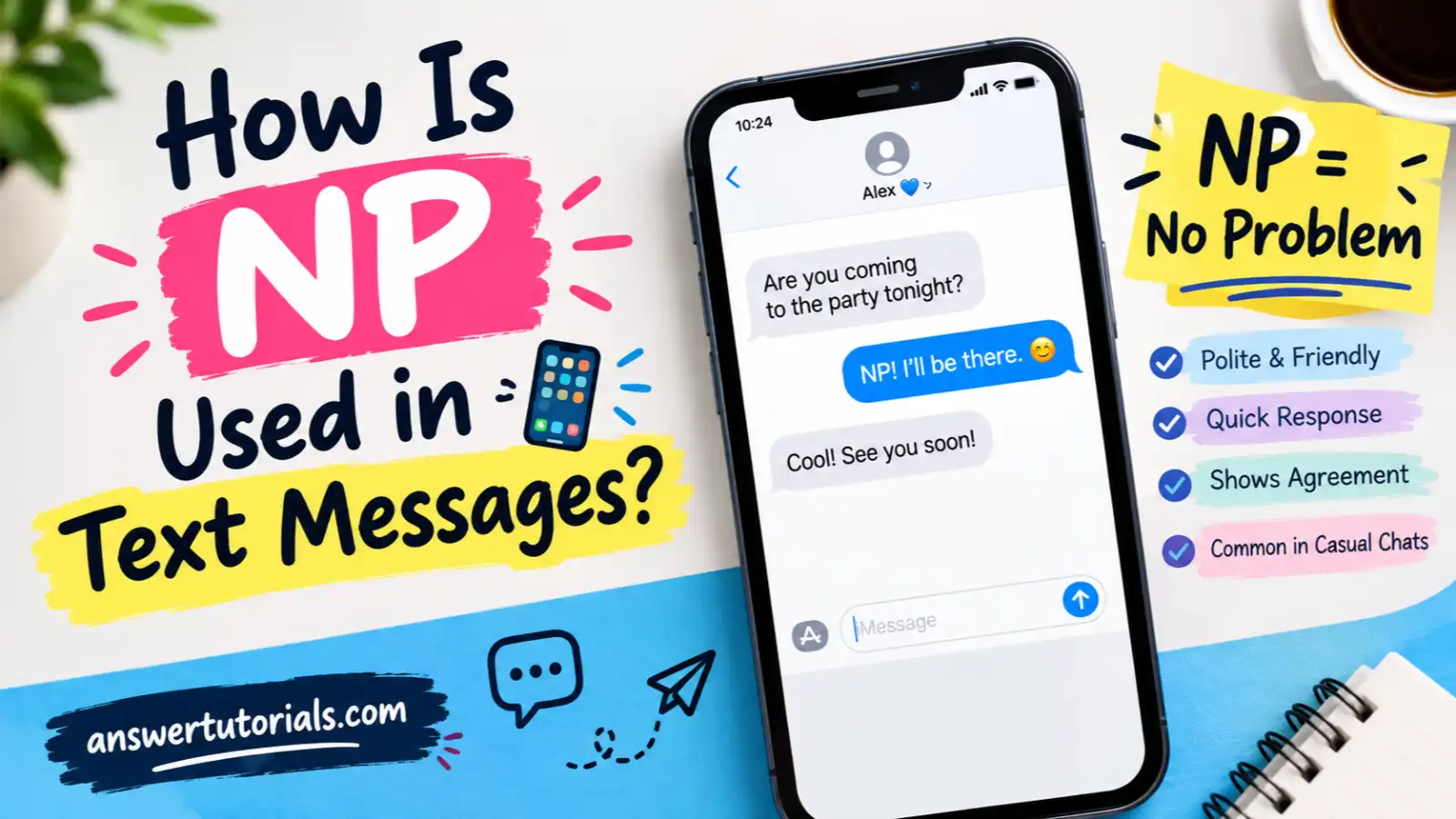
NP can appear in several conversational situations.
1. Responding to “Thank You”
This is one of the most common uses.
Person A: “Thanks for picking me up!”
Person B: “NP!”
Here, NP functions similarly to:
- You’re welcome.
- No worries.
- Anytime.
- Don’t mention it.
2. Responding to an Apology
Someone may also use NP to reassure another person after a minor mistake.
Person A: “Sorry I forgot to call.”
Person B: “NP.”
This communicates that the person is not upset or does not consider the mistake serious.
3. Accepting a Small Request
Person A: “Can you save me a seat?”
Person B: “NP.”
In this situation, NP means:
“Sure, I can do that.”
4. Reassuring Someone
Person A: “I hope I didn’t bother you.”
Person B: “NP 😊”
The abbreviation helps reassure the other person that everything is fine.
NP Meaning Depending on the Context 👀
Although “No Problem” is the most common texting meaning, context can affect how NP feels.
Consider these examples:
Friendly conversation
“Thanks for helping me!”
“NP 😊”
This sounds warm and helpful.
Very casual conversation
“Can you send it later?”
“np”
This sounds relaxed and straightforward.
Short or distant conversation
“Sorry about yesterday.”
“NP.”
Technically, it still means “No Problem,” but the short response may feel less emotionally expressive.
That does not automatically mean the person is angry or uninterested.
Important point
Do not judge the emotional meaning of NP from the abbreviation alone.
Look at the entire conversation.
The person’s previous messages, punctuation, emojis, relationship with you, and the situation can all provide useful clues.
NP Examples in Different Conversations 💬
Here are realistic examples of how NP can appear in everyday texting.
Example 1: After a thank-you
You: “Thanks for explaining that to me.”
Friend: “NP!”
Meaning: “No problem!”
Example 2: After an apology
You: “Sorry for replying so late.”
Friend: “NP.”
Meaning: “It’s okay.”
Example 3: Helping someone
You: “Could you send me the notes?”
Friend: “NP, I’ll send them now.”
Meaning: “No problem. I’ll help.”
Example 4: Making plans
You: “Can we meet 30 minutes later?”
Friend: “NP.”
Meaning: “That’s fine.”
Example 5: Casual conversation
You: “Can you remind me tomorrow?”
Friend: “np 👍”
Meaning: “Sure, no problem.”
Example 6: Workplace messaging
Coworker: “Can you forward that document?”
You: “NP, sending it now.”
Meaning: “No problem. I’ll do it.”
The last example shows why context matters. While NP is informal, the surrounding language can make the overall message appropriate for a casual workplace chat.
What Does NP Mean From a Girl? 👩
If a girl texts “NP,” it usually means exactly what it means in other conversations: “No Problem.”
The abbreviation itself does not reliably indicate romantic interest, annoyance, attraction, or disinterest.
For example:
You: “Thanks for waiting for me!”
Her: “NP 😊”
She is most likely simply saying that waiting was not a problem.
Another example:
You: “Sorry I couldn’t make it yesterday.”
Her: “NP.”
This generally communicates acceptance or reassurance.
Does NP mean she likes you?
Not by itself.
If you are trying to understand someone’s feelings, look at broader communication patterns instead of interpreting one abbreviation.
For example, consider whether the person:
- Starts conversations
- Asks questions
- Keeps conversations going
- Uses affectionate language
- Makes plans
- Responds consistently
- Shares personal details
Even then, individual behaviors can have different explanations. A single “NP” cannot establish romantic intent.
What Does NP Mean From a Guy? 👨
When a guy texts “NP,” it generally means “No Problem” as well.
For example:
You: “Thanks for covering for me!”
Him: “NP.”
That normally means he is saying the favor was not an issue.
Likewise:
You: “Sorry, I forgot to tell you earlier.”
Him: “NP.”
This usually means he is not making a big deal out of the situation.
Is “NP” a dry response?
It can sometimes feel dry because it is short, but that does not automatically mean the person is being cold.
Compare:
“NP”
“No problem 😊”
“No worries!! Happy to help!”
All three can communicate a similar basic idea, but they express different levels of warmth.
Someone who naturally sends short messages may use NP even when they are perfectly friendly.
NP vs. Other Similar Text Abbreviations 🔄
Several texting expressions have meanings that overlap with NP.
| Expression | Meaning | Common Feeling |
|---|---|---|
| NP | No Problem | Casual |
| NBD | No Big Deal | Reassuring |
| NVM | Never Mind | Dismissive or corrective depending on context |
| TY | Thank You | Appreciation |
| YW | You’re Welcome | Direct response to thanks |
| DW | Don’t Worry | Reassurance |
| Anytime | Happy to help | Friendly |
| No worries | It’s okay | Casual and reassuring |
NP vs. No Worries
NP and “no worries” can often be used interchangeably.
“Sorry I’m late.”
“NP.”
or:
“Sorry I’m late.”
“No worries!”
Both responses generally communicate that the situation is acceptable.
NP vs. You’re Welcome
These expressions can overlap, but they are not always identical.
NP emphasizes that something was not a problem.
You’re welcome directly responds to thanks.
For example:
“Thanks for helping!”
“You’re welcome.”
This is slightly different from:
“Thanks for helping!”
“NP!”
Both work naturally, but they have slightly different wording.
When Should You Use NP? 👍
NP is best suited to informal or semi-informal conversations.
You can comfortably use it with:
- Friends
- Family members
- Classmates
- Gaming friends
- Online communities
- Familiar coworkers
- People you regularly text
It is especially useful when the conversation is already casual.
Examples of good situations
“Thanks for the reminder!” → “NP!”
“Sorry about that.” → “NP.”
“Can you send it tonight?” → “NP.”
“Thanks for waiting.” → “NP 😊”
The abbreviation keeps the conversation quick and natural.
When Should You Avoid Using NP? ⚠️
Although NP is widely understood, it is not appropriate for every situation.
In formal communication, writing the complete phrase can sound more professional.
For example, instead of:
“NP.”
you might write:
“No problem. I’d be happy to help.”
This can be better when communicating with:
- A new client
- A manager
- A formal business contact
- A professor
- A customer
- Someone you do not know well
Why?
Text abbreviations can sometimes appear overly casual.
Compare:
Casual:
“NP, I’ll send it over.”
More professional:
“No problem. I’ll send it over shortly.”
Neither is inherently better. The appropriate choice depends on the relationship and communication setting.
Can NP Have Other Meanings? 🤔
Yes. NP can have meanings other than “No Problem” in specialized contexts.
For example, in healthcare, NP can refer to a nurse practitioner. In academic, professional, technical, or organizational settings, abbreviations can also have specialized meanings.
However, when you see NP in an ordinary text conversation, “No Problem” is usually the intended meaning.
This is why context is important.
Consider:
“Thanks for helping me!” → “NP.”
Here, “No Problem” makes obvious conversational sense.
But if someone is discussing a medical profession and writes “NP,” the abbreviation could mean something entirely different.
A simple rule
Ask yourself:
“What meaning fits the surrounding conversation?”
The context usually provides the answer.
How to Respond When Someone Texts NP 💡
You normally do not need a complicated response to NP.
If someone says:
“NP!”
the conversation can simply continue.
For example:
Them: “NP!”
You: “Thanks again!”
Or you can move to the next topic:
Them: “NP.”
You: “Anyway, are we still meeting tonight?”
Sometimes NP effectively closes a small exchange, so no response is necessary.
If you want to keep the conversation going
You could respond naturally with:
- “Appreciate it!”
- “Thanks 😊”
- “You’re awesome.”
- “I owe you one!”
- “That means a lot.”
- “Thanks, seriously.”
Your response should match the tone of the conversation.
FAQs:❓
What does NP mean in text?
NP usually means “No Problem.” It is a casual abbreviation used to reassure someone, accept a request, respond to thanks, or dismiss a minor inconvenience.
Does NP mean no problem?
Yes. In ordinary texting, NP most commonly means “No Problem.”
Is NP rude?
NP is not normally rude. It is generally neutral, friendly, or reassuring. However, a very short response can sometimes feel less warm depending on the surrounding conversation.
What does NP mean from a girl or guy?
From either a girl or a guy, NP usually means “No Problem.” The abbreviation itself does not provide reliable evidence about romantic feelings or personal interest.
Can NP mean something else?
Yes. Abbreviations can have specialized meanings in different fields. In everyday texting, however, “No Problem” is the common interpretation.
Final Thoughts 📝
So, what does NP mean in text? In most everyday conversations, NP means “No Problem.” It is a short, casual way to say that something is okay, acceptable, or not troublesome.
You may see NP after someone says thank you, apologizes, asks for a favor, or worries that they have caused an inconvenience.
The key is context. A simple “NP” can be friendly, neutral, reassuring, or simply efficient depending on the conversation around it. The abbreviation itself does not automatically reveal someone’s mood or feelings.
If you want to use NP yourself, keep it for casual texting and familiar conversations. In formal situations, writing “No problem” or a more complete response can sound more polished.
In short: NP = No Problem. 👍

Ayan Zaman is a content writer and researcher at answertutorials.com, specializing in text meanings, slang, abbreviations, and everyday communication. He creates clear, practical, and easy-to-understand guides to help readers communicate with confidence. His content focuses on accurate explanations, real-world examples, and useful answers for modern digital conversations.