
Have you ever received a message that simply said “DND” and wondered what the person meant? 🤔 If you are unfamiliar with texting abbreviations, a short three-letter message can feel surprisingly confusing.
So, what does DND mean in text? In most texting and online conversations, DND means “Do Not Disturb.” People use it when they do not want to be interrupted, called, messaged, or bothered for a certain period.
For example, someone might text:
“I’m studying rn, DND please.”
Here, the person is politely asking others not to disturb them while they study.
However, the exact tone can change depending on the situation. DND can sound polite, serious, casual, or even slightly annoyed. It can also refer to the Do Not Disturb feature on a smartphone.
In this guide, we’ll explore the DND meaning in text, where it comes from, how people use it, what it means from a girl or guy, examples, common misunderstandings, and how you can respond naturally. 💬
What Does DND Mean in Text? 📲
The most common DND meaning in text is “Do Not Disturb.”
It is an abbreviation that tells someone the sender does not want interruptions.
Depending on the context, DND may mean:
- Do Not Disturb
- Please don’t interrupt me
- I don’t want calls right now
- I don’t want messages right now
- I’m busy or unavailable
- I need some private time
- I’m focusing on something important
For example:
Person A: “Can I call you?”
Person B: “DND rn. I’ll call you later.”
In this example, DND means the person is currently unavailable and would prefer not to receive a call.
Another example:
“DND, I have an exam tomorrow.”
This means:
“Do not disturb me because I need to focus on my exam.”
The abbreviation is especially common in texting, social media, gaming, workplace chats, and smartphone conversations.
DND Meaning in Simple Words 🧠
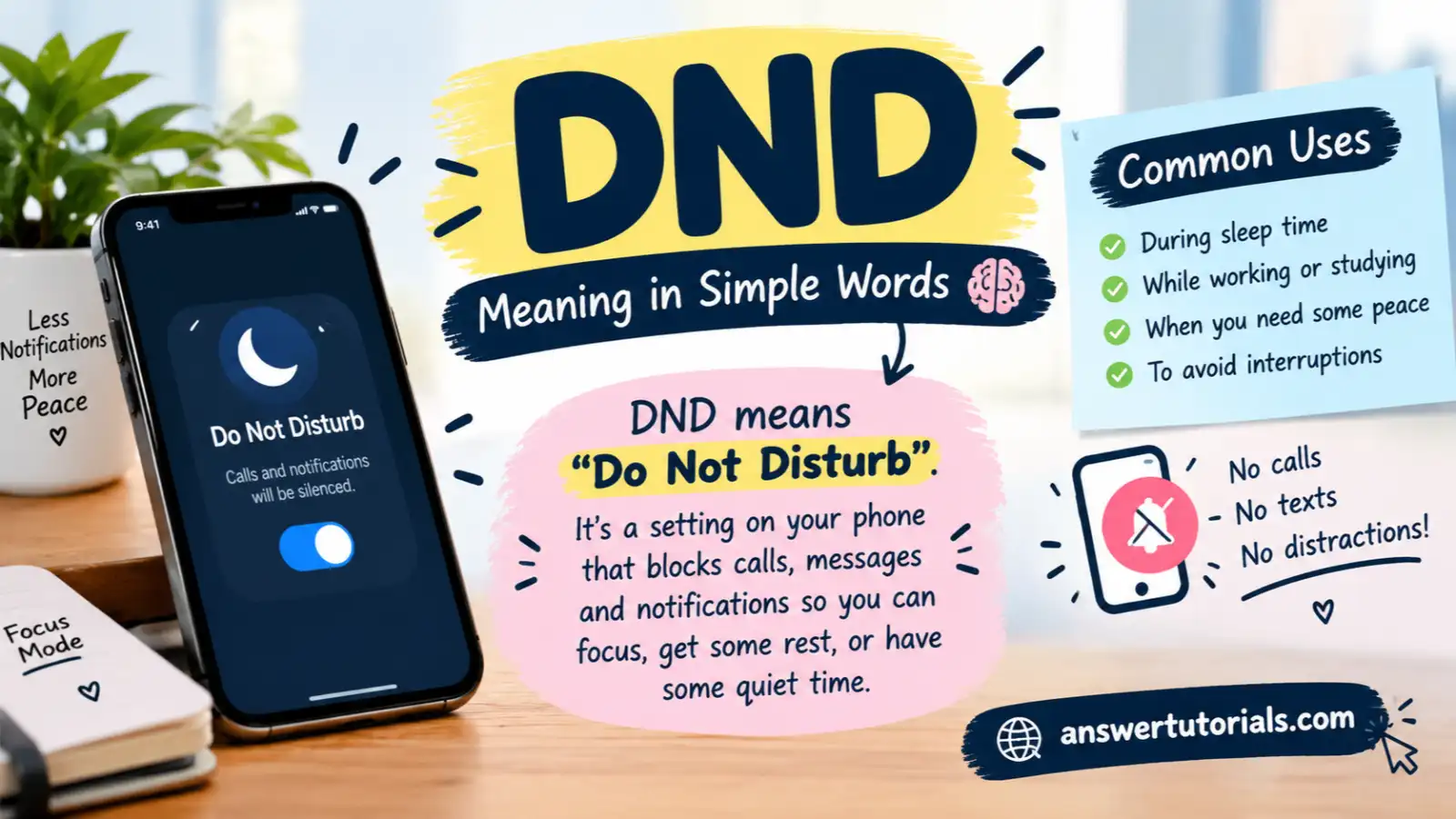
If you want the simplest explanation, DND means “Do Not Disturb.”
Think of it as a digital version of putting a “Please Do Not Disturb” sign on a door.
When someone says DND, they are usually communicating:
“I’m unavailable right now, so please give me some space.”
The reason can be anything.
They may be:
- Sleeping 😴
- Studying 📚
- Working 💻
- Driving 🚗
- Watching a movie 🎬
- Spending time with family 👨👩👧
- Playing a game 🎮
- Relaxing 🧘
- Feeling overwhelmed
- Simply wanting some quiet time
Therefore, DND does not automatically mean that someone is angry with you.
The surrounding conversation matters.
What Does DND Stand For? 🔤
DND stands for:
Do Not Disturb
Each word contributes to the meaning:
- D = Do
- N = Not
- D = Disturb
It is an abbreviated form of a phrase people have used for a long time.
In modern communication, people often shorten common expressions because texting rewards speed and convenience.
Instead of typing:
“Please do not disturb me right now.”
someone might simply write:
“DND rn.”
Here, “rn” means “right now,” making the message even shorter.
For example:
“DND rn, I’m working.”
means:
“Do not disturb me right now because I’m working.”
Where Did the DND Expression Come From? 🕰️
The phrase “Do Not Disturb” is much older than smartphones and texting.
People have traditionally used “Do Not Disturb” as a notice to indicate that interruptions are unwanted. You may have seen this phrase on hotel-room signs, office doors, private rooms, or other places where someone wants uninterrupted time.
Digital communication later adopted the same idea.
As texting, smartphones, and social platforms became common, people began shortening frequently used expressions. DND became a convenient abbreviation for communicating temporary unavailability.
The smartphone feature also helped make DND widely recognizable.
When a phone is placed in Do Not Disturb mode, notifications and calls may be silenced or restricted according to the device’s settings.
Because of this, DND now has both a texting meaning and a technology-related meaning.
DND Meaning on a Phone 📱
On smartphones, DND usually refers to “Do Not Disturb” mode.
When someone activates DND, their phone can limit interruptions from notifications, calls, alerts, or messages.
The exact behavior depends on the phone and its settings.
For example, someone might say:
“My phone is on DND.”
This generally means:
“My phone is currently set to Do Not Disturb mode.”
It can also explain why someone has not answered.
Imagine you text:
“Where are you? I called twice.”
They later respond:
“Sorry, my phone was on DND.”
They are explaining that their phone was configured to reduce interruptions.
This use is slightly different from simply saying “DND” in a message.
In texting, DND can be a direct request for space. On a phone, it can describe a device setting.
DND Meaning in Different Texting Situations 💬
The meaning of DND can remain “Do Not Disturb,” but the reason and tone can change based on the conversation.
DND While Studying 📚
Someone preparing for an exam may write:
“DND until 8. I need to study.”
This means they don’t want interruptions until 8 o’clock.
DND While Working 💼
A coworker might say:
“DND for the next hour. Deadline!”
Here, DND communicates that the person needs uninterrupted concentration.
DND While Sleeping 😴
Someone might text:
“Going to sleep. DND please.”
They are asking people not to call or message them while they sleep.
DND While Gaming 🎮
A gamer might say:
“DND, final round.”
They want to finish the game without distractions.
DND for Personal Space 🌿
“DND for a bit.”
This can mean they need some alone time.
The important thing is that DND does not always communicate anger. Often, it simply communicates temporary unavailability.
What Does DND Mean From a Girl? 👩
If a girl texts “DND,” the most straightforward interpretation is still “Do Not Disturb.”
However, the intended tone depends on the context.
For example:
“DND, studying for my test.”
This is clearly about concentration.
But:
“DND right now.”
is more direct and may indicate that she wants some space.
It is better not to automatically assume that she is angry or upset.
Look at the surrounding messages.
If she explains why she wants DND, the situation is usually easy to understand.
For example:
“DND please, I’m spending time with my family.”
This is different from:
“DND. I don’t want to talk.”
The first is a temporary request for fewer interruptions. The second communicates a stronger desire not to communicate at that moment.
So, when interpreting DND from a girl, focus on the complete message rather than the abbreviation alone.
What Does DND Mean From a Guy? 👨
When a guy texts “DND,” it usually has the same basic meaning: “Do Not Disturb.”
He might be busy, studying, working, gaming, sleeping, traveling, or simply taking some time away from his phone.
For example:
“Bro, DND. I’m in a meeting.”
means he doesn’t want interruptions during the meeting.
Or:
“DND tonight. Need some sleep.”
means he wants to avoid calls or messages so he can rest.
Again, DND by itself does not prove that someone is angry, ignoring you, or trying to end a relationship.
The context provides the real meaning.
DND Texting Examples You Can Use 💡
Here are some natural examples showing how people use DND in everyday conversations.
| Text Example | Meaning |
|---|---|
| “DND rn.” | Don’t disturb me right now. |
| “DND please.” | Please don’t interrupt me. |
| “I’m on DND.” | My phone is in Do Not Disturb mode. |
| “DND until tomorrow.” | Don’t contact me until tomorrow. |
| “DND, I’m studying.” | Don’t interrupt me because I’m studying. |
| “Going to bed, DND.” | Don’t disturb me while I sleep. |
| “DND for an hour.” | I don’t want interruptions for an hour. |
| “Sorry, I was on DND.” | My phone was set to Do Not Disturb. |
| “DND while I work.” | Don’t interrupt me during work. |
| “DND for a little while.” | I need some uninterrupted personal time. |
These examples show why DND meaning in text is highly dependent on context.
How to Respond When Someone Says DND 💬
If someone tells you DND, the best response is usually simple and respectful.
You don’t need to send a long message.
Here are some natural replies:
- “Sure, no problem.”
- “Got it. I’ll message you later.”
- “Okay, take your time.”
- “No worries.”
- “Sure, I’ll leave you to it.”
- “Alright, talk later.”
- “Got you. Good luck with studying!”
- “Okay, enjoy your quiet time.”
- “Understood. Message me when you’re free.”
If the person sounds stressed, a supportive response can work well:
“Of course. Take whatever time you need.”
The key is to respect the boundary.
If someone clearly says DND, repeatedly texting them can make the situation worse.
Is DND Rude in Texting? 🤔
DND is not inherently rude.
Its tone depends on how someone uses it.
Compare these two messages:
“DND. Stop texting me.”
and:
“Hey, DND for a little while. I’ll text you later 😊.”
Both communicate a desire not to be disturbed, but the second sounds much friendlier.
DND can feel blunt because abbreviations remove some of the softer language found in longer sentences.
However, many people use short messages simply because they are convenient.
If someone writes “DND rn,” it doesn’t necessarily mean they are upset with you.
Before assuming the worst, consider:
- What were you discussing?
- Did they give a reason?
- Do they normally text briefly?
- Did they say when they would return?
- Is the person usually busy at that time?
Context is often more important than the abbreviation itself.
DND vs. Other Similar Text Abbreviations 🔎
DND can sometimes be confused with other expressions related to availability.
| Abbreviation | Common Meaning | Typical Use |
|---|---|---|
| DND | Do Not Disturb | Asking for uninterrupted time |
| BRB | Be Right Back | Temporarily leaving a conversation |
| AFK | Away From Keyboard | Temporarily away from a device |
| GTG | Got To Go | Ending or leaving a conversation |
| TTYL | Talk To You Later | Planning to talk later |
| Busy | Currently occupied | Explaining unavailability |
| Offline | Not currently online | Describing online status |
The key difference is that DND specifically emphasizes avoiding interruptions.
For example, someone who says BRB may be back shortly and could still receive messages.
Someone who says DND is specifically asking for fewer interruptions.
Common Mistakes People Make With DND ⚠️
Understanding an abbreviation is easy. Understanding its emotional context can be harder.
Here are some common mistakes to avoid.
Assuming DND Means Someone Is Angry
A person might simply be busy.
Don’t immediately interpret DND as rejection.
Continuing to Send Messages
If someone asks for DND, repeatedly messaging them defeats the purpose.
Give them the space they requested.
Treating DND as a Permanent Goodbye
DND usually describes a temporary situation.
It doesn’t automatically mean the person never wants to talk again.
Ignoring the Context
The surrounding conversation can completely change how the message feels.
“DND, exam tomorrow” is clearly different from “DND. I don’t want to talk.”
Overthinking a Short Message
Texting abbreviations are often intentionally brief.
Sometimes DND simply means exactly what it says: Do Not Disturb.
When Should You Use DND in a Text? 📲
You can use DND when you want to communicate that you are temporarily unavailable or need uninterrupted time.
It works particularly well in casual conversations.
Examples include:
“DND for the next two hours. Studying.”
“DND tonight, I need some sleep.”
“I’ll be on DND during the meeting.”
“DND rn. I’ll call you later.”
For professional communication, however, it may be better to use a complete sentence.
Instead of:
“DND.”
you could write:
“I’m in a meeting right now and may not respond until later.”
That sounds clearer and more professional.
DND in Social Media and Online Conversations 🌐
DND is also common across online communities.
People may use it in:
- Group chats
- Gaming communities
- Messaging apps
- Social media conversations
- Online study groups
- Workplace chats
- Community servers
A user might write:
“DND while I finish this project.”
Another person may say:
“Going offline. DND please.”
In these environments, DND works as a quick signal.
It tells other people that the person is temporarily unavailable without requiring a detailed explanation.
Because online conversations move quickly, short abbreviations such as DND can save time.
DND and Personal Boundaries 🛑
One of the most useful ways to understand DND is as a digital boundary.
Everyone needs uninterrupted time occasionally.
You might need to focus on school, work, family, sleep, exercise, or simply yourself.
Saying DND allows you to communicate that boundary quickly.
A healthy message might be:
“I’m taking some quiet time tonight. DND for a few hours.”
This tells other people what you need without creating unnecessary conflict.
Likewise, when someone tells you DND, respecting their request shows consideration.
Good communication is not only about knowing what to say. It is also about knowing when to give someone space. ❤️
FAQs: ❓
What does DND mean in text?
DND usually means “Do Not Disturb.” It tells someone that the sender does not want interruptions, calls, or messages at that moment.
What does DND mean on a phone?
On a phone, DND usually means Do Not Disturb mode. This feature can reduce or silence notifications, calls, and other interruptions according to the device’s settings.
Does DND mean someone is angry?
Not necessarily. DND does not automatically mean anger. Someone may be studying, working, sleeping, busy, or simply wanting some personal time.
What should I reply to DND?
A simple response such as “Sure, no problem,” “Got it,” or “Message me when you’re free” is usually appropriate.
Is DND the same as ignoring someone?
No. DND generally communicates that someone wants to avoid interruptions temporarily. Ignoring someone can have a different meaning and may not involve any direct request for space.
Final Thoughts 💭
So, what does DND mean in text? The most common answer is simple: DND means “Do Not Disturb.”
People use it when they want uninterrupted time or do not want to receive calls and messages for a while. It can also refer to a phone’s Do Not Disturb mode, which helps reduce digital interruptions.
The meaning is usually straightforward, but the tone depends on context. A message such as “DND, studying” is simply a request for concentration, while “DND, I don’t want to talk” communicates a much stronger boundary.
If someone sends you DND, the best approach is usually to respect their space and avoid assuming that they are angry or upset.
In everyday texting, DND is simply a quick way of saying:
“Please give me some uninterrupted time right now.”
Once you understand that basic idea, you’ll be able to recognize and use DND naturally in texts, social media chats, group conversations, and everyday digital communication. 📱💬

Ayan Zaman is a content writer and researcher at answertutorials.com, specializing in text meanings, slang, abbreviations, and everyday communication. He creates clear, practical, and easy-to-understand guides to help readers communicate with confidence. His content focuses on accurate explanations, real-world examples, and useful answers for modern digital conversations.