

What does YW mean in text? If you’ve received a message containing “YW” and wondered what it means, you’re not alone.
Texting abbreviations can make online conversations faster, but they can also be confusing when you’re unfamiliar with the shorthand. In most texting and social media conversations, YW means “you’re welcome.” It is commonly used as a short, casual response after someone says “thank you.”
Understanding what does YW mean in text can help you communicate more naturally on platforms such as texting apps, Instagram, Snapchat, TikTok, and other social media.
Depending on the conversation, YW can sound friendly, casual, or simply convenient. In this guide, you’ll discover the YW meaning, how to use it correctly, real text-message examples, and how its tone can change depending on the situation.
Whether you’re decoding a message from a friend, family member, or someone you’re chatting with, this guide makes YW easy to understand.
What Does YW Mean in Text?
YW means “you’re welcome.”
It is commonly used as a quick response when someone thanks you.
For example:
Person A: Thanks for helping me with my homework!
Person B: YW 😊
Here, YW simply means “You’re welcome.”
The abbreviation is especially common in casual digital conversations. Someone might use it after receiving a simple “thanks,” “thank you,” or “ty.”
Quick Meaning
| Text | Meaning | Common Use |
|---|---|---|
| YW | You’re welcome | Replying to thanks |
| TY | Thank you | Showing appreciation |
| TYSM | Thank you so much | Stronger appreciation |
| NP | No problem | Casual response |
| NWS | No worries | Reassuring response |
| OFC | Of course | Friendly agreement or help |
So, if someone sends YW, they are usually telling you that there is no need to thank them.
YW Meaning at a Glance 📱
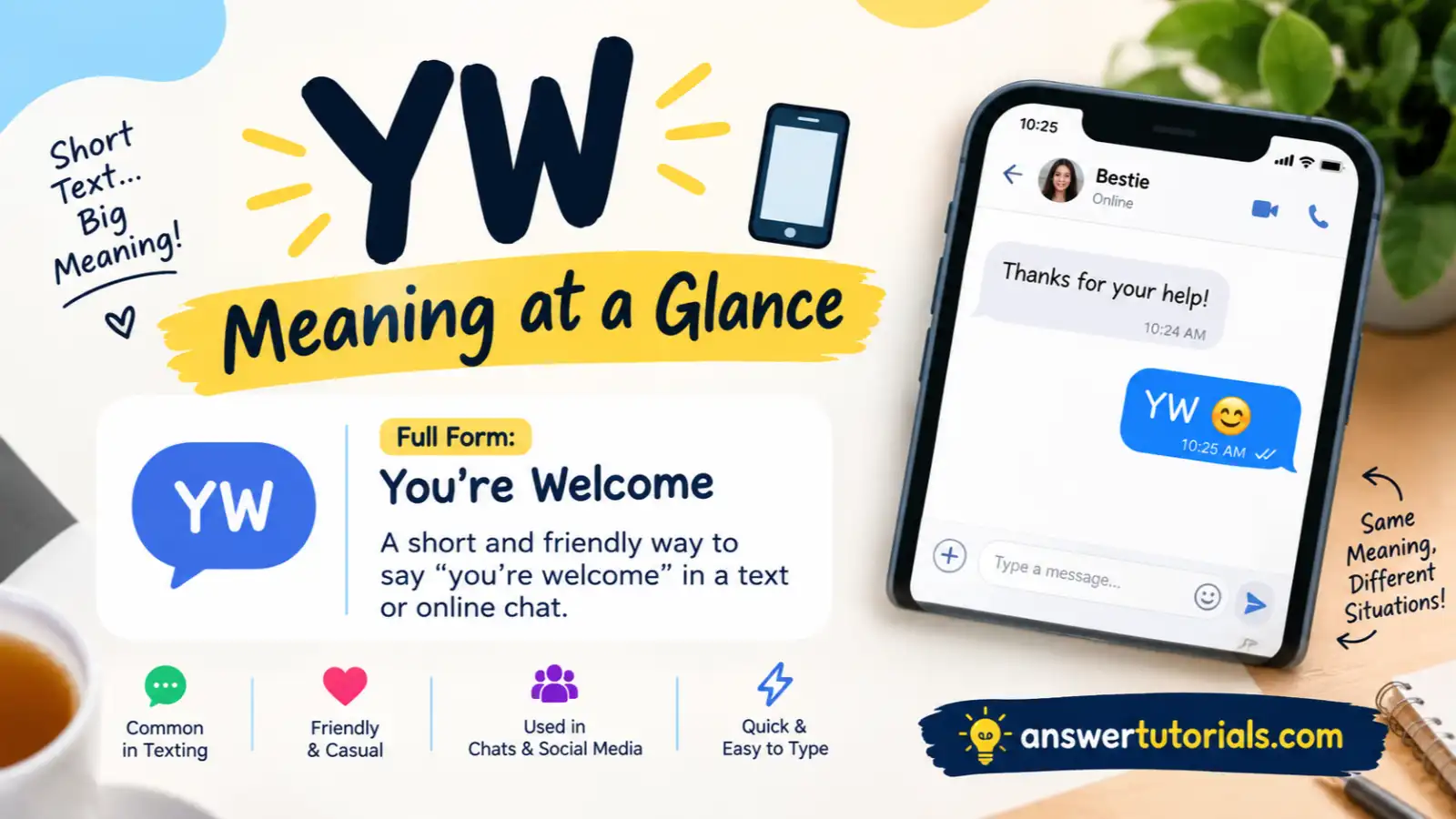
Here is the simplest way to understand it:
YW = You’re welcome
It is usually:
- 💬 A response to “thank you”
- 📱 Common in texting
- 😊 Casual and friendly
- ⚡ Quick to type
- 🌐 Common in online conversations
- ✨ Usually positive or neutral
For example:
“Thanks for sending me the notes.”
“YW!”
The person is simply saying:
“You’re welcome!”
The meaning is generally straightforward. However, tone depends on context. A friendly conversation may make “YW 😊” feel warm, while a very short “yw” after a tense exchange could feel more neutral or distant.
Where Did YW Come From? 🕰️
YW is a shortened form of the phrase “you’re welcome.”
It developed naturally from the broader culture of internet and text-message abbreviations. Digital communication often encourages people to shorten common expressions so they can respond quickly.
Similar abbreviations include:
- BRB — be right back
- LOL — laugh out loud
- IDK — I don’t know
- IMO — in my opinion
- BTW — by the way
- TY — thank you
- YW — you’re welcome
Unlike some slang terms that have complicated or disputed origins, YW has a very direct relationship with the phrase it represents.
It works because “you’re welcome” is such a common conversational response. Instead of typing both words, users can simply type the initials.
How Is YW Used in Text Conversations?
People typically use YW after someone expresses gratitude.
For example:
Friend: “Thanks for picking me up!”
You: “YW!”
Or:
Friend: “Ty for the recommendation.”
You: “YW 😊”
You might also see it in longer conversations:
Alex: “Thanks for explaining that to me.”
Sam: “YW. Glad I could help.”
The abbreviation can stand alone or appear alongside other words and emojis.
Common Patterns
“YW!”
A simple, upbeat response.
😊“yw ”
A softer, friendlier response.
❤️“YW!!”
A more enthusiastic version.
“yw lol”
A casual response among friends.
“yw, anytime”
A more welcoming response.
❤️“YW ”
A warm response, depending on the relationship.
What Does YW Mean From a Girl? 👩📱
If a girl texts you “YW,” the basic meaning is still “you’re welcome.”
The abbreviation alone does not automatically indicate flirting, romantic interest, annoyance, or any other specific emotion.
Context matters more.
For example:
You: “Thanks for helping me today!”
Her: “YW 😊”
That could simply be a friendly response.
If the conversation contains other clearly affectionate or flirtatious messages, the overall conversation may have a different tone. However, YW itself does not establish romantic interest.
Consider the Surrounding Conversation
Look at:
- The message you sent before “YW”
- Whether she uses emojis
- Whether she continues the conversation
- Your existing relationship
- Her usual texting style
- Whether she normally uses abbreviations
For example:
You: “Thanks for always having my back ❤️”
Her: “YW 😊”
This feels warmer than a bare “yw”, but the emojis and surrounding message contribute to that feeling.
What Does YW Mean From a Guy? 👨📱

When a guy sends YW, it generally means exactly the same thing:
“You’re welcome.”
For example:
You: “Thanks for sending that file.”
Him: “YW”
There is no special male-specific meaning attached to the abbreviation.
The tone can range from casual to warm depending on the conversation.
Examples
Casual:
“You: Thanks bro!”
“Guy: YW”
Friendly:
“You: Thanks for helping me out!”
“Guy: YW 😊”
Professional:
“You: Thank you for sending the document.”
“Guy: You’re welcome.”
In professional communication, writing “You’re welcome” is generally clearer than using texting abbreviations.
Is YW Rude or Friendly? 🤔
YW is usually neutral or friendly, not inherently rude.
However, text messages do not contain vocal tone or facial expressions. As a result, a very short reply can sometimes be interpreted differently depending on the situation.
Compare these responses:
“YW 😊”
This can feel warm and friendly.
“YW!”
This can feel cheerful or enthusiastic.
😊“yw”
This is usually casual and straightforward.
“You’re welcome!”
This is clearer and slightly more polished.
“You’re very welcome.”
This may sound warmer or more formal.
The important point is that YW does not automatically signal a negative attitude.
If someone normally writes short messages, their “yw” may simply reflect their normal communication style.
YW vs. Other Ways to Say You’re Welcome
There are several ways to respond when someone thanks you. Each one can create a slightly different conversational feeling.
| Response | Meaning | Typical Tone |
|---|---|---|
| YW | You’re welcome | Casual |
| You’re welcome | You’re welcome | Neutral |
| You’re very welcome | Glad to help | Warm |
| NP | No problem | Casual |
| No problem | It wasn’t an issue | Friendly |
| No worries | Don’t worry about it | Relaxed |
| Anytime | Happy to help again | Warm |
| Of course | Gladly / naturally | Friendly |
| My pleasure | Happy to help | Polite |
| Sure thing | Happy to do it | Casual |
Which One Should You Use?
It depends on who you’re talking to.
With a close friend, “YW,” “NP,” or “no worries” can work naturally.
With a teacher, customer, manager, client, or professional contact, “You’re welcome” or “My pleasure” may sound more appropriate.
Examples of YW in Text Conversations 💬
Understanding examples is one of the easiest ways to recognize the abbreviation naturally.
Example 1: Friends
A: “Thanks for saving me a seat!”
B: “YW!”
Here, YW is a quick and friendly acknowledgment.
Example 2: Homework
A: “Thanks for explaining that question.”
B: “YW 😊”
The emoji makes the reply feel warmer.
Example 3: Social Media
A: “Thanks for sharing my post!”
B: “YW!”
The abbreviation works well in a casual online conversation.
Example 4: Gaming
Player 1: “Thanks for covering me.”
Player 2: “YW.”
Here, the abbreviation keeps the communication fast.
Example 5: Helping a Friend
A: “Thanks for driving me home.”
B: “YW, anytime.”
This combines the abbreviation with a more welcoming phrase.
Example 6: Short Conversation
A: “Ty!”
B: “YW”
This is one of the most common patterns.
How to Respond When Someone Says YW
Usually, you don’t need to respond to “YW.”
The conversation can naturally end there.
For example:
You: “Thanks!”
Them: “YW!”
That’s already a complete exchange. 👍
However, if you want to continue the conversation, you can introduce a new topic.
Casual Responses
- “😊”
- “Of course!”
- “Appreciate it!”
- “Anytime!”
- “Haha, thanks again!”
- “You’re the best!”
If someone sends YW after you thank them, responding with another “thank you” is usually unnecessary unless you have something else to add.
YW in Different Social Contexts
The meaning stays the same, but the appropriateness can change depending on the situation.
Friends and Family 👨👩👧👦
YW works naturally in casual conversations.
Example:
“Thanks for grabbing my charger.”
“YW!”
Dating and Relationships ❤️
YW can be used casually between romantic partners.
Example:
“Thanks for bringing me coffee ❤️”
“YW 😊”
The surrounding conversation determines whether the interaction feels romantic.
School 🎓
Among classmates, YW is common in casual messaging.
Example:
“Thanks for sending the assignment details.”
“YW!”
In formal communication with teachers or administrators, spelling out “You’re welcome” may be more suitable.
Work 💼
YW may be acceptable in informal workplace chats, especially among colleagues who regularly use abbreviations.
However, professional emails often benefit from complete phrases.
Instead of:
“YW”
you might write:
“You’re welcome. Happy to help.”
Social Media 📲
YW is common in comments and direct messages where short responses are normal.
Capitalization: Does “YW” vs. “yw” Matter?
Not really.
YW and yw generally mean the same thing.
Capitalization usually reflects writing style rather than a different definition.
You may also encounter:
- YW
- yw
- Yw
- YW!
- yw 🙂
- yw 😊
The core meaning remains “you’re welcome.”
Punctuation and emojis can influence the perceived tone, though.
For example:
“YW!” can appear enthusiastic.
😊“yw ” can feel relaxed and friendly.
“YW.” may look more serious simply because of the period, but context still matters.
Common Mistakes When Understanding YW
Because text abbreviations can be confusing, people sometimes overthink a simple message.
Mistake 1: Assuming It Is Flirty
YW does not automatically mean someone is flirting.
It primarily means “you’re welcome.”
Mistake 2: Assuming It Is Rude
A short abbreviation is not necessarily dismissive.
Some people naturally communicate using very short messages.
Mistake 3: Treating Every Abbreviation as Slang
YW is an abbreviation rather than a word with a completely separate definition.
Mistake 4: Ignoring Context
The surrounding conversation can tell you much more about tone than the abbreviation itself.
Mistake 5: Using It Everywhere
YW is best suited to casual digital communication. A formal business email may call for a complete phrase instead.
YW, TY, TYSM, and NP: Quick Comparison 📊
These abbreviations often appear together in text conversations.
| Abbreviation | Full Form | Purpose |
|---|---|---|
| TY | Thank you | Expresses gratitude |
| TYSM | Thank you so much | Strong gratitude |
| YW | You’re welcome | Responds to gratitude |
| NP | No problem | Says something wasn’t an issue |
| NWS | No worries | Reassures the other person |
| OFC | Of course | Shows willingness or agreement |
| ATM | At the moment | Gives a current-time context |
A typical conversation might look like this:
A: TYSM for helping me!
B: YW 😊
Or:
A: TY for sending that.
B: NP!
These abbreviations make digital conversations faster while keeping the meaning easy to understand.
When Should You Use YW? ✅
Use YW when the situation is casual and the other person is comfortable with texting abbreviations.
It works especially well when:
- 💬 You’re chatting with friends.
- 📱 You’re messaging on social media.
- 🎮 You’re communicating during online gaming.
- 😊 The conversation is informal.
- ⚡ You want a quick response.
- 👥 The other person already uses abbreviations.
For example:
“Thanks for the invite!”
“YW!”
Simple, clear, and natural.
When Should You Avoid YW? 🚫
Although YW is widely understandable, it isn’t ideal for every situation.
Consider avoiding it when:
- You’re writing a formal business email.
- You’re responding to an important client.
- You’re communicating with someone who prefers formal language.
- The message requires a more thoughtful response.
- You aren’t sure whether the recipient understands texting abbreviations.
Instead, use:
“You’re welcome.”
Or:
“You’re very welcome. I’m glad I could help.”
This removes ambiguity and sounds more polished.
FAQs:
What does YW mean in text?
YW means “you’re welcome.” It is commonly used as a short response after someone says “thank you.”
Is YW slang?
YW is best described as a texting abbreviation. It is widely used in informal digital communication as a shortened form of “you’re welcome.”
What does YW mean from a girl?
If a girl texts YW, it generally means “you’re welcome.” The abbreviation alone does not establish whether she is being friendly, romantic, or formal. Context matters.
What does YW mean from a guy?
A guy using YW generally means “you’re welcome.” It is a simple response to gratitude and does not have a separate meaning based on gender.
Is YW rude?
YW is not inherently rude. It is usually casual or neutral. The perceived tone can depend on the surrounding conversation, punctuation, emojis, and the person’s normal texting style.
Final Thoughts 🫶
So, what does YW mean in text? In most everyday digital conversations, YW means “you’re welcome.”
It is a short and convenient way to respond when someone thanks you. You can find it in texts, social media messages, gaming chats, group conversations, and other informal communication.
Remember these key points:
- YW = You’re welcome
- It usually responds to “thank you”
- It is commonly used in casual texting
- YW and yw generally have the same meaning
- The abbreviation itself does not automatically indicate flirting or rudeness
- Context, punctuation, emojis, and communication style can affect how the message feels
- In formal situations, writing “You’re welcome” is usually clearer
The next time someone sends “YW”, you can confidently understand it as a quick digital version of “you’re welcome.” 📱✨

Ayan Zaman is a content writer and researcher at answertutorials.com, specializing in text meanings, slang, abbreviations, and everyday communication. He creates clear, practical, and easy-to-understand guides to help readers communicate with confidence. His content focuses on accurate explanations, real-world examples, and useful answers for modern digital conversations.