

If someone suddenly texts you “ion know,” “ion want to,” or “ion even care,” you might wonder what they mean. Is ION an abbreviation? Is it slang? Or did they simply make a typo?
In casual texting, ION usually means “I don’t.” It is a shortened, informal way of writing “I don’t,” especially in casual online conversations, social media posts, and messages.
For example:
“Ion know what you mean.”
This generally means:
“I don’t know what you mean.”
The important thing is that ION is highly informal. It works best when people are chatting casually. You would not normally use it in a school essay, professional email, business document, or formal message.
The meaning can also depend on context. In some situations, ion may have a completely different meaning, such as the scientific term for a charged atom or molecule. That is why understanding the surrounding words matters.
In this guide, you will learn what does ION mean in text, where the slang comes from, how people use it, what it sounds like emotionally, and how to respond when someone sends it. 👇
What Does ION Mean in Text? Quick Answer ⚡
ION in texting usually means “I don’t.” It is informal internet and texting slang created by shortening the spoken phrase “I don’t.” You may see it in expressions such as “ion know,” “ion want that,” “ion care,” or “ion think so.” It is mostly used in casual conversations and social media rather than formal writing.
| Text | Standard English |
|---|---|
| Ion know | I don’t know |
| Ion want it | I don’t want it |
| Ion care | I don’t care |
| Ion think so | I don’t think so |
| Ion like that | I don’t like that |
| Ion remember | I don’t remember |
| Ion understand | I don’t understand |
So, if a friend says “ion know,” they probably are not referring to chemistry. 😄 They are simply saying “I don’t know” in a casual slang style.
What Does ION Stand For in Texting? 📱
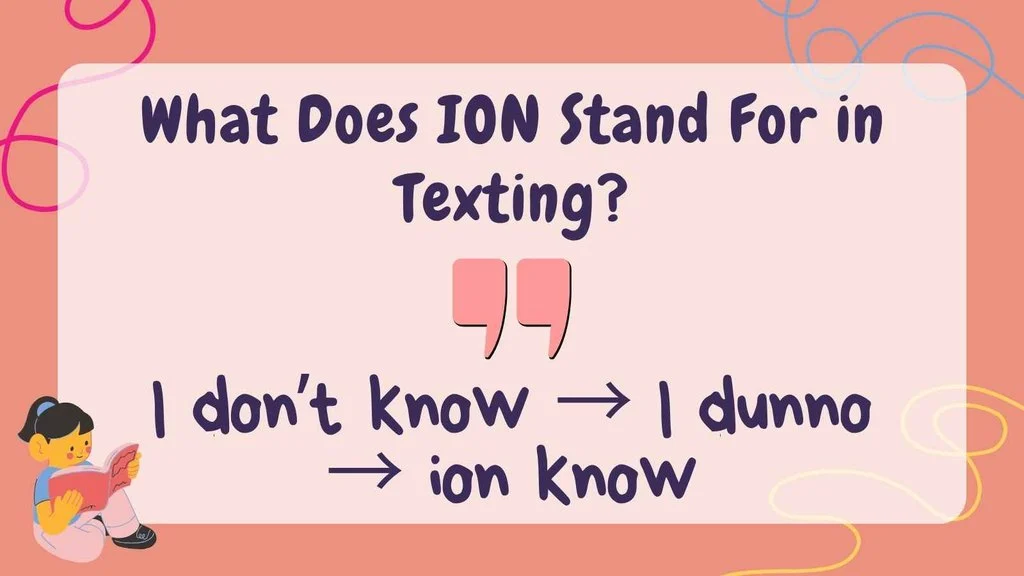
When used as texting slang, ION commonly represents “I don’t.”
Unlike traditional abbreviations such as LOL or BRB, ION does not always work by taking the first letters of several words. Instead, it reflects the way “I don’t” can sound when spoken quickly in certain accents and speech patterns.
Think of it as a written representation of casual pronunciation.
For example:
I don’t know → I dunno → ion know
The exact pronunciation and spelling can vary between communities. Some people write “ion,” while others may use different spellings to capture informal speech.
That is why you should not automatically interpret ION as a formal abbreviation with one official expansion.
Common ION phrases
Here are some everyday examples:
- “Ion know.” → I don’t know.
- “Ion want to go.” → I don’t want to go.
- “Ion care.” → I don’t care.
- “Ion think that’s true.” → I don’t think that’s true.
- “Ion remember.” → I don’t remember.
- “Ion have time.” → I don’t have time.
- “Ion like him.” → I don’t like him.
- “Ion understand.” → I don’t understand.
- “Ion wanna argue.” → I don’t want to argue.
- “Ion even know.” → I don’t even know.
The word following ION usually gives you the clue about its intended meaning.
Where Did ION Slang Come From? 🧠
The texting use of ION is connected to informal spoken language and internet slang, particularly forms of speech associated with African American English (AAE/AAVE) and online youth culture.
In casual speech, words and phrases can naturally become compressed. “I don’t” may be pronounced in a way that sounds closer to “ion” in certain varieties of speech. Social media then helped carry this spelling into digital conversations.
As texting became more conversational, people increasingly began writing messages the way they might say them aloud.
That process has created many forms of internet slang.
For example:
- going to → gonna
- want to → wanna
- got to → gotta
- kind of → kinda
- I don’t → ion
However, there is an important distinction.
ION is not simply a random misspelling. In many online conversations, it intentionally represents casual speech. The spelling communicates a particular conversational style.
Social media platforms have helped spread expressions like this across different communities. A phrase that begins in one speech community can become recognizable to a much wider internet audience.
Still, context and cultural awareness matter. Using slang authentically is different from copying expressions simply because they are trending.
How Is ION Used in a Text Message? 📲
The easiest way to understand ION meaning in text is to look at the sentence around it.
ION normally appears before a verb or phrase where you would expect “I don’t.”
For example:
“Ion want pizza.”
The sentence structure makes the meaning obvious:
I + don’t + want + pizza
Therefore:
“Ion want pizza” = “I don’t want pizza.”
Another example:
“Ion think we should go.”
This means:
“I don’t think we should go.”
ION often appears with casual spelling
You may see ION alongside other informal spellings:
“Ion wanna go rn.”
This could mean:
“I don’t want to go right now.”
Here, ION means “I don’t,” while wanna means “want to” and rn means “right now.”
A single message can therefore contain several pieces of internet slang.
ION is usually lowercase
People commonly type:
- ion know
- ion care
- ion want that
rather than:
- ION KNOW
- ION CARE
But capitalization is not important. Someone may use ION simply for emphasis.
For example:
“ION EVEN KNOW 😭”
The meaning is still “I don’t even know.”
The capital letters mainly add emotional emphasis.
ION Meaning Can Change With Context 🔍
Although ION usually means “I don’t” in casual texting, context always matters.
This is one of the most important rules when interpreting internet slang.
Consider this message:
“Ion know what you’re talking about.”
ION clearly means “I don’t.”
But imagine someone writes:
“The ion has a positive charge.”
That is not slang.
Here, ion refers to a scientific concept: an atom or molecule with an electrical charge because it has gained or lost electrons.
So the same spelling can have two completely different meanings.
| Context | Meaning of “ion” |
|---|---|
| Casual texting | I don’t |
| Social media slang | I don’t |
| Scientific discussion | A charged atom or molecule |
| Chemistry class | Charged particle |
| Formal writing | Usually not used as slang |
How can you tell which meaning is intended?
Look at the words around ion.
If you see:
“ion know”
it is almost certainly texting slang.
If you see:
“positive ion”
it is almost certainly the scientific meaning.
If you see:
“ion want that”
it is texting slang.
If you see:
“negative ion”
it is chemistry.
Context solves the mystery. 🕵️
20 Examples of ION in Texting 💬
Seeing real examples makes slang much easier to understand.
Here are 20 common-style examples with their standard meanings.
| Example Text | Meaning |
|---|---|
| Ion know | I don’t know |
| Ion care | I don’t care |
| Ion want it | I don’t want it |
| Ion like that | I don’t like that |
| Ion think so | I don’t think so |
| Ion remember | I don’t remember |
| Ion understand | I don’t understand |
| Ion have one | I don’t have one |
| Ion need it | I don’t need it |
| Ion wanna go | I don’t want to go |
| Ion feel like it | I don’t feel like it |
| Ion see the problem | I don’t see the problem |
| Ion believe you | I don’t believe you |
| Ion even know anymore | I don’t even know anymore |
| Ion got time | I don’t have time |
| Ion wanna argue | I don’t want to argue |
| Ion think that’s funny | I don’t think that’s funny |
| Ion remember saying that | I don’t remember saying that |
| Ion know why you mad | I don’t know why you’re mad |
| Ion wanna talk about it | I don’t want to talk about it |
Notice a pattern?
ION usually replaces “I don’t” at the beginning of a clause.
That pattern makes it easier to decode unfamiliar messages.
What Does “ION Know” Mean? 🤔
“Ion know” means “I don’t know.”
This is probably one of the most common ways you will encounter ION online.
For example:
Person A: “What time are we leaving?”
Person B: “Ion know 😭”
Person B is simply saying:
“I don’t know.”
However, the emotional tone can vary.
It can sound neutral
“Ion know what time yet.”
Meaning:
“I don’t know what time yet.”
It can sound confused
“Ion know what happened.”
Meaning:
“I don’t know what happened.”
It can sound dismissive
“Ion know, ask somebody else.”
Meaning:
“I don’t know, ask somebody else.”
It can sound playful
“Ion knowww 😂”
The extended spelling and emoji can make the message feel joking or dramatic.
Therefore, ION itself does not automatically communicate attitude. The surrounding words, punctuation, emojis, and conversation history help determine the tone.
What Does “ION Care” Mean? 😶
“Ion care” means “I don’t care.”
This phrase can be tricky because “I don’t care” can sound harsh in English.
For example:
“Ion care what they think.”
Usually means:
“I don’t care what they think.”
The speaker may be expressing confidence, annoyance, indifference, or frustration.
Possible interpretations
Confident:
“Ion care what people say. I’m doing me.”
Annoyed:
“Ion care anymore.”
Dismissive:
“Ion care about that.”
Playful:
“Ion care 😂 you pick.”
So don’t judge the tone based only on the word ION.
The rest of the message matters.
What Does “ION Want” Mean? 😅
“Ion want” means “I don’t want.”
For example:
“Ion want pizza.”
means:
“I don’t want pizza.”
You may also see it combined with other slang:
“Ion wanna go rn.”
That means:
“I don’t want to go right now.”
This kind of message is common in relaxed conversations because people often combine several informal shortcuts.
More examples
- “Ion want no drama.” → I don’t want any drama.
- “Ion wanna talk.” → I don’t want to talk.
- “Ion want that one.” → I don’t want that one.
- “Ion wanna leave yet.” → I don’t want to leave yet.
- “Ion want nobody mad.” → I don’t want anybody mad.
Again, these are casual forms. Standard English would normally use “I don’t want” or “I don’t want to.”
What Does ION Mean on Social Media? 📱🔥
On social media, ION generally has the same slang meaning: “I don’t.”
You may find it in comments, captions, direct messages, memes, and short posts.
For example:
“Ion know who needs to hear this, but…”
This means:
“I don’t know who needs to hear this, but…”
Another example:
“Ion care what anybody says.”
That means:
“I don’t care what anybody says.”
Social media encourages short, conversational language. People often write as if they are speaking directly to friends.
That is why slang such as ION can feel more natural online than it would in formal writing.
Why do people use ION?
There are several reasons:
- It is quick. ⚡
- It sounds conversational.
- It reflects spoken language.
- It fits internet culture.
- It can communicate personality.
- It can make a message feel more relaxed.
- It may signal familiarity with a particular online style.
In many cases, the purpose isn’t simply saving keystrokes. Slang can also communicate identity, tone, humor, and social connection.
Is ION a Formal or Informal Word? ✍️
ION is informal when used to mean “I don’t.”
That distinction is important.
You can use it with close friends or in casual online conversations, but it generally does not belong in formal communication.
Good places to use ION
✅ Texting friends
✅ Casual group chats
✅ Informal social media posts
✅ Memes
✅ Casual comments
✅ Playful conversations
Places to avoid ION
❌ Job applications
❌ Business emails
❌ Academic assignments
❌ Professional reports
❌ Formal presentations
❌ Official documents
❌ Customer-service communication
For example, this is fine in a casual text:
“Ion know 😂 maybe tomorrow.”
But in a professional email, write:
“I’m not sure. Perhaps tomorrow would work.”
The second version is clearer and more appropriate for a formal setting.
How Does ION Sound Emotionally? ❤️🔥
One interesting thing about texting slang is that the same phrase can carry different emotions depending on context.
Take:
“Ion care.”
It could mean:
Indifference:
“I genuinely don’t care.”
Confidence:
“I don’t care what other people think.”
Frustration:
“I’ve had enough of this.”
Playfulness:
“I don’t care 😂.”
Defensiveness:
“I don’t want to discuss this.”
This is why reading slang literally can sometimes lead to misunderstandings.
Text messages don’t contain facial expressions, voice tone, or body language. Instead, people use emojis, punctuation, capitalization, repeated letters, and context to communicate emotion.
Compare:
“ion know”
with:
“ION KNOW 😭😭”
and:
“ion know…”
They all basically mean “I don’t know,” but they can feel completely different.
A simple tone guide
| Message | Possible tone |
|---|---|
| ion know | Neutral |
| ion know lol | Lighthearted |
| ION KNOW 😭 | Dramatic/funny |
| ion know… | Uncertain or frustrated |
| ion care | Dismissive |
| ion care 😂 | Playful |
| ion wanna argue | Defensive or frustrated |
The surrounding conversation is your best clue.
How to Respond When Someone Says ION 💬
Your response depends on what follows ION.
If someone says:
“Ion know.”
You can respond naturally with:
- “That’s fair 😂.”
- “You really have no idea?”
- “Lol, think about it.”
- “No worries, I’ll figure it out.”
- “Same honestly 😭.”
If someone says:
“Ion care.”
You might respond:
- “Fair enough.”
- “Okay, your choice 😂.”
- “You sure about that?”
- “Alright, I hear you.”
- “Noted 😌.”
If someone says:
“Ion wanna go.”
You could say:
- “Why not?”
- “Come on, it’ll be fun.”
- “Okay, we can stay in.”
- “What changed your mind?”
- “No pressure.”
The best response depends on the relationship and the tone.
If the person is clearly annoyed, don’t turn the conversation into a joke just because ION is slang.
ION vs. Other Texting Abbreviations 🔤
ION belongs to a much larger world of internet language.
Here are some common expressions you might see alongside it:
| Slang | Meaning |
|---|---|
| ION | I don’t |
| IDK | I don’t know |
| IDC | I don’t care |
| IMO | In my opinion |
| TBH | To be honest |
| RN | Right now |
| NGL | Not gonna lie |
| FR | For real |
| LMK | Let me know |
| BTW | By the way |
| WYD | What are you doing? |
| WYA | Where are you? |
| IKR | I know, right? |
One useful distinction is that ION isn’t necessarily an initialism like IDK or IDC.
Compare:
IDK → I Don’t Know
Each letter represents a word.
But:
ION → I Don’t
ION is better understood as a slang spelling that reflects informal pronunciation.
That difference explains why it looks unusual compared with many classic texting abbreviations.
Common Mistakes When Understanding ION 🚨
Even though ION is simple once you know it, people sometimes misunderstand it.
Mistake 1: Assuming it means “ion” in chemistry
If you receive:
“Ion know.”
the person probably isn’t discussing charged particles. 😄
Read the whole sentence before deciding what the word means.
Mistake 2: Treating ION as formal English
ION is casual slang when used as “I don’t.”
Don’t automatically transfer it into professional writing.
Mistake 3: Assuming the speaker is rude
A phrase such as:
“Ion know.”
isn’t automatically rude.
The tone depends on the situation.
Mistake 4: Thinking ION always means exactly the same thing
The slang meaning is generally “I don’t,” but context determines the complete interpretation.
For example:
“Ion wanna talk.”
doesn’t merely communicate “I don’t.” It communicates “I don’t want to talk.”
Mistake 5: Overthinking capitalization
Whether someone writes:
ion
or:
ION
the basic slang meaning can remain the same.
Capitalization often adds emphasis rather than changing the definition.
How to Use ION Naturally in a Text 📲
If you’re trying to use ION slang yourself, keep the setting casual.
The easiest approach is to replace “I don’t” with “ion” in a relaxed sentence.
For example:
Standard:
“I don’t know what happened.”
Casual:
“Ion know what happened.”
Another:
Standard:
“I don’t want to go tonight.”
Casual:
“Ion wanna go tonight.”
And:
Standard:
“I don’t think that’s a good idea.”
Casual:
“Ion think that’s a good idea.”
A few natural-style examples
“Ion know 😭 you decide.”
“Ion wanna deal with that today.”
“Ion think he’s serious.”
“Ion care anymore lol.”
“Ion remember what I said.”
The key is to match the style of the conversation.
If everyone in a group chat writes casually, ION may feel natural. If the conversation is formal, standard English is a better choice.
Why Internet Slang Like ION Keeps Evolving 🌐
Language is always changing.
People have shortened words in speech and writing for centuries. The internet simply makes these changes visible and spreads them faster.
Texting encourages people to communicate quickly. Social media encourages short, memorable expressions. Communities develop their own vocabulary, and popular phrases can travel across platforms.
That’s why you may encounter a new abbreviation today and see it everywhere a few months later.
However, slang does not always have one fixed definition.
A term can have:
- A community-specific meaning
- A regional meaning
- A platform-specific meaning
- A humorous meaning
- A completely different formal meaning
ION is a good example of this.
In everyday texting, it commonly means “I don’t.”
In science, ion has a completely different definition.
Understanding language therefore requires more than memorizing vocabulary. You also need to understand context, audience, tone, and usage.
ION in Different Conversation Situations 🎯
The meaning stays similar, but the emotional effect can change based on the situation.
Talking with a friend
“Ion know bro 😂.”
This is casual and relaxed.
Talking about plans
“Ion wanna go tonight.”
This expresses reluctance.
During an argument
“Ion care what he said.”
This may sound dismissive or defensive.
In a playful conversation
“Ion knowww 😭.”
This may sound dramatic or humorous.
In a social media caption
“Ion know who needs to hear this…”
This creates a conversational, attention-grabbing tone.
The words remain similar, but the social context changes how readers interpret them.
ION vs. “I Don’t”: What’s the Difference? ⚖️
The basic meaning is usually the same, but the style is different.
| “I don’t” | “ION” |
|---|---|
| Standard English | Informal slang |
| Appropriate in formal writing | Usually inappropriate in formal writing |
| Clear to almost all readers | May confuse unfamiliar readers |
| Neutral style | Casual/conversational style |
| Common in professional communication | Common in casual online communication |
| Traditional spelling | Slang representation |
For example:
“I don’t know.”
sounds neutral.
“Ion know.”
sounds more casual and internet-oriented.
Neither is necessarily better. The correct choice depends on who you’re talking to and where you’re writing.
FAQs:
What does ION mean in text?
ION usually means “I don’t” in casual texting and online slang. For example, “ion know” means “I don’t know,” while “ion care” means “I don’t care.”
Is ION the same as IDK?
Not exactly. IDK means “I don’t know,” while ION generally means “I don’t.” ION can therefore be followed by different words, such as “ion care,” “ion want,” or “ion think.”
Is ION a bad word?
No. ION is not inherently offensive. It is informal slang. However, the complete sentence containing ION could be rude depending on what the person says.
Can I use ION in formal writing?
It is best to avoid it. ION is casual texting slang, so standard phrases such as “I don’t know” are more appropriate for school, work, business, and professional communication.
Does ION always mean “I don’t”?
No. Context matters. In casual online conversation, ION often means “I don’t.” In science, however, an ion is a charged atom or molecule. Always examine the surrounding words before interpreting it.
Final Thoughts:
So, what does ION mean in text? In most casual texting and social media conversations, ION means “I don’t.” It is an informal slang spelling that reflects casual speech and is commonly used in phrases such as “ion know,” “ion care,” “ion want,” and “ion think.”
The easiest way to understand ION is to look at the words that come after it. If someone writes “ion know,” they are saying “I don’t know.” If they write “ion care,” they mean “I don’t care.”
Remember that ION is informal. It can fit naturally into a text with friends, but standard English is a better choice for professional or academic communication.
Most importantly, don’t judge the tone from ION alone. Emojis, punctuation, surrounding words, and the relationship between the people involved can completely change how a message feels.
Once you recognize the pattern, ION is actually pretty easy to understand. 💬✨

Ayan Zaman is a content writer and researcher at answertutorials.com, specializing in text meanings, slang, abbreviations, and everyday communication. He creates clear, practical, and easy-to-understand guides to help readers communicate with confidence. His content focuses on accurate explanations, real-world examples, and useful answers for modern digital conversations.