

When someone sends you “IMO, that’s the best option” in a text, you might pause and wonder what those three letters actually mean. Is it slang? Is it casual? Does it sound rude? 🤔
If you’ve ever seen IMO in a text message, social media comment, group chat, or online conversation, you’re not alone. Short abbreviations can make digital conversations faster, but they can also be confusing when you don’t know what they mean.
So, what does IMO mean in text?
IMO means “in my opinion.” People use it when they want to share a personal thought, belief, preference, or judgment without presenting it as an absolute fact.
For example:
“IMO, this movie is better than the first one.”
Here, the person is simply saying “In my opinion, this movie is better than the first one.”
The abbreviation is especially common in texting, social media, forums, gaming chats, and casual online conversations. 📱
Let’s explore exactly what IMO means, where it came from, how to use it naturally, what it means from a girl or guy, and how it compares with similar expressions.
What Does IMO Mean in Text?
IMO stands for “in my opinion.”
It is an internet and texting abbreviation people use before or after expressing a personal view.
The important part is that IMO signals subjectivity. In other words, the speaker is making it clear that what follows is their personal perspective rather than an objective fact.
For example:
- “IMO, pizza is better than burgers.”
- “That was the best episode, IMO.”
- “IMO, you should take the earlier flight.”
- “IMO, this outfit looks great on you.”
- “The second option is easier, IMO.”
All of these sentences communicate a personal judgment.
Without IMO, a statement can sometimes sound more definite:
“This is the best restaurant.”
Adding IMO makes the statement softer:
“IMO, this is the best restaurant.”
That small difference can matter in online conversations because text does not always communicate tone clearly. 💬
What Does IMO Stand For?
IMO stands for “in my opinion.”
Each letter represents a word:
| Letter | Word |
|---|---|
| I | In |
| M | My |
| O | Opinion |
So:
I + M + O = In My Opinion
The phrase is straightforward, but its usefulness comes from how quickly it communicates the speaker’s intention.
Instead of typing “In my opinion” every time, someone can simply type “IMO.”
This makes conversations faster, especially when people are chatting from their phones.
For example:
Long version:
“In my opinion, you should wait until tomorrow.”
Texting version:
“IMO, you should wait until tomorrow.”
Both have the same basic meaning.
IMO Meaning in Social Media and Online Chats
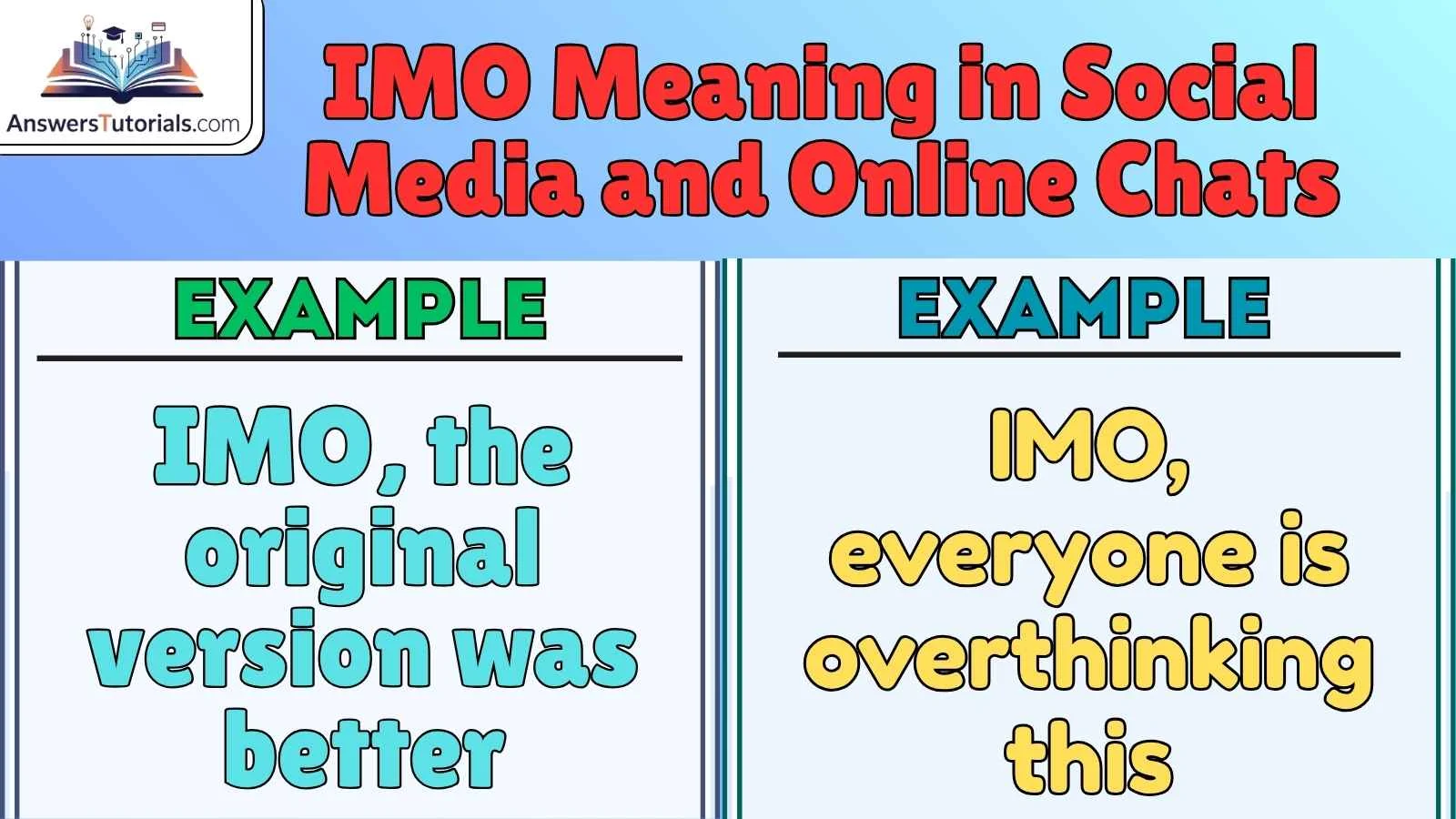
On social media, IMO is often used when someone wants to share a personal take.
You might see it in:
- Facebook comments
- Instagram conversations
- TikTok comments
- Reddit-style discussions
- Discord chats
- Gaming communities
- Group messages
- Online forums
- Private messages
For example:
“IMO, the original version was better.”
Or:
“IMO, everyone is overthinking this.”
The abbreviation can help establish that the person is giving an opinion rather than claiming their statement is universally true.
It is especially useful during discussions where people have different preferences.
For example:
Person A: “Which phone should I buy?”
Person B: “IMO, the smaller one is better if you travel a lot.”
The second person isn’t saying that the smaller phone is objectively better for everyone. They’re sharing their personal recommendation.
That distinction is one of the main reasons people use IMO.
The Origin of IMO
The exact everyday history of internet abbreviations can be difficult to tie to one specific person or moment. However, IMO became part of the broader culture of online communication, where users began shortening common phrases to communicate faster.
As internet communities, chat rooms, message boards, instant messaging, and texting became more popular, abbreviations became a natural part of digital language.
Expressions such as:
- IMO — In My Opinion
- IMHO — In My Humble Opinion
- TBH — To Be Honest
- IDK — I Don’t Know
- BTW — By The Way
- FYI — For Your Information
became convenient ways to express common ideas with fewer characters.
IMO eventually became widely recognizable in casual online communication.
Today, you don’t need to be part of an old-school internet community to understand it. People can encounter IMO in everyday texting, social media posts, comments, and group chats. 🌐
How Is IMO Used in a Text Message?
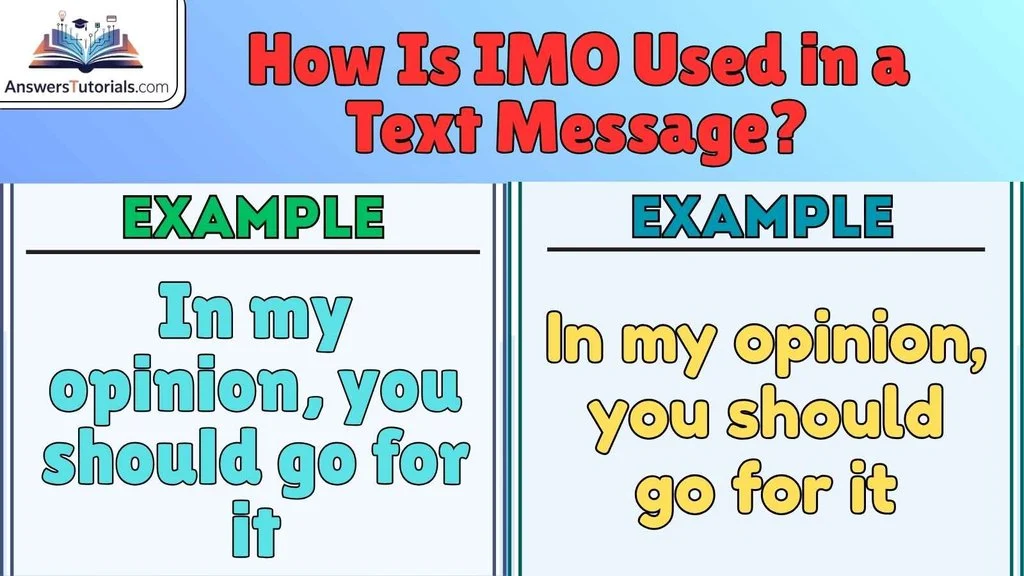
IMO is generally easy to use. It can appear at the beginning, middle, or end of a sentence.
IMO at the Beginning
This is probably the most obvious placement.
Example:
“IMO, you should go for it.”
Meaning:
“In my opinion, you should go for it.”
Another example:
“IMO, that restaurant is overrated.”
This clearly introduces the following statement as a personal opinion.
IMO at the End
You can also place IMO at the end.
Example:
“That was the funniest scene, IMO.”
This has the same basic meaning.
Another example:
“The blue one looks better, IMO.”
The speaker is simply emphasizing that the statement reflects their personal view.
IMO in the Middle
It can also appear naturally in a longer sentence.
Example:
“The new update is, IMO, much easier to use.”
This style is slightly more formal but still understandable.
In everyday texting, putting IMO at the beginning or end is usually more natural.
IMO Text Examples in Everyday Conversations
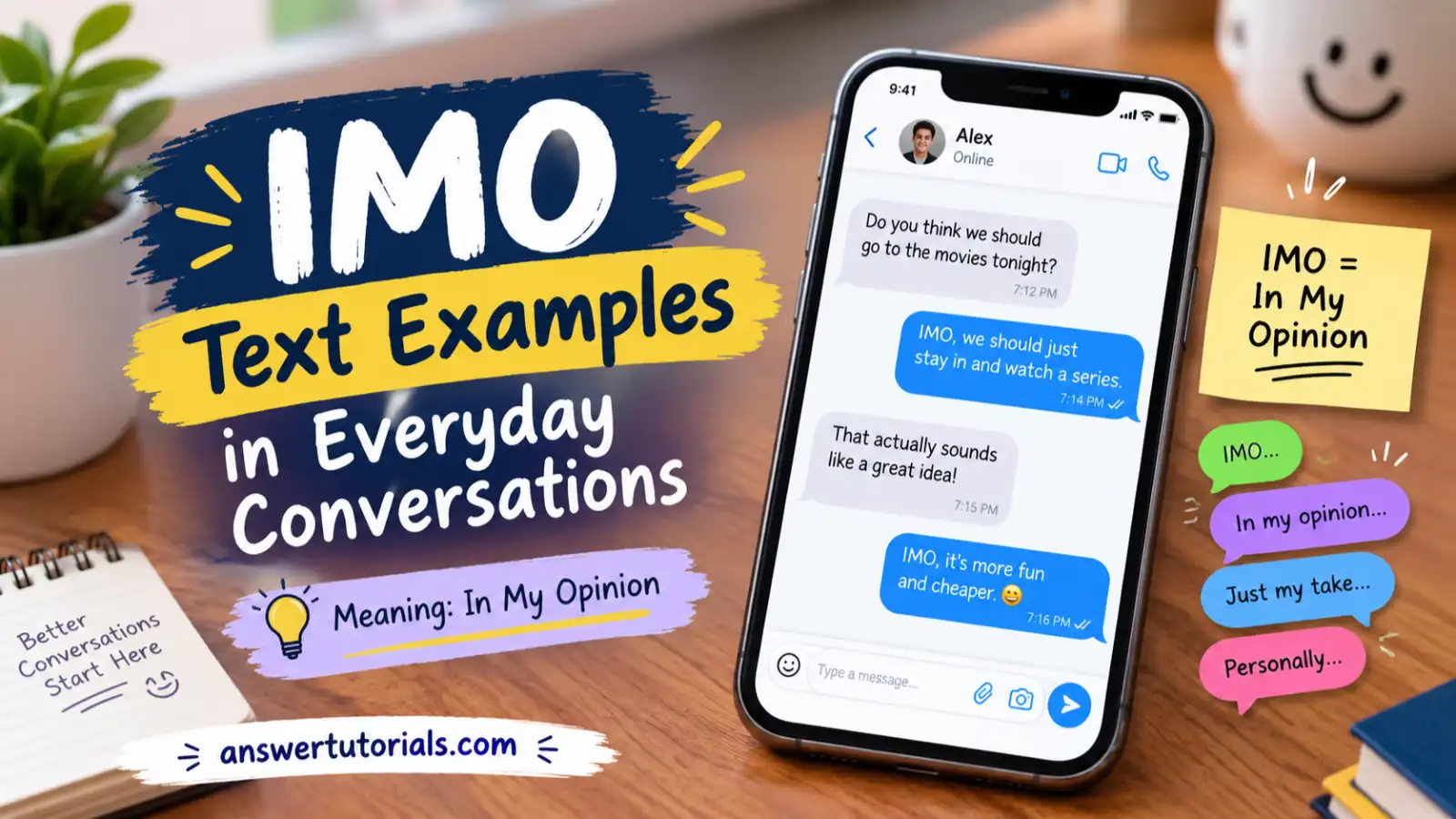
Understanding examples is often easier than memorizing a definition. Here are some realistic situations where IMO can appear. 👇
Example 1: Talking About Food
Friend: “Which pizza should we order?”
You: “IMO, the spicy chicken one is the best.”
Meaning: You personally think the spicy chicken pizza is the best.
Example 2: Discussing a Movie
Friend: “Did you like the ending?”
You: “IMO, the ending was actually pretty good.”
The person is sharing a personal reaction.
Example 3: Giving Advice
Friend: “Should I text her again?”
You: “IMO, wait until tomorrow.”
This means:
“In my opinion, wait until tomorrow.”
Example 4: Talking About Clothes
Friend: “Which outfit looks better?”
You: “IMO, the black one suits you more.”
The speaker is giving a personal preference.
Example 5: Online Debate
Person A: “The first game was better.”
Person B: “IMO, the second one had better gameplay.”
Neither person necessarily has to be objectively correct. They’re expressing different opinions.
Example 6: Casual Compliment
“IMO, you’re seriously underrated.”
Here, IMO makes the statement sound like a personal assessment.
What Does IMO Mean From a Girl?
If a girl sends you IMO, the basic meaning doesn’t change.
IMO still means “in my opinion.”
The important thing is the sentence surrounding it.
For example:
“IMO, you look better with short hair.”
She’s giving her personal opinion about your appearance.
Or:
“IMO, you should talk to him.”
She’s offering her perspective or advice.
Or:
“IMO, you’re overthinking it.”
She’s sharing her personal interpretation of the situation.
IMO by itself does not automatically indicate flirting, attraction, annoyance, or affection.
The surrounding conversation determines the tone.
For example:
“IMO, you look really cute in that picture.”
This could feel complimentary or even slightly flirty depending on the relationship and context.
But:
“IMO, you should get some sleep.”
is simply advice.
So, don’t interpret IMO alone as a hidden romantic signal. Look at the complete message and the conversation around it. 💬
What Does IMO Mean From a Guy?
If a guy uses IMO, it also simply means “in my opinion.”
For example:
“IMO, you should take the job.”
He’s expressing his personal recommendation.
Or:
“IMO, that was the best part of the game.”
He’s sharing his opinion.
Or:
“IMO, you’re making the right decision.”
He’s communicating his personal view about your decision.
Again, IMO does not automatically mean flirting or romantic interest.
A guy might use it with friends, coworkers, family members, gaming teammates, or someone he’s dating.
The surrounding words provide much more information about his intention.
IMO vs. IMHO: What’s the Difference?
One abbreviation that often appears alongside IMO is IMHO.
IMO
IMO = In My Opinion
IMHO
IMHO = In My Humble Opinion
Both are used to introduce a personal viewpoint.
For example:
“IMO, this is the better choice.”
And:
“IMHO, this is the better choice.”
The basic message is almost identical.
The word “humble” in IMHO can make the expression sound more self-conscious or modest.
However, people don’t always use IMHO literally. Someone can write IMHO before a very strong opinion.
In casual texting, IMO is usually the simpler option.
IMO vs. TBH: Are They the Same?
Not exactly.
IMO means “in my opinion.”
TBH means “to be honest.”
They can sometimes appear in similar conversations, but they communicate different ideas.
For example:
“IMO, that movie was boring.”
This emphasizes that the statement is a personal opinion.
Meanwhile:
“TBH, that movie was boring.”
This emphasizes honesty or frankness.
You can even combine them:
“TBH, IMO, the old version was better.”
That means the speaker is being honest while also emphasizing that the statement is their personal opinion.
However, using both isn’t always necessary. In casual texting, people often choose whichever abbreviation best matches what they want to communicate.
Is IMO Formal or Informal?
IMO is mostly informal or semi-casual.
It works especially well in:
- Text messages
- Social media
- Group chats
- Online discussions
- Gaming chats
- Casual emails
- Comments
- Forums
However, it may not be the best choice for highly formal writing.
For example, in a professional report, academic paper, or formal business document, writing “in my opinion” or using more precise language may be more appropriate.
Compare:
Casual:
“IMO, this plan is better.”
More formal:
“In my view, this approach may be more effective.”
The meaning is similar, but the style is different.
When communicating professionally, always consider your audience.
Is IMO Rude or Disrespectful?
Generally, IMO is not rude.
In fact, it can sometimes make a statement feel less absolute because it clearly identifies the statement as a personal opinion.
Compare:
“You’re wrong.”
with:
“IMO, I think there’s another way to look at it.”
The second version can sound more conversational and less confrontational.
However, the words that follow IMO still matter.
For example:
“IMO, that’s a terrible idea.”
may still sound harsh.
So, IMO itself isn’t usually rude. The tone depends on the entire message.
If you’re discussing a sensitive topic, you can make your opinion softer by combining IMO with polite language.
For example:
“IMO, there might be a better approach.”
That sounds less aggressive than:
“IMO, your idea makes no sense.”
How to Reply When Someone Uses IMO
Usually, you don’t need to respond specifically to the abbreviation.
Instead, respond to the opinion itself.
For example:
Them: “IMO, you should take the new job.”
You: “Yeah, I’m starting to think you’re right.”
Or:
Them: “IMO, the first movie was better.”
You: “I disagree. I liked the sequel more.”
Or:
Them: “IMO, you need a break.”
You: “Honestly, you’re probably right 😂.”
You can agree, disagree, ask a question, or continue the discussion.
Some natural responses include:
- “I agree.”
- “That’s a good point.”
- “I see what you mean.”
- “I hadn’t thought about it that way.”
- “I respectfully disagree.”
- “Interesting take.”
- “Fair point.”
- “Why do you think that?”
- “Honestly, I agree.”
- “I’m not convinced 😂.”
The best response depends on the conversation.
Common Examples of IMO in Texting
Here are more examples to help you recognize the abbreviation quickly:
| Text Example | Meaning |
|---|---|
| “IMO, that’s the best choice.” | In my opinion, that’s the best choice. |
| “That was funny, IMO.” | I personally thought that was funny. |
| “IMO, you should wait.” | I think you should wait. |
| “The blue one wins IMO.” | I personally prefer the blue one. |
| “IMO, she’s right.” | I think she is right. |
| “That’s overrated IMO.” | I personally think it’s overrated. |
| “IMO, this is easier.” | I think this is easier. |
| “You handled it well, IMO.” | I personally think you handled it well. |
| “IMO, we should leave early.” | I think we should leave early. |
| “That was the best part, IMO.” | In my personal view, that was the best part. |
These examples show why IMO is so useful: three letters can instantly tell the reader that the statement represents a personal viewpoint.
When Should You Use IMO?
You can use IMO when you’re giving an opinion and want to make that clear.
It works particularly well when:
- You are giving advice.
- You are comparing two things.
- You are discussing entertainment.
- You are sharing a preference.
- You are participating in a debate.
- You are commenting on someone’s decision.
- You are recommending something.
- You want to soften an absolute-sounding statement.
For example:
“IMO, you should choose the second option.”
This tells the other person that you’re offering advice rather than demanding that they follow it.
Similarly:
“IMO, the ending could have been better.”
This communicates criticism while making it clear that it’s your personal assessment.
When Should You Avoid IMO?
Although IMO is useful, you don’t need to add it to every opinion.
If the conversation is already clearly personal, adding IMO can sometimes feel unnecessary.
For example:
“I love this song.”
You don’t need to write:
“IMO, I love this song.”
That sounds awkward because “I love” already identifies the statement as personal.
You should also avoid relying heavily on texting abbreviations in formal situations.
For example, instead of:
“IMO, this is the best solution.”
a professional document might use:
“In my view, this solution is the most appropriate.”
The right choice depends on the audience, setting, and purpose.
Why Do People Use IMO Instead of “In My Opinion”?
The biggest reason is speed and convenience. 📱
Typing three letters is faster than typing a full phrase.
Digital conversations often move quickly. People may be replying from their phones while multitasking, traveling, gaming, or chatting with friends.
Abbreviations help reduce typing without completely losing meaning.
IMO also has a familiar tone.
When someone writes:
“IMO, you should try it.”
it feels like casual conversation.
The abbreviation can make online communication feel shorter, lighter, and more natural.
Over time, abbreviations like IMO have become part of the vocabulary of digital communication.
What Does IMO Mean in Different Contexts?
The meaning stays the same, but the purpose can change depending on the situation.
In Advice
“IMO, you should apologize.”
Here, IMO introduces advice.
In an Argument
“IMO, both sides have a point.”
Here, IMO introduces a personal assessment.
In Entertainment
“IMO, season two was better.”
Here, it expresses a preference.
In Dating Conversations
“IMO, you look amazing tonight.”
Here, it can introduce a compliment.
In Friend Conversations
“IMO, we should order pizza.”
Here, it simply communicates a preference.
In Online Discussions
“IMO, the issue is more complicated than that.”
Here, it identifies the statement as the writer’s interpretation.
The abbreviation remains the same, but context gives it personality and tone.
Quick Guide to IMO
If you want the shortest possible explanation, remember this:
IMO = In My Opinion 💬
Use it when you’re about to share a personal thought, preference, judgment, or recommendation.
Quick examples:
“IMO, that’s better.”
= “In my opinion, that’s better.”
“IMO, you should go.”
= “In my opinion, you should go.”
“That movie was overrated, IMO.”
= “I personally think that movie was overrated.”
“IMO, she’s right.”
= “I think she’s right.”
Once you understand this pattern, you’ll recognize IMO almost instantly whenever you see it in a conversation.
FAQs:
What does IMO mean in texting?
IMO means “in my opinion.” It is commonly used in text messages, social media, chats, and online discussions to introduce a personal opinion or viewpoint.
What does IMO stand for?
IMO stands for “In My Opinion.” Each letter represents the first letter of the three words.
Is IMO slang?
IMO is best described as a texting and internet abbreviation. It is informal and commonly used in digital conversations rather than formal writing.
Does IMO mean the same thing from a girl or guy?
Yes. IMO has the same basic meaning regardless of who sends it. It means “in my opinion.” The surrounding message determines whether the overall conversation sounds friendly, serious, humorous, romantic, or critical.
Is IMO rude?
No. IMO itself is not rude. It simply identifies a statement as a personal opinion. However, the words used with IMO can still make a message sound polite, blunt, funny, or harsh.
Final Thoughts:
So, what does IMO mean in text? The answer is simple: IMO means “in my opinion.” 💬
People use this abbreviation to introduce a personal thought, preference, judgment, recommendation, or perspective. You may see it at the beginning or end of a message, such as “IMO, that’s the better choice” or “That’s the best option, IMO.”
The abbreviation is especially common in texting, social media, online discussions, gaming chats, and other casual digital conversations.
Remember that IMO doesn’t automatically signal a particular emotion or relationship. If a girl or guy sends you IMO, focus on the complete sentence and surrounding conversation rather than the abbreviation itself.
If you remember just one thing, make it this:
IMO = In My Opinion.
It’s short, easy to recognize, and useful whenever someone wants to make it clear that they’re sharing their personal view—not necessarily an objective fact. 📱✨

Ayan Zaman is a content writer and researcher at answertutorials.com, specializing in text meanings, slang, abbreviations, and everyday communication. He creates clear, practical, and easy-to-understand guides to help readers communicate with confidence. His content focuses on accurate explanations, real-world examples, and useful answers for modern digital conversations.