

If someone suddenly texts you “HRU?”, you might wonder what those three letters mean. Is it a slang word, an acronym, or simply a shortened question? In everyday texting, HRU means “How are you?”
People use HRU as a quick and casual way to check on someone. You may see it in text messages, social media chats, dating conversations, group messages, or online communities.
For example:
“Hey! HRU?”
This simply means:
“Hey! How are you?”
The abbreviation saves time and makes a message feel informal. It does not usually carry a hidden meaning. The exact tone depends on the conversation, the relationship between the people, and what comes before or after it.
In this guide, you’ll learn what does HRU mean in text, where it came from, how people use it, what it means from a girl or guy, how to respond, and when you should avoid using it. 📱
HRU Meaning in Text at a Glance 🔎
The easiest way to understand HRU meaning in text is to break down the letters:
| Text | Meaning |
|---|---|
| HRU | How are you? |
| HRU? | How are you? |
| Hey HRU? | Hey, how are you? |
| Hi HRU | Hi, how are you? |
| HRU doing? | How are you doing? |
HRU is primarily a shortened form of “How are you?”
It is generally used to start a conversation or check on someone’s current mood or situation. Someone might send it after saying hello, after being away for a while, or when they simply want to reconnect.
For example:
Person A: Hey, HRU?
Person B: I’m good! Just relaxing. You?
Here, the abbreviation works exactly like the full question.
The main difference is style rather than meaning. “How are you?” sounds more complete, while “HRU?” feels quicker and more casual.
What Does HRU Stand For? 📝
HRU stands for “How are you?”
It is a form of texting shorthand created by shortening the phrase into its most recognizable letters.
- H = How
- R = Are
- U = You
The letter R represents “are,” while U represents “you.” This type of spelling became popular because digital conversations often encouraged people to type quickly.
Instead of writing:
“How are you?”
Someone can simply write:
“HRU?”
The message still communicates the same basic question.
However, abbreviations such as HRU can sometimes feel different depending on the person using them. One person may use HRU because they naturally text with abbreviations. Another person might use it because they want to keep the conversation short.
Therefore, HRU does not automatically indicate a particular emotion or relationship.
The surrounding conversation provides the important context.
The Origin of HRU in Texting 📱
The exact moment when HRU became popular is difficult to pinpoint because texting abbreviations developed gradually across different online communities.
The abbreviation belongs to a larger style of digital shorthand. Early internet chats, instant messaging, SMS texting, and online communities encouraged users to shorten common phrases.
People began replacing words with letters and reducing familiar expressions:
- U → you
- R → are
- Y → why
- B4 → before
- IDK → I don’t know
- BTW → by the way
- BRB → be right back
- HRU → how are you?
These shortcuts made conversations faster and easier to type.
Over time, some abbreviations became strongly associated with casual digital communication. HRU remained useful because “How are you?” is such a common conversational question.
Today, you may encounter HRU in text messages, messaging apps, social platforms, gaming chats, and other informal digital conversations.
The important point is that HRU is texting shorthand rather than a completely different phrase.
How Is HRU Used in a Text Message? 💬
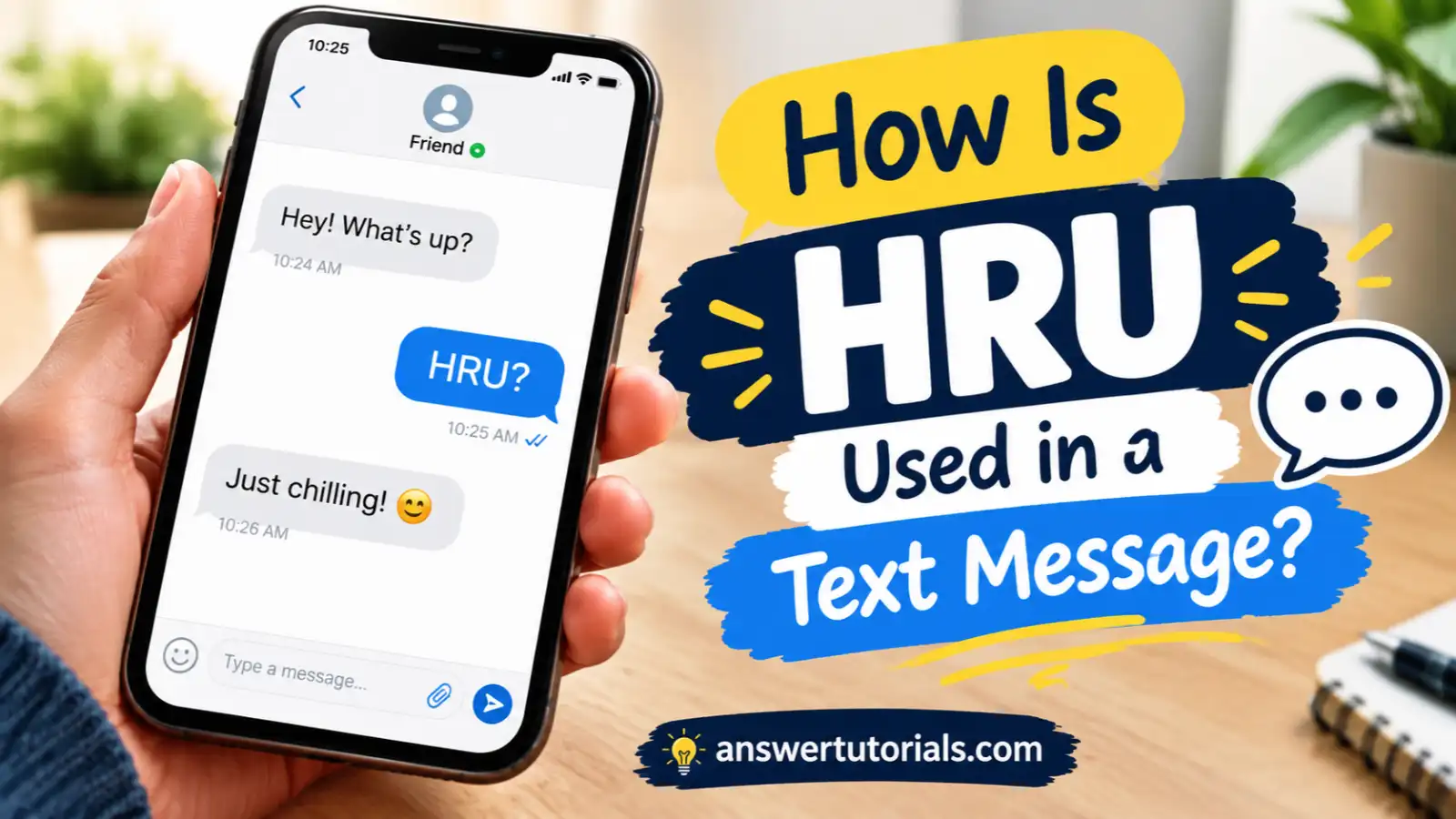
People generally use HRU when they want to ask about someone’s current state.
The question can be friendly, casual, curious, or conversational.
Here are some common examples:
1. Starting a conversation
“Hey HRU?”
The sender is simply opening a conversation.
2. Checking on a friend
“Haven’t heard from you today. HRU?”
Here, HRU can show that the sender wants to know how the person is doing.
3. Reconnecting
“Long time no talk! HRU?”
The abbreviation helps make the message sound relaxed.
4. Casual conversation
“Morning! HRU today?”
This is another informal way of checking in.
5. Following up
“HRU after the exam?”
In this situation, the question may carry more context because the sender already knows something happened.
The phrase is flexible. Its meaning stays essentially the same, but the emotional tone can change based on context.
What Does HRU Mean From a Girl? 👩💬
If a girl texts you “HRU?”, the basic meaning is still “How are you?”
It does not automatically mean she is flirting, interested romantically, or trying to communicate a hidden message.
Context matters.
For example:
“Hey HRU?”
This could simply be a friendly check-in.
But:
“Heyyy, HRU? 😊”
may feel warmer because of the extra letters and emoji.
Similarly:
“HRU? Haven’t talked in forever!”
sounds like an attempt to reconnect.
The safest interpretation is to start with the literal meaning: she is asking how you are.
Then consider the rest of the conversation.
Look at factors such as:
- What you were talking about before
- How frequently you communicate
- Whether she usually uses abbreviations
- Whether she continues the conversation
- Whether there are other clear signs of friendliness or interest
- The emojis and wording around HRU
Avoid treating the abbreviation itself as proof of romantic interest.
What Does HRU Mean From a Guy? 👨💬
When a guy sends “HRU?”, it generally means exactly what it says: “How are you?”
He could be checking in, starting a conversation, reconnecting, or simply making casual conversation.
For example:
“Yo HRU?”
This sounds relaxed and informal.
Or:
“Hey, HRU? Everything good?”
This sounds more concerned because the sender adds another question.
A message such as:
“HRU? What are you up to later?”
could be the beginning of a longer conversation, but HRU itself does not establish why the person is messaging.
The best way to understand the intention is to consider the full exchange rather than focusing on three letters.
What Does HRU Mean From a Crush? ❤️
If your crush sends “HRU?”, it can definitely feel exciting. However, the abbreviation itself does not prove that they have romantic feelings.
It means “How are you?”
The interesting part is what happens afterward.
For example:
“HRU?”
“I’m good! How about you?”
“Good. What are you doing tonight?”
That conversation may show that the person wants to keep talking.
On the other hand:
“HRU?”
“I’m good.”
“Nice.”
might simply be a brief check-in.
If you’re trying to understand someone’s intentions, pay attention to the overall communication pattern, not just HRU.
Does the person regularly start conversations? Do they ask follow-up questions? Do they remember things you told them? They make an effort to continue talking?
Those details provide much more context than the abbreviation itself.
How to Reply to HRU 💡
There is no single correct response to HRU.
Your reply should match the tone of the person who sent it and the kind of conversation you want.
Simple Replies
If you want to keep things straightforward:
- “I’m good, you?”
- “Doing well! HRU?”
- “I’m okay. How about you?”
- “Pretty good today.”
- “I’m doing great!”
These are natural responses for everyday conversations.
Friendly Replies 😊
If you want to sound warm:
- “I’m good! Nice to hear from you.”
- “Doing pretty well! How have you been?”
- “I’m great. What about you?”
- “Good so far! How’s your day going?”
These responses make it easier to continue the conversation.
Funny Replies 😂
If you have a playful relationship:
- “Surviving Monday 😂 You?”
- “Still alive, so that’s something!”
- “Better now that you asked.”
- “Running on caffeine and hope. You?”
- “Currently accepting compliments. HRU?”
Humor works best when you already know the other person appreciates that style.
Flirty Replies ❤️
If the conversation is already romantic or playful, you can make your response warmer:
- “Better now that I’m talking to you.”
- “I’m good. How about you, trouble?”
- “I was fine, but your message made my day.”
- “Doing good. Missing someone though.”
- “I’m good. Were you thinking about me?”
Keep the tone appropriate to your relationship. A flirty reply can feel natural in an established conversation but awkward when you barely know someone.
Short Replies
Sometimes you simply don’t have much time.
Try:
- “Good! U?”
- “I’m good.”
- “Doing okay.”
- “Pretty good.”
- “All good here.”
A short response is perfectly acceptable in casual texting.
HRU vs. How Are You: What’s the Difference? 🤔
The basic meaning is the same, but the tone and presentation can differ.
| Phrase | Typical Tone | Best Setting |
|---|---|---|
| HRU? | Very casual | Friends, casual chats |
| How are you? | Neutral | Most conversations |
| How are you doing? | Friendly | Casual or semi-formal |
| How have you been? | Warm | Reconnecting |
| How are you today? | Caring/neutral | Check-ins |
| How are things? | Conversational | Friends or colleagues |
Using HRU makes the message shorter and more informal.
Compare:
“How are you?”
with:
“HRU?”
The first looks more complete. The second feels more like quick digital conversation.
That does not mean HRU is rude. It simply belongs to a more casual communication style.
Is HRU Rude or Informal? 😎
HRU is informal, but it is not inherently rude.
Whether it feels polite depends on the relationship and setting.
With a close friend:
“Hey HRU?”
is completely normal.
With a professor, employer, customer, or formal business contact, writing “HRU?” may look too casual.
For professional communication, write the full phrase instead:
“How are you?”
or:
“I hope you’re doing well.”
The general rule is simple:
Use HRU where casual texting is expected. Avoid it when a polished or professional tone matters.
When Should You Avoid Using HRU? 🚫
Although HRU is easy to understand, it is not suitable for every situation.
Avoid using it when:
1. You’re writing professionally
A work email should usually use complete words and sentences.
2. You’re contacting someone for the first time
If you don’t know the person, a complete greeting may create a better first impression.
3. You’re writing something important
Formal messages benefit from clear, complete language.
4. The recipient dislikes texting abbreviations
Some people find excessive shorthand difficult to read.
5. The conversation is serious
If someone is dealing with a difficult situation, a thoughtful message such as “How are you doing?” may feel more appropriate than a quick abbreviation.
The goal is not simply to save characters. Good communication also depends on tone, timing, and context.
Common Texting Examples Using HRU 📲
Here are realistic examples showing how HRU meaning in text works in different conversations.
Example 1: Friends
Alex: Hey HRU?
Sam: I’m good! Just got home. You?
Example 2: Reconnecting
Mia: Hey! It’s been ages. HRU?
Lena: I know! I’m doing great. How about you?
Example 3: After an Event
Jake: HRU after the interview?
Noah: A little nervous, honestly.
Example 4: Casual Morning Text
Ella: Morning! HRU? ☀️
Ryan: Doing pretty good. Still sleepy though 😂
Example 5: Flirty Conversation
Chris: HRU?
Taylor: Better now that you texted me 😉
Example 6: Checking on Someone
Jordan: Haven’t heard from you. HRU?
Casey: I’m okay. Just been busy lately.
Example 7: Group Chat
Sam: HRU guys?
Alex: Good here!
Jamie: Same 😂
These examples show why context matters. The abbreviation stays the same, but the social purpose of the message can change.
Similar Text Abbreviations You May See 🔤
If you’re learning texting slang, HRU is just one abbreviation in a much larger group.
Here are some common examples:
| Abbreviation | Meaning |
|---|---|
| HRU | How are you? |
| HBU | How about you? |
| WYD | What are you doing? |
| WYA | Where you at? / Where are you? |
| HMU | Hit me up |
| IDK | I don’t know |
| IMO | In my opinion |
| TBH | To be honest |
| BTW | By the way |
| LMK | Let me know |
| TTYL | Talk to you later |
| LOL | Laughing out loud |
These abbreviations make digital communication faster.
However, not every abbreviation works in every situation. Some have multiple meanings, while others can feel outdated depending on the platform and age group.
That is why context remains important when interpreting texting slang.
Why Do People Use HRU Instead of “How Are You?” 📱
There are several simple reasons.
Speed
Typing three letters is faster than typing a full question.
Convenience
People often use shortcuts when communicating from a phone.
Casual Tone
HRU can make a conversation feel relaxed and informal.
Digital Culture
Texting has developed its own vocabulary and communication habits.
Familiarity
Frequent texters may naturally use abbreviations without thinking about them.
Still, using an abbreviation does not necessarily mean someone is being careless. In many conversations, shorthand is simply part of the communication style.
A person who writes “HRU?” may be perfectly comfortable using complete sentences elsewhere.
HRU in Social Media and Online Chats 🌐
The meaning of HRU generally stays the same across different digital platforms.
You might encounter it in:
- Direct messages
- Group chats
- Text messages
- Gaming conversations
- Social media comments
- Dating apps
- Online communities
For example:
“Hey HRU?”
works whether the message arrives through a phone or an online messaging platform.
However, communication styles vary between communities. Some groups use many abbreviations, while others prefer normal sentences.
You should therefore pay attention to how the people around you communicate.
If everyone in the conversation writes complete sentences, HRU may stand out as particularly casual.
If everyone uses abbreviations, HRU will probably feel completely normal.
What Is the Best Response to “HRU?” 💬
The best response depends on what you actually want to communicate.
If you’re doing well:
“I’m good! How about you?”
You’re having a difficult day:
“Honestly, it’s been a rough day, but I’m getting through it.”
If you’re busy:
“Doing okay, just really busy today. You?”
You want to continue talking:
“I’m good! What have you been up to?”
If you’re interested in the person:
“I’m good 😊 How are you doing?”
The strongest responses usually do one additional thing: they give the other person something to respond to.
Instead of:
“Good.”
you could say:
“Good! I just finished dinner. How about you?”
The second version creates a natural opening for conversation.
FAQs ❓
What does HRU mean in text?
HRU means “How are you?” It is an informal texting abbreviation commonly used to check how someone is doing or to start a casual conversation.
What does HRU stand for?
HRU stands for “How are you?” The letters come from the words How, are, and you, with “R” representing “are” and “U” representing “you.”
Is HRU a slang word?
HRU is better described as texting shorthand or an abbreviation rather than a traditional slang word. It is used in casual digital conversations.
How should I reply to HRU?
You can reply naturally with something such as “I’m good, how about you?”, “Doing great!”, or “I’m okay, just tired. You?” Your response should match the conversation.
Does HRU mean someone likes you?
Not necessarily. HRU simply means “How are you?” If someone sends it, their romantic interest cannot be determined from the abbreviation alone. The broader conversation provides more useful context.
Final Thoughts 📝
So, what does HRU mean in text? It means “How are you?”
It is a short, casual abbreviation commonly used in digital conversations. People use HRU to check on someone, start a conversation, reconnect with a friend, or keep a chat moving.
The important thing to remember is that HRU usually has no secret meaning. Its tone depends on the surrounding conversation and the relationship between the people involved.
If a friend texts:
“HRU?”
a natural response could simply be:
“I’m good! How about you?”
For a more playful conversation, you can add humor or personality. In professional situations, however, writing the full phrase “How are you?” is usually a better choice.
Once you understand the abbreviation, HRU is easy to recognize. The next time it appears in a message, you’ll know exactly what the sender is asking. 💬📱

Ayan Zaman is a content writer and researcher at answertutorials.com, specializing in text meanings, slang, abbreviations, and everyday communication. He creates clear, practical, and easy-to-understand guides to help readers communicate with confidence. His content focuses on accurate explanations, real-world examples, and useful answers for modern digital conversations.