

If someone sends you “hm” in a text, you might pause and wonder what they really mean. Is the person thinking? Are they unsure? Did they dislike what you said? Or are they simply acknowledging your message?
The meaning of HM in text depends heavily on the conversation, punctuation, and the person’s tone. Unlike abbreviations with one clear definition, “hm” is usually a conversational sound that represents hesitation, thought, uncertainty, curiosity, or a mild reaction.
For example:
You: “Do you think I should take the new job?”
Them: “Hm… maybe.”
Here, “hm” suggests that the person is thinking carefully before answering.
In another conversation:
You: “I saw your message but forgot to reply.”
Them: “Hm.”
That short reply could sound skeptical, disappointed, or unconvinced.
So, if you’re searching for what does hm mean in text, the simplest answer is: HM usually expresses thought, hesitation, uncertainty, skepticism, or a reaction that depends on context.
HM Meaning in Text at a Glance
The easiest way to understand HM meaning in text is to look at the possible emotions behind it.
| HM Usage | Possible Meaning | Typical Tone |
|---|---|---|
| “Hm…” | Thinking | Neutral |
| “Hm?” | Confused or asking for clarification | Curious |
| “Hmm” | Considering something | Thoughtful |
| “Hm, okay.” | Mild uncertainty | Reserved |
| “Hm.” | Skepticism or doubt | Potentially cold |
| “Hmmm…” | Deep thought or hesitation | Reflective |
| “Hm 😂” | Amused reaction | Playful |
| “Hm, interesting.” | Curiosity | Interested |
| “Hm, I see.” | Acknowledgment | Neutral |
| “Hm?” | Asking someone to repeat or explain | Curious |
As you can see, HM does not have one fixed emotional meaning. The surrounding words often tell you more than the abbreviation itself.
What Does HM Stand For in Texting?
Unlike acronyms such as “LOL” or “BRB,” HM does not always stand for a specific phrase.
In everyday texting, “hm” generally represents a written version of a sound people make while thinking.
You might say “hmm” aloud when:
- You are thinking about an answer.
- You are unsure about something.
- You are considering an idea.
- You are suspicious.
- You want more information.
- You are mildly surprised.
- You don’t know what to say.
- You are not completely convinced.
That is why HM in chat can be difficult to interpret.
Consider this example:
Friend: “Want to go out tonight?”
You: “Hm… what time?”
Here, HM signals that you are considering the invitation.
But compare it with:
Friend: “I definitely didn’t eat your leftovers.”
You: “Hm.”
Now, the same two letters may communicate doubt or suspicion.
The letters haven’t changed. The context has.
The Origin of “Hm” in Everyday Communication
The use of “hm” comes from natural human speech rather than modern texting alone.
People have long used sounds such as “hm,” “hmm,” and similar vocal expressions when they are processing information. These sounds can buy a person a moment to think before responding.
Texting simply turned that spoken reaction into written communication.
As digital conversations became more informal, people began using variations such as:
- Hm
- Hmm
- Hmmm
- Hmmm…
- Hm?
- Hm!
Each variation can subtly change the perceived tone.
For example, “hm…” may feel slower and more thoughtful, while “hm?” can indicate that someone wants clarification.
This is one reason text conversations require more attention to punctuation, context, and previous messages.
Different Meanings of HM in Text Messages
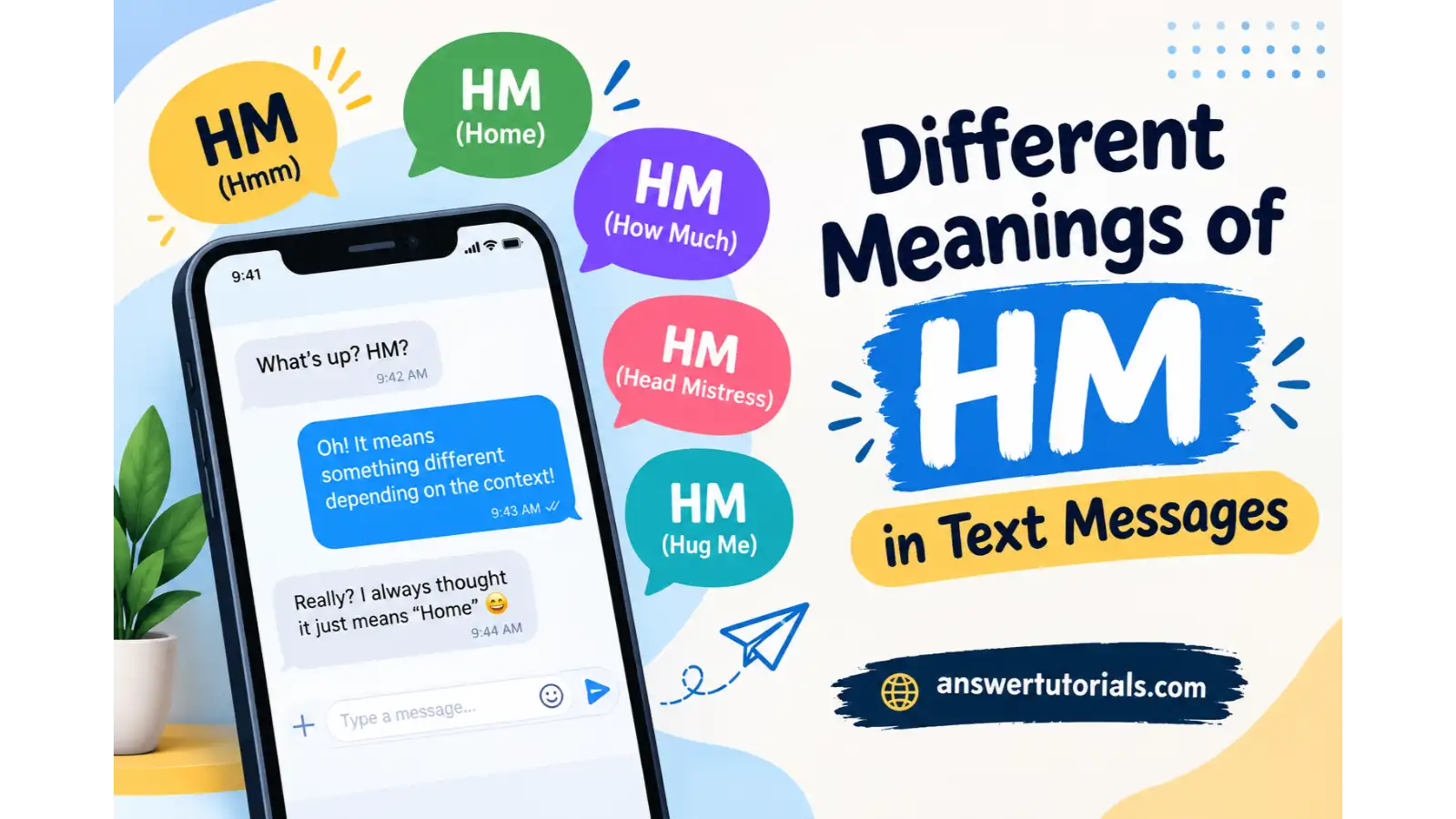
The meaning of HM can change depending on what happened immediately before it. Here are some of the most common interpretations.
HM Can Mean “I’m Thinking”
This is probably the most straightforward interpretation.
You: “Which restaurant should we try?”
Friend: “Hm… let me think.”
The person is simply processing the question.
There is no hidden negative message.
HM Can Mean “I’m Not Sure”
Sometimes “hm” communicates uncertainty.
You: “Are you coming tomorrow?”
Them: “Hm, I’m not sure yet.”
Here, HM introduces an uncertain answer.
HM Can Show Skepticism
A short “hm” can also communicate doubt.
You: “I can finish everything in ten minutes.”
Them: “Hm.”
In this situation, the person may not believe you.
The shorter the response, the more important context becomes.
HM Can Mean “Interesting”
Someone might use HM after hearing unexpected information.
You: “I found out they are moving next month.”
Them: “Hm, interesting.”
This use is generally neutral and indicates that the person is processing new information.
HM Can Ask for Clarification
When written as “hm?”, it may function almost like:
- “What?”
- “Really?”
- “What do you mean?”
- “Can you explain?”
For example:
You: “I don’t think that’s going to work.”
Them: “Hm?”
You: “I mean we should try another approach.”
The question mark changes the feel considerably.
HM vs. Hmm vs. Hmmm: Is There a Difference?
Yes, although these differences aren’t strict rules.
People often use the number of letters to communicate tone or timing.
| Version | Common Impression |
|---|---|
| Hm | Brief reaction |
| Hmm | Thinking or considering |
| Hmmm | Longer hesitation |
| Hmm… | Deep thought or uncertainty |
| Hm? | Confusion or clarification |
| Hmm! | Interest or realization |
However, don’t treat these interpretations as absolute.
One person may use “hm” casually, while another may use it when they’re annoyed.
Texting doesn’t include facial expressions or vocal tone, so the reader has to infer meaning from the surrounding conversation.
How Context Changes the Meaning of HM
Context is the key to understanding what does HM mean in text.
Imagine you receive:
“Hm.”
By itself, that message tells you very little.
Now consider three different situations.
Situation 1: Making Plans
You: “How about pizza at 7?”
Friend: “Hm… 7 works.”
This sounds like consideration followed by agreement.
Situation 2: An Argument
You: “I didn’t ignore you.”
Them: “Hm.”
Here, the response may indicate skepticism or disbelief.
Situation 3: Sharing News
You: “I might move to another city.”
Them: “Hm…”
Now the person could be surprised, thoughtful, or unsure how to respond.
The word stays the same, but the emotional meaning changes.
That’s why reading the entire conversation is more useful than trying to assign one dictionary definition to HM.
HM Meaning in Different Texting Situations
The relationship between the people texting can also influence how HM feels.
Between Friends 👫
Friends may use HM casually.
“Hm, maybe 😂”
This might simply mean they’re considering an idea.
In a Romantic Conversation ❤️
HM can be more emotionally ambiguous.
You: “Do you actually miss me?”
Them: “Hm…”
That response could indicate hesitation, teasing, uncertainty, or reluctance.
Don’t automatically assume it means rejection.
Look at what they say next.
At Work 💼
In professional conversations, a message like “hm” can sound overly informal or unclear.
Instead, someone might write:
“Let me think about that.”
or:
“That’s an interesting suggestion. I’ll consider it.”
These alternatives make the intended meaning clearer.
During an Argument 😬
A short “hm” can sometimes feel dismissive.
For example:
You: “I already explained what happened.”
Them: “Hm.”
Depending on the relationship and previous messages, this could suggest doubt, frustration, or disagreement.
HM Texting Examples You Can Easily Understand
Here are realistic examples showing how people may use HM in everyday conversations.
Example 1: Thinking
A: “Should I buy the black one or the blue one?”
B: “Hm… I’d go with blue.”
Meaning: B is considering the choices.
Example 2: Doubt
A: “He said he’ll definitely arrive early.”
B: “Hm.”
Meaning: B may not believe that claim.
Example 3: Curiosity
A: “Guess who I met today?”
B: “Hm? Who?”
Meaning: B wants more information.
Example 4: Surprise
A: “They cancelled the event.”
B: “Hm, really?”
Meaning: B is reacting to unexpected information.
Example 5: Uncertainty
A: “Are you ready to leave?”
B: “Hm… give me five minutes.”
Meaning: B isn’t quite ready.
Example 6: Playful Reaction
A: “I didn’t steal your fries.”
B: “Hm 😂”
Meaning: B is probably teasing or pretending not to believe them.
How to Tell If HM Sounds Positive, Negative, or Neutral
If someone sends you HM, don’t judge the tone from those two letters alone.
Instead, check these clues:
1. Look at the previous message.
What did you say immediately before they replied?
2. Check punctuation.
“Hmm…” and “Hm?” can feel very different.
3. Notice what comes next.
A follow-up sentence can reveal the real intention.
4. Consider your relationship.
A close friend may use HM casually. Someone upset with you may use it differently.
5. Look for emojis.
“hm 😂” usually feels less serious than simply “hm.”
6. Consider their normal texting style.
Some people naturally use short replies.
A Useful Rule
Don’t interpret “HM” in isolation. Interpret it as part of the conversation.
That simple rule prevents many texting misunderstandings.
How to Respond When Someone Texts “HM”
Your response should depend on what you think the person means.
If they seem uncertain, you can ask:
- “What are you thinking?”
- “Not sure?”
- “What do you mean?”
- “Want to talk about it?”
- “Something on your mind?”
HM seems skeptical, you can respond playfully:
- “That sounded suspicious 😂”
- “Why the ‘hm’? 😅”
- “You don’t believe me, do you?”
- “Okay, what’s that supposed to mean?”
If you’re unsure, the safest response is simple:
“What do you mean by that?”
This gives the other person a chance to clarify instead of forcing you to guess their tone.
Common Mistakes When Interpreting HM in Text
One of the biggest mistakes is assuming that HM always means something negative.
A short response can feel cold because text removes vocal tone and facial expressions. But brevity doesn’t automatically equal anger or disinterest.
Another common mistake is overanalyzing punctuation.
For example, someone might write:
“Hmm…”
because that’s simply how they normally type.
Instead of immediately assuming something is wrong, look at the bigger conversation.
Avoid These Assumptions
- “HM means they’re angry.” Not necessarily.
- “HM means they don’t care.” Not necessarily.
- “HM means they’re rejecting me.” Not necessarily.
- “HM always means they’re thinking.” Not always.
- “HM has one official texting definition.” It doesn’t.
The meaning comes from context, tone, relationship, and conversation flow.
HM vs Other Similar Texting Expressions
Several expressions can look similar to HM but communicate slightly different reactions.
| Expression | Common Meaning |
|---|---|
| Hm | Brief thought or reaction |
| Hmm | Thinking or uncertainty |
| Oh | Surprise or realization |
| Uh-huh | Agreement or acknowledgment |
| Okay | Acceptance or acknowledgment |
| Interesting | Curiosity or attention |
| Really? | Surprise or doubt |
| I see | Understanding |
| Well… | Hesitation or transition |
These aren’t exact substitutes in every conversation. Still, the comparison helps explain why HM can feel so ambiguous.
For example:
“Really?” clearly asks for confirmation.
But:
“Hm.”
leaves more room for interpretation.
Is HM Rude in Texting?
HM is not inherently rude.
Its tone depends on how and when someone uses it.
A thoughtful:
“Hmm, let me think.”
is perfectly normal.
A one-word:
“Hm.”
after a serious explanation could feel dismissive.
If you’re communicating professionally or discussing something sensitive, it’s usually better to use a complete sentence.
Instead of:
“Hm.”
try:
“I need a little time to think about that.”
This removes ambiguity and makes your intention easier to understand.
Is HM the Same as “Hmm”?
They are closely related, but they’re not always identical.
HM is usually a shorter written reaction. Hmm often feels more deliberate or expressive.
For example:
“Hm, okay.”
may sound like a quick acknowledgment.
Meanwhile:
“Hmm… I’m not sure.”
sounds more like someone is carefully considering something.
Still, texting is flexible. People don’t follow a universal rule about the number of letters.
When Should You Ask What HM Means?
If the message feels unclear or emotionally important, asking for clarification is usually better than guessing.
For example:
Them: “Hm.”
You could say:
“Is everything okay?”
Or:
“What are you thinking?”
Or simply:
“What do you mean?”
This works especially well when you’re discussing relationships, disagreements, plans, or important decisions.
A two-letter message can sometimes create a surprisingly large misunderstanding. 😅
FAQs:
What does HM mean in text from a girl?
When a girl texts “hm,” it can mean she’s thinking, uncertain, curious, skeptical, or simply reacting to what you said. The message itself doesn’t reveal one definite emotion. Check the surrounding conversation and her usual texting style.
What does HM mean from a guy?
HM from a guy can similarly indicate thought, hesitation, uncertainty, disbelief, or a brief reaction. Don’t assume that it has a romantic or negative meaning without additional context.
Does HM mean “hmm”?
Usually, yes. HM and hmm are closely related texting expressions. Both can represent the sound people make while thinking. The exact tone depends on punctuation, spelling, and context.
Is HM a bad response?
Not necessarily. HM isn’t automatically negative or rude. It can be completely neutral. However, a very short “hm” during an argument or serious conversation may come across as skeptical or dismissive.
What should I reply to HM?
If you’re unsure what the person means, ask a simple follow-up such as “What are you thinking?”, “What do you mean?”, or “Everything okay?” If the conversation is playful, you can respond with a light joke instead.
Final Thoughts:
So, what does HM mean in text? Most often, HM is a written expression of thought, hesitation, uncertainty, curiosity, or skepticism. Its meaning isn’t fixed.
The most important clue is context.
A thoughtful “hm…” can mean someone is considering your idea. A “hm?” can ask for clarification. A short “hm” after a questionable statement may show doubt. And an “hm 😂” might simply be playful.
Remember that texting removes many of the signals we use in face-to-face conversations. That’s why punctuation, emojis, previous messages, and personal texting habits matter.
When you’re unsure, don’t overthink two letters. Ask for clarification and keep the conversation moving. 💬

Ayan Zaman is a content writer and researcher at answertutorials.com, specializing in text meanings, slang, abbreviations, and everyday communication. He creates clear, practical, and easy-to-understand guides to help readers communicate with confidence. His content focuses on accurate explanations, real-world examples, and useful answers for modern digital conversations.