

If someone sends you “TM” in a text, you might pause and wonder what they actually mean. Is it an abbreviation, a casual expression, or something connected to a trademark? 🤔
The meaning of TM in text depends heavily on the conversation. In many texting situations, TM can mean “tomorrow.” However, it can also refer to “text message,” “trademark,” “too much,” or other phrases depending on the context.
That is why understanding the surrounding conversation matters. Texting abbreviations are designed to save time, but they can sometimes create confusion.
For example:
“I’ll call you tm.”
Here, tm most likely means “tomorrow.”
But:
“Send me the tm when you get a chance.”
In a different context, tm could mean “text message.”
So, what does TM mean in text? Let’s break down the most common meanings, examples, origins, and situations where you may encounter this abbreviation. 📲
TM Meaning in Text at a Glance 🔎
The most common interpretation of TM in texting is “tomorrow.” People often use it as a quick abbreviation when talking about plans, appointments, calls, school, work, or future activities.
| TM Meaning | Common Context | Example |
|---|---|---|
| Tomorrow | Everyday texting | “See you tm!” |
| Text Message | Communication | “Did you get my tm?” |
| Trademark | Brands/business | “That name has a TM.” |
| Too Much | Casual conversation | “That’s tm for me.” |
| Tell Me | Less common | “Tm what happened.” |
| Team Member | Work/group context | “Ask the tm.” |
Context is the key. The same two letters can represent different phrases.
If someone says “See you tm,” the intended meaning is almost certainly “See you tomorrow.”
What Does TM Stand for in Texting? 📲
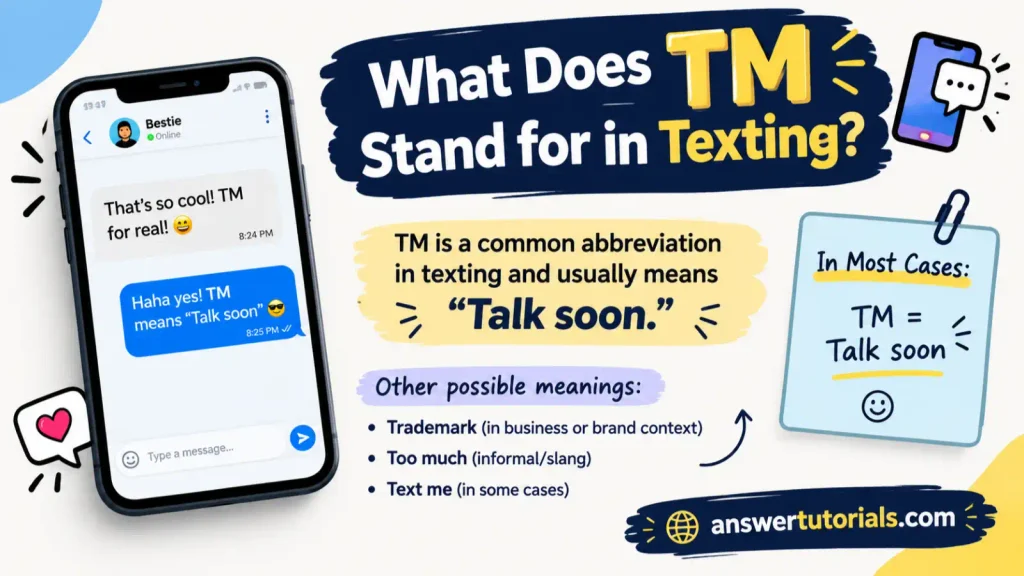
In everyday texting, TM most commonly stands for “tomorrow.”
People shorten words because texting is fast and informal. Instead of typing:
“I’ll talk to you tomorrow.”
someone might write:
“I’ll talk to you tm.”
This usage is especially common when the meaning is obvious from the sentence.
Common examples
- “Can we talk tm?” → Can we talk tomorrow?
- “I’ll see you tm.” → I’ll see you tomorrow.
- “Are you free tm?” → Are you free tomorrow?
- “Let’s finish it tm.” → Let’s finish it tomorrow.
- “I’m busy today, maybe tm.” → Maybe tomorrow.
The abbreviation is generally casual, so it fits better in texts, DMs, and informal chats than in formal emails or professional documents.
TM Can Mean “Tomorrow” 🗓️
The “tomorrow” meaning is one of the easiest ways to understand TM.
People frequently use short forms for days and time-related words when chatting. Depending on the person, you might see tm, tmmrw, or simply tomorrow.
For example:
Person A: Are you coming to the party?
Person B: Nah, I have work tm. 😭
Here, tm clearly means tomorrow.
Another example:
“I’ll send you the details tm morning.”
This means:
“I’ll send you the details tomorrow morning.”
Why do people use TM for tomorrow?
There are several practical reasons:
- It is shorter to type.
- The meaning is usually obvious.
- It keeps conversations quick and casual.
- It works well on phones.
- Friends often understand it without explanation.
However, not everyone uses TM this way. Some people prefer writing the complete word tomorrow, especially in professional conversations.
TM Can Also Mean “Text Message” 💬
Another possible meaning of TM is “text message.”
This interpretation is less universal than “tomorrow,” so you should look at the sentence carefully.
For example:
“Did you receive my tm?”
Someone could mean:
“Did you receive my text message?”
Similarly:
“I sent you a tm earlier.”
This could mean:
“I sent you a text message earlier.”
However, many people simply say “text” rather than “TM” when referring to a text message.
That means you should not automatically assume TM means “text message.” Look at what the sentence is discussing.
Quick comparison
“I’ll see you tm.”
→ Most likely tomorrow
“Did you get my tm?”
→ Could mean text message
The words surrounding the abbreviation provide the strongest clue. 🧩
TM Meaning as “Trademark” ™️
You may also encounter TM outside ordinary texting.
In branding and business, TM commonly refers to “trademark.”
You may see it written as:
BrandName™
The symbol indicates that someone is claiming a trademark or using a name, phrase, logo, or other branding element as a trademark.
This is different from the casual texting abbreviation.
For example:
“We are launching our new brand, BrightBox™.”
Here, TM does not mean tomorrow. It refers to trademark.
You might also see someone jokingly add ™ to a phrase:
“Professional Overthinker™”
In casual online culture, people sometimes use the trademark symbol humorously to suggest that a phrase, personality trait, or idea is their “official brand.”
So if you see TM immediately after a name or phrase, especially as ™, think trademark rather than tomorrow.
How Context Changes the Meaning of TM 🧠
Context is the most important part of interpreting TM meaning in text.
Consider these three messages:
| Message | Likely Meaning |
|---|---|
| “See you tm.” | Tomorrow |
| “Did you get my tm?” | Text message |
| “Cool idea™” | Trademark/humorous branding |
The abbreviation itself does not always tell you enough.
Ask yourself:
- What is the conversation about?
- Where does TM appear in the sentence?
- Is it being used with a time or date?
- Is it attached to a brand or phrase?
- Does replacing TM with “tomorrow” make sense?
This simple approach usually makes the intended meaning clear.
Examples of TM in Text Conversations 💬
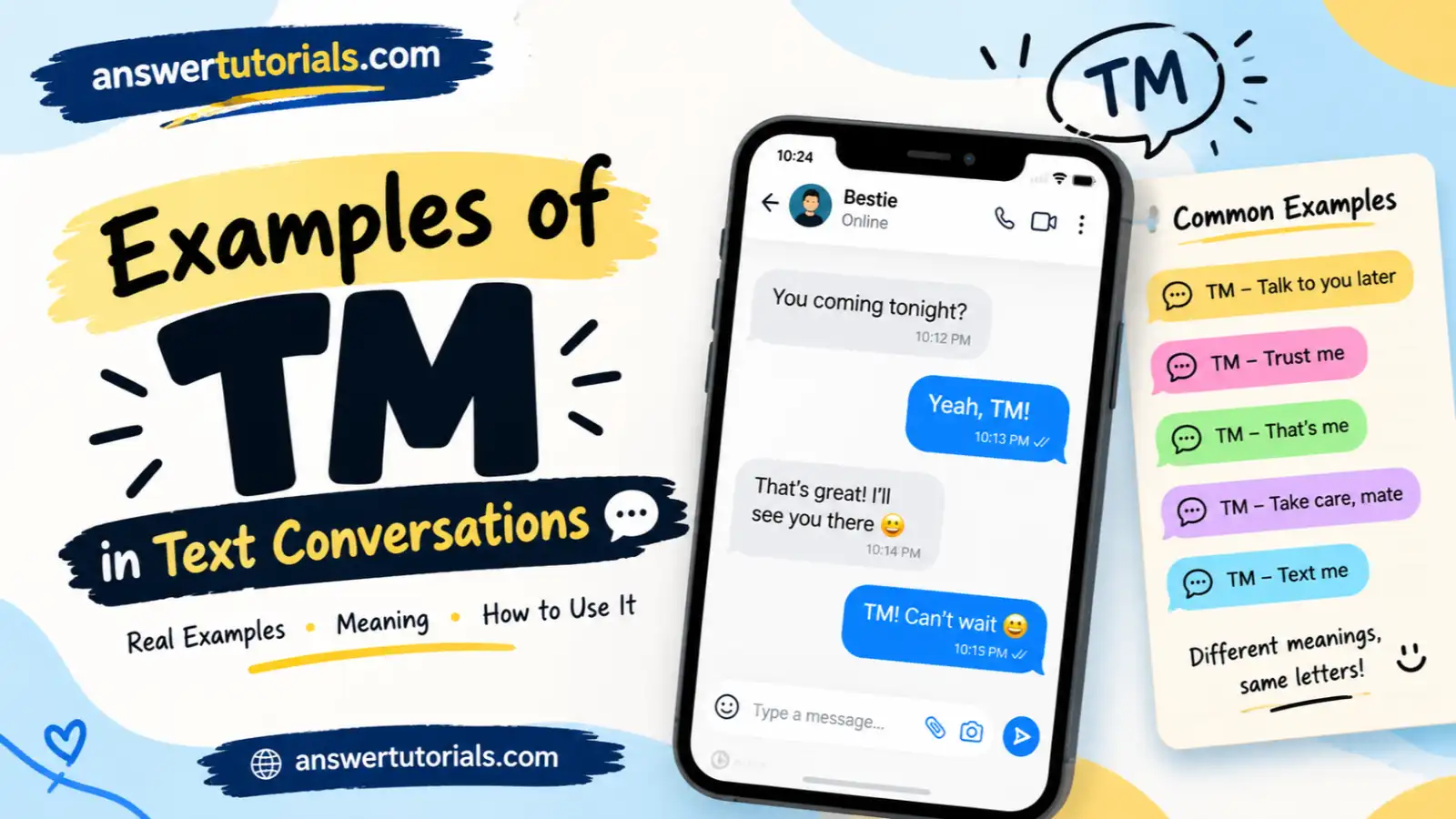
Seeing real examples makes abbreviations much easier to understand.
Example 1: Making Plans
Alex: Are you free tonight?
Sam: Nope, but I’m free tm.
Meaning:
Sam is saying they are free tomorrow.
Example 2: Planning a Call
Alex: Can we talk about the project?
Sam: Sure, call me tm.
Meaning:
“Call me tomorrow.”
Example 3: School Conversation
Alex: Did you finish the assignment?
Sam: Not yet. I’ll do it tm.
Meaning:
“I’ll do it tomorrow.”
Example 4: Talking About a Message
Alex: Did you send me anything?
Sam: Yeah, I sent a tm earlier.
Meaning:
Here, TM may mean text message.
Example 5: Branding
Alex: What is that symbol after the name?
Sam: It’s TM. It means trademark.
Meaning:
TM refers to trademark, not tomorrow.
Example 6: Casual Humor
“Late Again™”
Here, the trademark symbol is being used humorously. The person is treating “Late Again” like a fictional personal brand.
TM vs. Other Texting Abbreviations 📱
TM is just one of many abbreviations used in digital communication.
Understanding similar abbreviations can help you recognize the pattern.
| Abbreviation | Common Meaning |
|---|---|
| TM | Tomorrow |
| TMRW | Tomorrow |
| TMR | Tomorrow |
| BTW | By the way |
| IDK | I don’t know |
| IMO | In my opinion |
| TBH | To be honest |
| FYI | For your information |
| TTYL | Talk to you later |
| BRB | Be right back |
| LMK | Let me know |
Not every abbreviation has one fixed meaning. TM is a good example of why context matters.
The Origin of TM as a Texting Abbreviation 🕰️
The casual use of TM for “tomorrow” comes from the broader habit of shortening words in fast communication.
Long before modern messaging apps, people used abbreviations in notes, personal messages, calendars, and informal writing. As texting became popular, people naturally developed shorter forms that were quick to type.
Mobile phones made this habit even more noticeable.
Instead of typing a complete sentence, people began using compact forms such as:
- tm for tomorrow
- pls for please
- thx for thanks
- msg for message
- u for you
Modern messaging has changed significantly, but the basic idea remains the same: save time while keeping the meaning understandable.
The important distinction is that TM does not have one single origin or universal definition in texting. Its meaning developed through informal digital communication, while the abbreviation TM has also long existed independently as a symbol for trademark.
When Should You Use TM in a Text? 👍
Using TM is generally appropriate when the conversation is casual.
You can use it with:
- Friends
- Family
- Close classmates
- Casual group chats
- Informal DMs
- People who already use texting abbreviations
For example:
“I’ll send it tm.”
This sounds natural in a casual conversation.
However, there are situations where writing “tomorrow” is clearer.
Avoid TM when:
- Writing a formal email
- Communicating with a client
- Sending an important business message
- Writing an application
- Communicating with someone who may not understand abbreviations
- Giving official instructions
Instead of:
“I’ll send the report tm.”
a professional message would usually be clearer as:
“I’ll send the report tomorrow.”
Clarity matters more than saving a few keystrokes. ✍️
How to Reply When Someone Uses TM 💬
If someone sends a message containing TM, you usually do not need to mention the abbreviation itself.
Simply respond to the intended meaning.
For example:
Them: “Can we meet tm?”
You: “Sure! What time?”
Or:
Them: “I’ll send it tm.”
You: “Sounds good.”
If you’re unsure what they mean, ask naturally:
“Do you mean tomorrow?”
That is better than guessing when the message could have multiple meanings.
If you want a casual reply
You can say:
- “Sure, tm works!”
- “Yep, see you tm 😊”
- “Sounds good!”
- “Okay, what time tm?”
- “No problem, talk tomorrow!”
The best response depends on the conversation and your relationship with the person.
Common Mistakes About TM Meaning ❌
Because TM has multiple interpretations, people sometimes misunderstand it.
Mistake 1: Assuming TM always means tomorrow
Not necessarily.
If someone says:
“Did you get my TM?”
they could be referring to a text message.
Mistake 2: Confusing TM with the trademark symbol
TM and ™ can be related, but they are not necessarily being used in the same way.
In a message such as:
“See you tm.”
the lowercase abbreviation probably means tomorrow.
In:
“MyBrand™”
the symbol refers to trademark.
Mistake 3: Using TM in every situation
Text abbreviations are not appropriate for every audience.
A professional reader may prefer:
“tomorrow”
rather than:
“tm.”
Mistake 4: Ignoring sentence context
Never interpret an abbreviation in isolation when the sentence provides clues.
The surrounding words usually reveal the intended meaning.
TM in Social Media and Online Chats 🌐
You may encounter TM on platforms such as messaging apps, social networks, gaming chats, and online communities.
The meaning can change depending on the platform and community.
For example:
“You joining tm?”
Most likely means:
“Are you joining tomorrow?”
But:
“Did you see my tm?”
could refer to a text message.
Online communication also makes playful uses more common.
Someone might write:
“CEO of Procrastination™”
Here, the trademark symbol is being used humorously.
This is one reason digital language can feel confusing: the same abbreviation can function as slang, shorthand, or a formal symbol depending on the context.
TM Meaning in Different Contexts 📊
Here is a simple reference chart:
| Context | Possible Meaning of TM | Example |
|---|---|---|
| Casual texting | Tomorrow | “See you tm.” |
| Planning | Tomorrow | “Can we meet tm?” |
| Personal messages | Text message | “Did you get my tm?” |
| Business/branding | Trademark | “BrandName™” |
| Humor/memes | Trademark-style joke | “Snack Expert™” |
| Work/group chat | Context-dependent | “Ask the tm.” |
The most important takeaway is simple:
Read the whole sentence before deciding what TM means.
Is TM a Formal or Informal Abbreviation? 📝
When TM means “tomorrow,” it is generally an informal texting abbreviation.
It works well in quick conversations but is less suitable for formal writing.
For example:
Casual:
“I’ll see you tm.”
More formal:
“I’ll see you tomorrow.”
Both communicate the same basic idea, but the second version is more appropriate in professional communication.
Meanwhile, TM as a trademark designation belongs to a completely different context.
So, whether TM is appropriate depends on what you mean and who you are communicating with.
Quick Ways to Identify What TM Means 🧩
When you see TM in a message, use these clues.
1. Look for time-related words
If the message mentions:
- today
- tonight
- morning
- afternoon
- later
- meeting
- call
- see you
then TM probably means tomorrow.
2. Look at the position
If TM appears after a brand or phrase, especially as ™, it likely means trademark.
3. Look at the verb
Consider:
“I’ll call you tm.”
The phrase naturally points toward tomorrow.
But:
“I sent a tm.”
could point toward text message.
4. Consider the relationship
Friends often use informal abbreviations freely. Professional communication usually uses clearer language.
5. Ask if necessary
If there is genuine ambiguity, asking is perfectly normal.
“What do you mean by TM here?”
A quick clarification can prevent an unnecessary misunderstanding. 😊
FAQs:❓
What does TM mean in text?
TM most commonly means “tomorrow” in casual texting. However, it can also mean “text message” or “trademark,” depending on context.
Does TM mean tomorrow in texting?
Yes. TM can be used as a short form of “tomorrow.” For example, “See you tm” means “See you tomorrow.”
What does TM mean on social media?
On social media, TM can have several meanings, including “tomorrow” and “text message.” If it appears as ™, it usually refers to a trademark.
Is TM slang?
When TM is used to mean “tomorrow,” it is generally considered an informal texting abbreviation rather than formal English.
Should I use TM in professional messages?
Usually, writing “tomorrow” is clearer in professional communication. TM is better suited to casual conversations where the recipient understands the abbreviation.
Final Thoughts 💡
So, what does TM mean in text? In most casual conversations, TM means “tomorrow.” It is a convenient abbreviation people use when discussing plans, calls, appointments, school, work, or other future activities.
However, TM can have multiple meanings. It may also refer to a text message, while ™ commonly represents a trademark.
The best way to understand TM is to look at the complete sentence and conversation context.
Remember these simple examples:
“See you tm.” → Tomorrow
“Did you get my tm?” → Possibly text message
“BrandName™” → Trademark
When in doubt, don’t guess. Check the context or ask the person what they mean. That small step can make digital conversations much clearer. 📱✨

Ayan Zaman is a content writer and researcher at answertutorials.com, specializing in text meanings, slang, abbreviations, and everyday communication. He creates clear, practical, and easy-to-understand guides to help readers communicate with confidence. His content focuses on accurate explanations, real-world examples, and useful answers for modern digital conversations.