
When someone suddenly types “TB” in a text, it can leave you wondering what they actually mean. Is it an abbreviation for “throwback,” “text back,” “to be,” or something completely different? 🤔
The tricky part is that TB meaning in text depends heavily on context. Unlike some texting abbreviations that have one widely accepted definition, TB can represent different phrases in conversations, captions, comments, and social media posts.
That is why understanding the sentence around TB matters more than memorizing one definition.
In this guide, you’ll learn the most common meanings of TB in text, how people use it, what it can mean on social media, and how to respond when you’re unsure. 💬
What Does TB Mean in Text? 💡
The most common meaning of TB in text is “throwback.” People often use it when talking about an old memory, photograph, event, conversation, or experience.
For example:
“TB to our first trip together!”
Here, TB means “throwback.” The person is referring to something from the past.
However, TB can have other meanings depending on the conversation. In some contexts, someone may use it as an abbreviation for “text back,” while in other situations it may have a completely different meaning.
TB at a Glance
| TB Meaning | Common Context | Example |
|---|---|---|
| Throwback | Memories, photos, social media | “TB to summer!” |
| Text back | Casual messaging | “TB when you get home.” |
| To be | Informal shorthand | “What do you want TB?” |
| Tuberculosis | Health or medical context | “The doctor tested for TB.” |
| Terabyte | Technology | “The drive has 2 TB.” |
The conversation itself determines the intended meaning.
TB Meaning as “Throwback” 📸
One of the most familiar uses of TB is “throwback.”
A throwback refers to something from the past that someone is remembering, sharing, or revisiting.
You might see TB in:
- Old photos
- Childhood memories
- Vacation pictures
- Previous events
- Old friendships
- Nostalgic social media posts
- Memories from school or university
- Previous relationships or experiences
For example:
“TB to our school days 😂”
The person is looking back at their school days.
Another example:
“TB to that amazing holiday!”
Here, TB introduces a memory from a previous holiday.
Why People Use “TB”
Using an abbreviation makes a caption or message shorter and more casual.
Instead of writing:
“This is a throwback to our holiday last year.”
Someone might simply write:
“TB to last year’s holiday 🌴”
This style is especially common in casual online communication.
TB Meaning in Social Media 📱
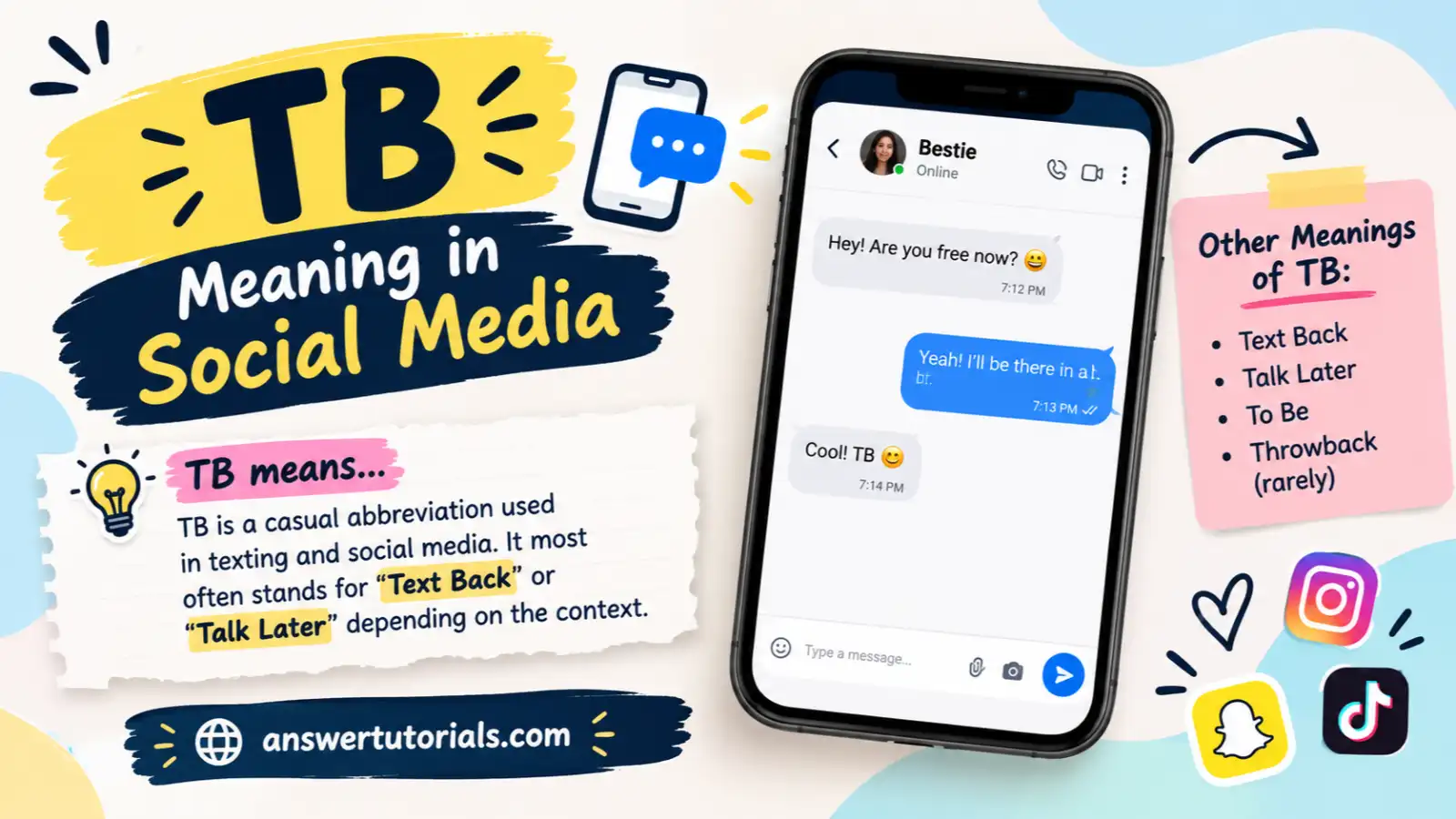
On social media, TB often relates to old memories or throwback content.
Someone might post an older picture and add:
“TB ❤️”
The idea is simple: the person is revisiting a moment from the past.
You may also see combinations such as:
- TB to 2019
- TB to college
- TB to summer
- TB to the good old days
- TB with my best friend
- TB from our vacation
The exact wording changes, but the underlying idea is usually the same: remembering or sharing something from the past.
TB and Nostalgia
The word throwback often carries a nostalgic feeling.
For example:
“TB to when everything was simpler.”
This isn’t simply identifying an old event. It also communicates an emotional connection to that memory.
That is why TB can appear alongside emojis such as:
- ❤️
- 😂
- 🥹
- 🥰
- 😭
- 📸
- ✨
The emoji can provide additional clues about the writer’s mood.
TB Can Mean “Text Back” 💬
Another possible meaning of TB is “text back.”
This interpretation is more dependent on sentence structure.
For example:
“TB when you’re free.”
In this context, the person may be asking you to text back when you have time.
Another example could be:
“TB later.”
If the surrounding conversation is clearly about replying to messages, TB may refer to texting back.
However, this usage is less universally understood than “throwback.” That’s important because abbreviations can vary between friend groups and online communities.
How to Recognize This Meaning
Look at what surrounds TB.
If the message is about:
- Replying
- Calling
- Messaging
- Getting back to someone
- Being available
then “text back” may make more sense.
If the message is about:
- Old photos
- Memories
- Past events
- Previous experiences
then “throwback” is more likely.
TB Meaning in Different Contexts 🧠
Context is the key to understanding TB meaning in text.
Consider these examples:
| Message | Likely Meaning |
|---|---|
| “TB to our beach trip!” | Throwback |
| “TB when you get home.” | Text back |
| “This TB photo is hilarious.” | Throwback |
| “The storage is 2 TB.” | Terabyte |
| “The doctor mentioned TB testing.” | Tuberculosis |
The same two letters can represent completely different things.
This is why looking only at the abbreviation can be misleading.
A Simple Context Test
Ask yourself:
“What is this conversation about?”
If the topic is memories, TB probably means throwback.
The topic is replying to messages, TB could mean text back.
If the topic is computers or storage, TB probably means terabyte.
The conversation is medical, TB could refer to tuberculosis.
Context acts like a decoder. 🔎
TB Meaning in Texting Conversations 💬
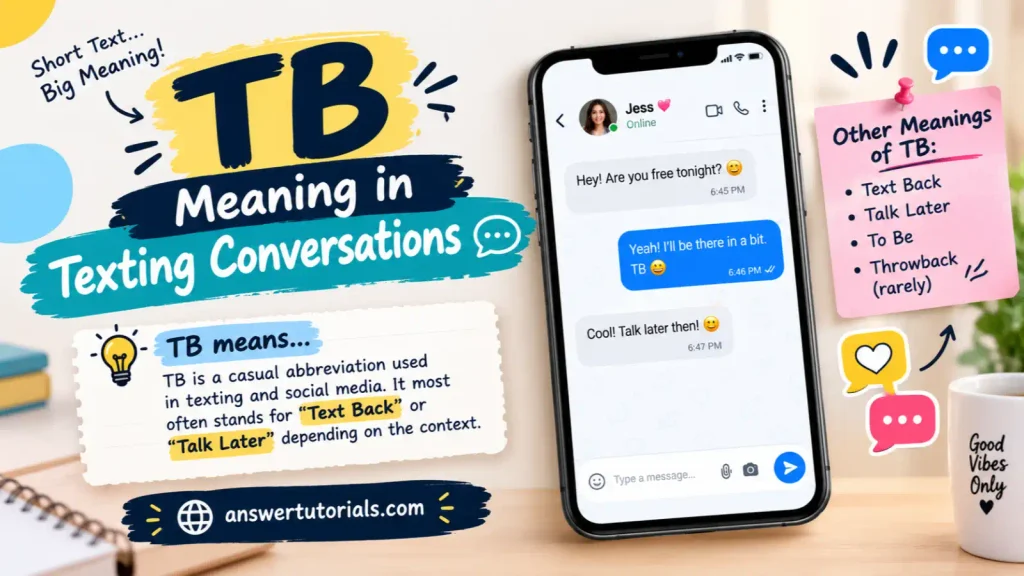
Let’s look at realistic texting examples.
Example 1: Talking About Memories
Alex: “Found this old picture of us.”
Sam: “OMG 😂 TB!”
Here, TB most naturally refers to a throwback.
Example 2: Asking Someone to Reply
Alex: “I have to go for a bit.”
Sam: “Okay, TB when you’re free.”
Here, TB can mean text back.
Example 3: Sharing an Old Photo
Alex: “TB to our graduation day 🎓”
Sam: “Those were good times!”
Again, TB means throwback.
Example 4: Technology
Alex: “How much storage does your laptop have?”
Sam: “1 TB.”
Here, TB means terabyte, a unit of digital storage.
Example 5: Medical Conversation
Alex: “What does TB stand for?”
Sam: “It can refer to tuberculosis.”
In a health-related discussion, the context changes the meaning completely.
TB Meaning in Text vs. TB Meaning Online 🌐
Texting and social media overlap, but people don’t always use abbreviations in exactly the same way.
In a private chat, TB might appear as part of a sentence:
“TB when you get there.”
On social media, it may appear as a caption:
“TB to 2018 📸”
The surrounding language gives you an important clue.
Private Messages
Private texts often use abbreviations to save time.
People may shorten phrases because both participants already understand the conversation.
Social Media Posts
Social media users often use short forms to make captions brief and recognizable.
That’s why TB can appear alongside dates, locations, memories, and photos.
Is TB Slang or an Abbreviation? 🤔
TB is better understood as an abbreviation rather than one specific slang word.
Its meaning changes according to the context.
For example, “throwback” is a normal English word, while TB is a shortened form used in casual digital communication.
Likewise, terabyte is a technical term, while TB is its standard abbreviation.
This distinction matters because not every use of TB should be considered internet slang.
Casual vs. Formal Usage
TB is common in:
- Text messages
- Social media
- Casual chats
- Captions
- Online conversations
But you should generally avoid ambiguous texting abbreviations in formal communication.
For example, instead of writing:
“TB when possible.”
in a professional email, it would be clearer to write:
“Please text me back when possible.”
Clear language reduces confusion. 👍
How to Know Which TB Meaning Someone Intended 🔍
When you see TB, don’t immediately assume one meaning.
Use these five clues.
1. Look at the Topic
What are you discussing?
A photo suggests throwback.
A reply suggests text back.
A hard drive suggests terabyte.
A medical conversation suggests tuberculosis.
2. Read the Entire Sentence
Never interpret an abbreviation by itself when context is available.
Compare:
“TB to our old photos.”
with:
“TB when you’re done.”
They clearly point toward different meanings.
3. Check for Dates
Dates can strongly suggest a throwback.
For example:
“TB to 2017.”
That’s almost certainly referring to something from the past.
4. Look for Related Words
Words such as photo, memory, old, years ago, school, vacation, childhood, and yesterday can suggest a throwback.
Words such as reply, message, later, free, call, and home can suggest texting back.
5. Ask If You’re Still Unsure
There is nothing wrong with asking.
You can simply say:
“TB as in throwback?”
That’s often better than guessing.
Common Examples of TB in Text 📲
Here are more examples to help you understand how the abbreviation works.
Throwback Examples
“TB to my favourite summer.”
“TB to our college days 🎓.”
“TB with my best friend.”
“TB to this beautiful place.”
“TB when we had no responsibilities 😂.”
In each example, TB refers to a memory or moment from the past.
Text Back Examples
“TB when you get home.”
“TB when you’re available.”
“TB after work.”
In these examples, the surrounding wording makes the intended interpretation clearer.
Technology Examples
“I bought a 2 TB drive.”
“My computer has 1 TB of storage.”
Here, TB means terabyte.
Common Mistakes When Interpreting TB ⚠️
One common mistake is assuming that TB always means throwback.
That’s understandable because throwback is a familiar social-media use. However, the same abbreviation can mean different things.
Another mistake is ignoring the subject of the conversation.
For example, if someone says:
“The external drive is 4 TB.”
there is no reason to interpret TB as “throwback.”
Likewise, if someone writes:
“TB to our first trip.”
the technology meaning makes no sense.
The Best Rule
Don’t decode TB by the letters alone. Decode it by the conversation.
That simple habit will help you understand most abbreviation-based messages.
TB vs. Similar Text Abbreviations 📚
Many texting abbreviations can look confusing because several of them are used in similar casual situations.
Here is a quick comparison:
| Abbreviation | Common Meaning | Typical Use |
|---|---|---|
| TB | Throwback | Memories |
| TBT | Throwback Thursday | Social media memories |
| TBH | To be honest | Personal opinions |
| BRB | Be right back | Temporary absence |
| BTW | By the way | Changing topics |
| TTYL | Talk to you later | Ending a chat |
| IDK | I don’t know | Uncertainty |
| LOL | Laughing out loud | Humor |
One particularly relevant abbreviation is TBT, which is commonly associated with Throwback Thursday.
TB can sometimes function as a shorter reference to a throwback, but TB and TBT are not automatically interchangeable in every situation.
When Should You Use TB? 👍
You can use TB in casual situations when the intended meaning is obvious.
It works particularly well for:
- Instagram-style captions
- Casual texts
- Group chats
- Personal posts
- Conversations with friends
- Nostalgic memories
For example:
“TB to our first road trip 🚗.”
That’s short, natural, and easy to understand.
However, if the recipient might not understand the abbreviation, write the full phrase instead.
When to Avoid TB
Avoid ambiguous abbreviations when:
- Writing professionally
- Communicating with someone unfamiliar with texting slang
- Giving important instructions
- Discussing technical information without context
- Writing formal documents
In those situations, clarity is more valuable than brevity.
How to Respond When Someone Says TB 💬
Your response depends on what the person means.
If TB Means Throwback
You could reply:
- “Aww, I remember that day!”
- “That brings back memories!”
- “Wow, we looked so young 😂.”
- “Such a good memory!”
- “Those were the days!”
If TB Means Text Back
You can simply respond:
- “Sure, I will.”
- “Okay, I’ll text you later.”
- “No problem!”
- “I’ll message you when I’m free.”
If You’re Unsure
Try:
“Do you mean throwback?”
or:
“What do you mean by TB here?”
A quick clarification can prevent an awkward misunderstanding.
Why Context Matters So Much in Texting 🧩
Digital communication removes many clues we normally use when talking face-to-face.
You cannot always hear someone’s tone of voice. May not see their facial expression. You may only have a few words on your screen.
That makes abbreviations particularly dependent on context.
For example:
“TB 😂”
could mean something completely different from:
“TB when you arrive.”
The first may point toward a memory. The second may suggest a request to text back.
This is one reason contextual reading is more reliable than dictionary-style interpretation when you’re decoding texting abbreviations.
FAQs:❓
What does TB mean in text?
TB most commonly means “throwback” in casual texting and social media, especially when someone is talking about an old memory, photo, or event. In other contexts, TB can mean something else.
Does TB mean “text back”?
Yes, TB can be used to mean “text back” in some casual conversations. The sentence and surrounding discussion determine whether this interpretation makes sense.
What does TB mean on social media?
On social media, TB often refers to “throwback.” It may appear with old photos, memories, dates, or posts about past experiences.
What does TB mean in technology?
In technology, TB commonly means “terabyte,” a unit used to describe digital storage capacity. For example, a device might have 1 TB or 2 TB of storage.
Is TB the same as TBT?
Not exactly. TBT commonly means “Throwback Thursday,” while TB can simply refer to a throwback. The two abbreviations are related but aren’t identical.
Final Thoughts 📝
Understanding TB meaning in text is mostly about reading the context rather than memorizing a single definition.
In casual messages and social media, TB often means “throwback,” especially when someone shares an old photo, memory, or experience. In some conversations, it can mean “text back.” Outside casual texting, TB can also refer to terms such as terabyte or tuberculosis.
The easiest way to interpret TB is to look at the words around it, identify the topic, and consider what the person is discussing.
When you’re unsure, don’t guess. A simple question can quickly clarify the intended meaning. 💬
Key takeaway: TB doesn’t have one universal meaning. Context is the key to understanding what TB means in a text message, caption, or online conversation.

Ayan Zaman is a content writer and researcher at answertutorials.com, specializing in text meanings, slang, abbreviations, and everyday communication. He creates clear, practical, and easy-to-understand guides to help readers communicate with confidence. His content focuses on accurate explanations, real-world examples, and useful answers for modern digital conversations.