

When someone sends you “mb” in a text, it can leave you wondering what they actually mean. Is it an apology? A quick way to say they made a mistake? Or does it mean something completely different? 🤔
In most casual texting conversations, “mb” means “my bad.” People use it as a short, informal apology when they make a mistake, misunderstand something, forget something, or send the wrong message.
For example, if a friend texts, “mb, I thought you said Friday,” they are simply saying, “My bad, I thought you said Friday.”
However, context matters. MB can have other meanings outside everyday texting, so understanding the conversation around it is important.
This guide explains mb meaning in text, where it comes from, how people use it, what it sounds like in different situations, and how you can respond. 💬
What Does MB Mean in Text? 📲
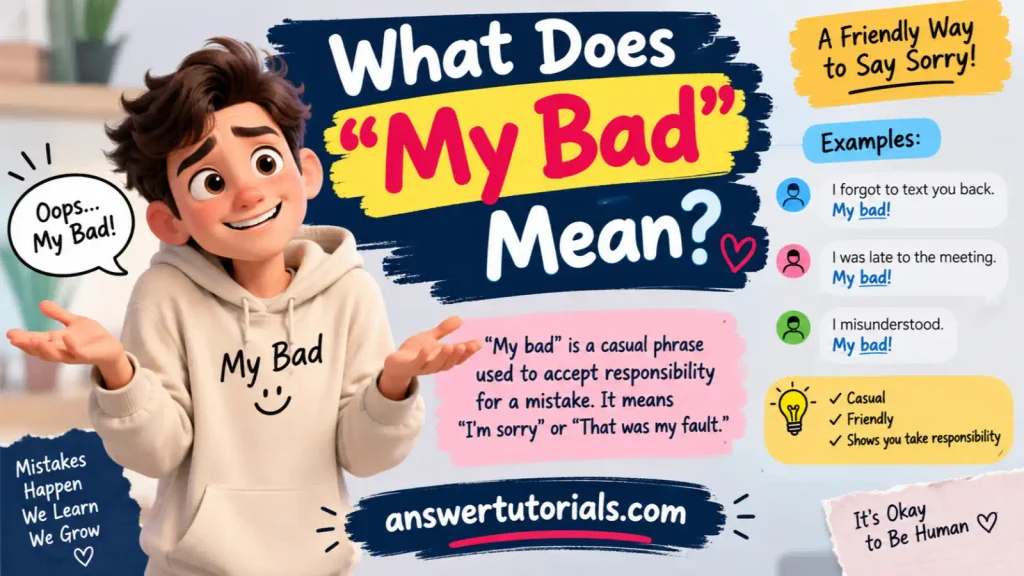
The most common mb meaning in text is “my bad.”
It is an informal expression people use to acknowledge a small mistake or take responsibility for something.
Think of “mb” as a quick digital version of:
- My bad
- Sorry
- Oops, that was my mistake
- I messed up
- I misunderstood
- That one’s on me
Simple example
Person A: You were supposed to send that yesterday.
Person B: mb 😭
Here, “mb” means “my bad.”
It usually has a casual and friendly tone. People often use it with friends, family members, classmates, gaming friends, or people they communicate with informally.
Quick answer: In texting, MB usually means “my bad,” especially when someone is admitting a small mistake.
What Does “My Bad” Mean? 🫶
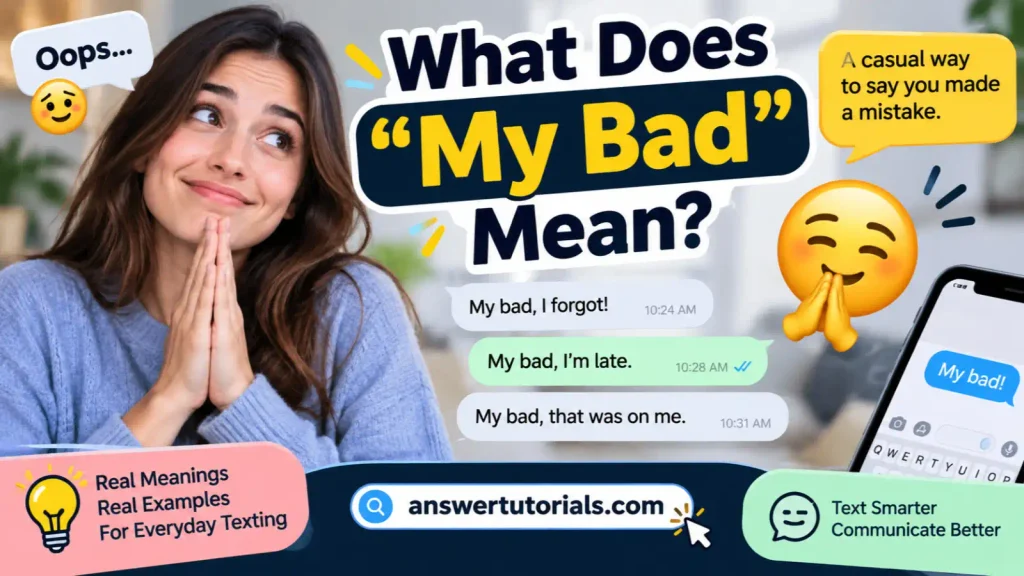
To understand MB, it helps to understand the phrase “my bad.”
“My bad” is an informal way of accepting responsibility for a mistake. It is usually lighter and less formal than saying “I sincerely apologize.”
For example:
“My bad, I forgot to call you.”
This means:
“I’m sorry. I forgot to call you.”
When shortened to MB, the message becomes even quicker:
“mb, forgot to call.”
This style works especially well in fast-moving conversations where people do not want to type complete sentences.
The phrase can also soften a conversation. Instead of giving a long explanation, someone can quickly acknowledge the problem and move forward.
Why Do People Use MB in Texting? 💬
Texting has created a communication style built around speed, convenience, and brevity.
People often shorten familiar phrases because typing three or four words feels unnecessary when a two-letter abbreviation communicates the same idea.
There are several reasons someone might type MB:
1. They want to apologize quickly
If someone realizes they made a mistake, “mb” lets them acknowledge it immediately.
Example:
“mb, I sent the wrong screenshot.”
2. They want to keep the conversation casual
“My bad” already sounds informal. MB makes it even more relaxed.
Example:
“mb 😂 I totally forgot.”
3. They made a small mistake
MB is generally associated with minor mistakes, rather than serious situations.
For example:
- Forgetting an appointment reminder
- Misreading a message
- Sending the wrong photo
- Getting someone’s name wrong
- Misunderstanding a plan
- Replying to the wrong person
4. They are texting quickly
Short abbreviations are common when someone is busy, gaming, commuting, or having a rapid conversation.
MB Meaning in Different Texting Contexts 🔍
The exact feeling behind MB can change depending on the situation.
The basic meaning usually remains “my bad,” but the emotional tone can vary.
| Text | Likely Meaning | Tone |
|---|---|---|
| “mb” | My bad | Casual |
| “mb lol” | My bad | Playful |
| “mb 😭” | My bad | Embarrassed/funny |
| “mb, I forgot” | My bad | Apologetic |
| “oh mb” | Oh, my bad | Corrective |
| “mb bro” | My bad, bro | Friendly |
| “MB” | My bad | Context-dependent |
| “my bad” | My mistake | More explicit |
Example 1: Forgetting something
Them: You said you’d call me tonight.
You: mb, I got caught up with work.
The speaker is apologizing for forgetting.
Example 2: Misunderstanding
Them: I meant next Saturday.
You: Oh mb 😭
Here, MB means “Oh, my bad.”
Example 3: Sending something accidentally
Them: Was that message for me?
You: mb wrong chat 💀
The person admits they sent the message to the wrong conversation.
Is MB Always an Apology? 🤔
Not necessarily.
Although “my bad” is the dominant interpretation in casual texting, the meaning depends on the context.
Sometimes someone uses MB almost automatically after being corrected. In those cases, it can mean:
“Okay, I understand. I was mistaken.”
It may not represent a serious apology.
For example:
Friend: The movie starts at 8, not 9.
You: mb.
That response simply acknowledges the mistake.
On the other hand:
Friend: You really hurt my feelings yesterday.
You: mb.
This could sound too casual because the situation is more serious.
In an emotionally sensitive conversation, a full apology is usually more appropriate than a two-letter abbreviation.
Other Meanings of MB You Should Know 🧠
While “my bad” is the most common interpretation in casual texting, MB can represent other things in different contexts.
This is why you should avoid assuming that every use of MB means the same thing.
Megabyte
In technology, MB commonly means megabyte, a unit used to describe digital data.
For example:
“The file is 25 MB.”
Here, MB has nothing to do with “my bad.”
Manitoba
In geographical contexts, MB can be an abbreviation for Manitoba, a Canadian province.
For example, someone discussing an address or location might use MB as a regional abbreviation.
Other specialized meanings
Depending on the industry, community, game, platform, or conversation, MB can have other meanings.
However, if you’re talking about casual texting or social media, “my bad” is usually the first meaning to consider.
How to Tell What MB Means From Context 🕵️
Context is the easiest way to determine what someone means.
Ask yourself what happened immediately before “mb.”
If they made a mistake
“mb, I read that wrong.”
➡️ It means my bad.
If they are discussing file sizes
“The video is 100 MB.”
➡️ It means megabytes.
If they are talking about a place
“She lives in MB.”
➡️ It may refer to Manitoba, depending on the conversation.
If they are correcting themselves
“Wait, wrong date. MB.”
➡️ It almost certainly means my bad.
A useful rule is:
Look at the words around the abbreviation before deciding what it means.
The same two letters can mean very different things in different conversations.
MB Meaning on Snapchat, Instagram, TikTok & Other Apps 📱
People use MB across many messaging and social platforms.
You may see it in:
- Text messages
- Instagram DMs
- Snapchat
- TikTok messages
- Facebook Messenger
- Discord
- Gaming chats
- Group chats
The platform usually does not change the basic meaning.
For example:
Instagram DM:
“mb I didn’t see your message.”
Snapchat:
“mb 😭 sent that to the wrong person.”
Discord:
“mb, I misunderstood the rules.”
WhatsApp:
“mb, running late.”
In each example, MB means “my bad.”
The informal nature of these platforms makes short expressions particularly common.
MB vs. Sorry: What’s the Difference? 🙏
MB and sorry can communicate a similar idea, but they do not always feel identical.
“Sorry” can work in casual and serious situations.
“My bad” is usually more relaxed.
Compare these:
“Sorry I forgot.”
This sounds straightforward and apologetic.
“mb I forgot.”
This sounds casual and conversational.
“I sincerely apologize for forgetting.”
This sounds formal and serious.
That difference matters.
If you’re talking to a close friend about a tiny mistake, MB may be perfect.
If you made a serious mistake at work, MB could sound careless or unprofessional.
Quick comparison
| Expression | Typical Tone | Best Used For |
|---|---|---|
| MB | Very casual | Small mistakes |
| My bad | Casual | Everyday apologies |
| Sorry | Neutral | Most situations |
| I apologize | Formal | Professional or serious situations |
| I’m really sorry | Sincere | Emotional situations |
How to Respond When Someone Says MB 💬
Your response should depend on the situation.
If the mistake is minor, you don’t need to make the conversation complicated.
Casual responses
- No worries!
- All good.
- You’re good.
- No problem.
- It’s fine 😂
- Haha, you’re good.
- Don’t worry about it.
Friendly responses
- You’re totally fine!
- No stress.
- All good, bro.
- It happens 😂
- We’re good!
- No worries at all.
Playful responses
If you’re joking with a friend, you could say:
- I’ll allow it this time 😂
- You are officially forgiven.
- Fine, you’re off the hook. 😭
- I’ll pretend I didn’t see that.
- Accepted, mistake noted. 😂
When the situation is serious
If someone uses MB after doing something that genuinely upset you, you can respond honestly:
“I appreciate you acknowledging it, but I’d like to talk about what happened.”
That keeps the conversation respectful while making it clear that the issue matters.
When Should You Use MB? ✅
MB works best when the situation is casual and the mistake is relatively small.
You can use it when:
- You misunderstood someone’s message.
- You forgot something minor.
- You sent the wrong information.
- You accidentally interrupted someone.
- You gave the wrong time.
- You sent a message to the wrong chat.
- You made a harmless mistake while gaming.
- You need a quick informal apology.
Example texts
“mb, I thought we were meeting at 7.”
😭Mb, wrong person .”
“mb I forgot to send it.”
“Oh mb, I misunderstood you.”
“mb lol, I wasn’t paying attention.”
These examples show why MB is so popular: it communicates responsibility without making a small mistake sound dramatic.
When Should You Avoid MB? ⚠️
Although MB is useful, it is not suitable for every situation.
Avoid relying on it when the situation requires sincerity, professionalism, or emotional sensitivity.
Professional conversations
Don’t normally write:
“mb, I missed the meeting.”
to a manager or important client.
A better option would be:
“I’m sorry I missed the meeting. I take responsibility and will make sure it doesn’t happen again.”
Serious personal issues
If someone tells you that your actions genuinely hurt them, simply saying “mb” may feel dismissive.
Instead, explain what you are sorry for.
Important commitments
If you miss an important appointment, deadline, or responsibility, a two-letter apology may not be enough.
The key lesson is simple:
The more serious the mistake, the more thoughtful your apology should be.
Is MB Rude or Disrespectful? 😬
MB is not inherently rude.
Its tone depends heavily on context, relationship, and timing.
Among friends, it can sound perfectly normal.
Friend: You forgot my charger.
You: mb 😭
No major issue.
But imagine this:
Person: You ignored me when I needed help.
You: mb.
That response could feel cold or dismissive.
So the problem is not necessarily the abbreviation itself. The issue is whether the level of apology matches the situation.
A useful texting rule
Small mistake + casual relationship = MB can work.
Serious mistake + emotional situation = use a fuller apology.
Is MB Used by Gen Z? 👀
Yes. Short forms like MB fit naturally into modern digital communication, especially among people who frequently communicate through messaging apps, social media, gaming platforms, and group chats.
However, it is not exclusive to one generation.
The important point is that texting language evolves quickly. People often shorten phrases when the meaning is already obvious from context.
Other examples of common texting abbreviations include:
- IDK — I don’t know
- TBH — to be honest
- IMO — in my opinion
- HMU — hit me up
- WYA — where you at
- BTW — by the way
- TTYL — talk to you later
- OMG — oh my God
MB belongs to this broader culture of short-form digital communication.
Where Did MB Come From? 📜
The expression “my bad” existed before modern texting.
It became popular in informal spoken English as a quick way to acknowledge personal responsibility for a mistake. As texting and online communication grew, people began shortening familiar phrases to save time and typing effort.
That naturally led to forms such as:
my bad → MB
Texting culture helped make abbreviations more visible and widespread because conversations often happen quickly and informally.
Unlike some internet abbreviations created specifically for online communities, MB is essentially a shortened form of an already-established casual expression.
Its popularity makes sense because the original phrase is already short and easy to understand.
MB Examples in Real-Life Text Conversations 💡
Seeing the abbreviation inside complete conversations makes its meaning much easier to understand.
Example 1: Wrong time
Alex: I thought you said 6 PM.
Sam: Oh mb, I meant 7.
Meaning: Sam is admitting they communicated incorrectly.
Example 2: Wrong chat
Alex: Did you mean to send that to me?
Sam: MB 💀 wrong chat.
Meaning: Sam accidentally sent the message to the wrong person.
Example 3: Forgetting something
Alex: You didn’t send me the address.
Sam: mb, sending it now.
Meaning: Sam forgot and is correcting the mistake.
Example 4: Gaming
Player 1: You were supposed to cover me!
Player 2: mb, I got distracted.
Meaning: Player 2 admits making a mistake during the game.
Example 5: Misunderstanding
Alex: I said Tuesday, not Thursday.
Sam: Oh mb 😂
Meaning: Sam misunderstood the original information.
Example 6: Playful conversation
Alex: You just stole my fries.
Sam: mb 😌
Here, MB could be playful rather than a serious apology.
Common Mistakes People Make With MB ❌
Understanding an abbreviation is useful, but knowing when not to use it is equally important.
Mistake 1: Using MB in formal emails
Text abbreviations usually don’t belong in professional communication.
Mistake 2: Using MB for serious apologies
If someone is genuinely hurt, a thoughtful response is better.
Mistake 3: Assuming MB always means “my bad”
Always check the surrounding context.
Mistake 4: Overthinking a simple MB
Sometimes “mb” really is just “my bad.”
You don’t need to search for a hidden meaning when the conversation clearly involves a small mistake.
Mistake 5: Treating every abbreviation as slang
Some uses of MB, such as megabyte, are technical rather than slang.
MB Meaning: Quick Cheat Sheet 📝
Here’s a simple reference you can save:
| Question | Answer |
|---|---|
| What does MB mean in text? | Usually “my bad.” |
| Is MB an apology? | Usually, yes, for a small mistake. |
| Is MB formal? | No, it is informal. |
| Can MB mean something else? | Yes, depending on context. |
| Can I use MB with friends? | Yes. |
| Should I use MB in a professional email? | Usually no. |
| Is MB rude? | Not normally, but it can sound dismissive in serious situations. |
| What does MB mean online? | Usually “my bad” in casual conversations. |
FAQs:❓
What does MB mean in text from a girl?
If a girl sends “mb” in a casual conversation, it usually means “my bad.” She may be acknowledging a small mistake, misunderstanding, or accidental action. The exact emotional tone depends on the conversation.
What does MB mean from a guy?
The meaning is generally the same. MB usually means “my bad.” A guy might use it after forgetting something, misunderstanding you, or making a minor mistake.
Does MB mean sorry?
Usually, yes. MB is an informal way to acknowledge a mistake and can function like “sorry” in casual texting. However, it tends to sound more relaxed than a sincere or formal apology.
Is MB the same as my bad?
Yes. In casual texting, MB is commonly an abbreviation for “my bad.”
What does MB mean on social media?
On social media, MB commonly means “my bad” when someone is acknowledging a mistake. However, other meanings are possible, so context should always be considered.
Final Thoughts 💭
Understanding mb meaning in text is simple once you recognize the context. In most casual conversations, MB means “my bad.” It is a quick, informal way to admit a small mistake, correct yourself, or apologize without making the conversation overly serious.
You might see it after someone forgets something, sends the wrong message, misunderstands a plan, or gives incorrect information. Emojis such as 😂, 😭, 💀, or 😅 can make the message feel even more playful.
Still, context matters. MB can have other meanings, especially in technical or geographical conversations. And while “my bad” works well for minor mistakes, it may not be enough when someone is genuinely hurt or when you’re communicating professionally.
So, the next time someone texts “mb,” don’t panic or overanalyze it. If the conversation is casual and someone has just made a small mistake, they are probably saying:
“My bad.” 💬

Ayan Zaman is a content writer and researcher at answertutorials.com, specializing in text meanings, slang, abbreviations, and everyday communication. He creates clear, practical, and easy-to-understand guides to help readers communicate with confidence. His content focuses on accurate explanations, real-world examples, and useful answers for modern digital conversations.