

JS meaning in text is most commonly “just saying.” People use JS in texts, chats, comments, and social media to share an opinion or observation without making it sound like a strong demand. For example, someone might text, “JS, you could have told me earlier,” meaning “Just saying, you could have told me earlier.”
But context matters. JS can have different meanings depending on the conversation, the people involved, and the platform. In technology-related conversations, JS often means JavaScript, while in casual texting it commonly means “just saying.”
If you received a message containing “JS” and wondered whether the person was being friendly, sarcastic, defensive, or simply making a comment, you are not alone. A tiny abbreviation can completely change the tone of a message. 😅
This guide explains JS meaning in text, where it comes from, how people use it, what it means in different situations, and how you can respond naturally.
What Does JS Mean in Text? 💬
In everyday texting, JS usually means “just saying.”
It is often added before or after a statement to soften the speaker’s tone. It can suggest that the person is expressing an opinion without necessarily trying to start an argument.
Quick meaning
JS = Just Saying
For example:
- “JS, that movie was way too long.”
- “You could’ve called me, JS.”
- “JS, I think you’re overthinking it.”
- “That outfit looks great, JS!”
- “JS, maybe we should leave earlier next time.”
The abbreviation allows people to make a comment quickly without typing the complete phrase.
However, “just saying” does not always make a message sound neutral. Depending on the wording, it can sound playful, sarcastic, critical, supportive, or slightly passive-aggressive.
JS Meaning in Text at a Glance 🔎
Here is the simplest way to understand JS meaning in text:
| Abbreviation | Most common meaning | Typical use |
|---|---|---|
| JS | Just Saying | Casual texting and chats |
| JS | JavaScript | Technology and programming |
| JS | Job Seeker | Employment-related contexts |
| JS | Various context-specific meanings | Specialised conversations |
For ordinary social conversations, “just saying” is usually the first meaning to consider.
For example, if someone writes:
“JS, you looked really happy today.”
They are probably using JS as “just saying.”
On the other hand, if someone says:
“I’m learning JS this weekend.”
They are probably talking about JavaScript.
That difference shows why the surrounding words matter.
What Does “Just Saying” Mean? 🗣️
The phrase “just saying” generally means that someone wants to express a thought, opinion, observation, or suggestion without presenting it as an absolute fact or command.
Imagine your friend says:
“JS, you might want to bring an umbrella.”
The person is making a suggestion. They are not necessarily ordering you to bring one.
Another example:
“JS, I think you deserve better.”
Here, the speaker is sharing a personal opinion.
The phrase can also create emotional distance. Someone may use it after making a blunt statement to make it seem less confrontational.
For instance:
“You were kind of rude earlier. JS.”
The speaker is still pointing out something negative, but the abbreviation makes the statement feel more casual.
So, JS can soften a statement, but it does not automatically make the message friendly. Tone still depends heavily on context.
Where Did JS Come From? 📚
The texting use of JS comes from the broader culture of internet shorthand and SMS abbreviations.
As people began communicating through mobile phones, instant messaging, forums, and social platforms, shortening common phrases became convenient. People started using abbreviations such as:
- LOL — Laughing out loud
- BTW — By the way
- IDK — I don’t know
- TBH — To be honest
- IMO — In my opinion
- FYI — For your information
- JS — Just saying
The exact moment when JS became common in casual texting is difficult to pin down to one specific person or event. Like many internet abbreviations, it developed through repeated informal use.
The appeal is simple: two letters can replace two words and make a message faster to type.
Today, people can use JS in text messages, group chats, social media comments, direct messages, and online conversations.
How Is JS Used in Text Messages? 📱
People use JS in several different ways.
1. Before a statement
This is one of the most natural patterns.
Example:
“JS, I think we should leave now.”
Meaning:
“Just saying, I think we should leave now.”
It introduces an opinion or suggestion.
2. After a statement
JS can also appear at the end.
Example:
“That was definitely your fault, JS.”
Here, the person is adding “just saying” after making the observation.
3. As a standalone response
Someone might simply reply:
“JS 😂”
This is more dependent on the previous message. The speaker may be signaling that they are adding a thought without wanting to make the conversation too serious.
4. As a way to soften criticism
For example:
“You might want to check your email, JS.”
The person could be reminding you about something while trying to avoid sounding too demanding.
5. To emphasize an opinion
Sometimes JS does the opposite of softening a message. It can make a person’s opinion sound pointed.
Example:
“JS, everyone noticed you left early.”
Depending on the relationship and conversation, this could feel teasing or confrontational.
JS Examples in Real Text Conversations 💬
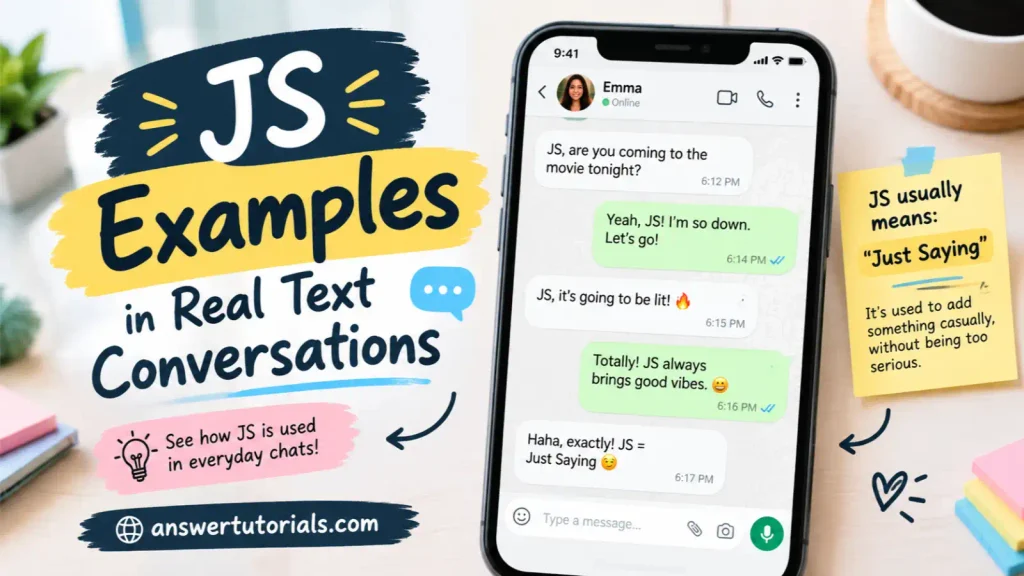
Seeing JS in context makes the meaning much easier to understand.
Example 1: Friendly advice
Alex: “I might go for a run tonight.”
Sam: “JS, take a jacket. It’s getting cold.”
Here, JS means “just saying.” Sam is giving friendly advice.
Example 2: Sharing an opinion
Alex: “Do you like this restaurant?”
Sam: “JS, I think the old place was better.”
The speaker is simply sharing a personal opinion.
Example 3: Playful teasing
Alex: “I’m definitely the funniest person here.”
Sam: “JS, nobody laughed at that joke. 😂”
Here, JS introduces playful criticism.
Example 4: Relationship conversation
Alex: “I don’t think she likes me.”
Sam: “JS, she messages you every morning.”
JS introduces an observation that challenges Alex’s assumption.
Example 5: Mild criticism
Alex: “Why didn’t anyone tell me?”
Sam: “JS, you never checked the group chat.”
This may sound slightly defensive or sarcastic depending on the relationship.
Example 6: Compliment
Alex: “I don’t think my new haircut looks good.”
Sam: “JS, you actually look amazing.”
In this case, JS introduces a positive opinion.
JS Meaning in Different Contexts 🌐
One of the most important things to remember about JS meaning in text is that abbreviations are context-dependent.
Casual texting
JS = Just Saying
This is the most likely interpretation in ordinary conversations.
Social media
On social media, JS can also mean “just saying.” People may use it in comments or captions when adding an opinion.
Example:
“JS, this song is still a classic.”
Programming
In technology conversations:
JS = JavaScript
For example:
“I’m learning JS for web development.”
Here, interpreting JS as “just saying” would obviously make no sense.
Work or career conversations
In certain professional settings, JS may have a specialised meaning such as job seeker or another industry-specific abbreviation.
Therefore, always look at the surrounding words before deciding what JS means.
JS vs. Similar Texting Abbreviations 🤔
Several abbreviations can appear alongside JS and express similar ideas.
| Abbreviation | Meaning | Common purpose |
|---|---|---|
| JS | Just Saying | Adds an opinion or observation |
| TBH | To Be Honest | Introduces honesty or personal opinion |
| IMO | In My Opinion | Clearly signals an opinion |
| IMHO | In My Humble Opinion | Gives a personal viewpoint |
| FYI | For Your Information | Provides information |
| BTW | By the Way | Adds another point |
| NGL | Not Gonna Lie | Introduces a candid statement |
The difference is mainly about tone and intention.
For example:
“TBH, I don’t like it.”
sounds like a direct admission.
“JS, I don’t really like it.”
can sound softer—or sometimes more indirect.
“IMO, the first option is better.”
clearly identifies the statement as personal opinion.
Is JS Rude or Passive-Aggressive? 😬
JS is not automatically rude.
The tone depends on the statement surrounding it.
Compare these two examples:
“JS, you look great today! 😊”
This sounds friendly and positive.
Now consider:
“JS, nobody asked for your opinion.”
That obviously sounds hostile, even though JS itself is not offensive.
There is also a middle ground:
“JS, you could have told me sooner.”
This might sound mildly annoyed.
The speaker may be trying to express frustration without starting a full argument.
What makes JS sound passive-aggressive?
JS may feel passive-aggressive when:
- The statement contains criticism.
- The speaker has already expressed frustration.
- The message is unusually short.
- The sender uses punctuation aggressively.
- The conversation was already tense.
- The phrase seems unnecessary.
For example:
“JS, you didn’t exactly help.”
The abbreviation does not remove the criticism. It simply frames it as a casual observation.
How to Tell What Someone Means by JS 🧠

If someone sends you JS, don’t interpret the abbreviation by itself.
Instead, look at the entire message.
Check the sentence
Ask yourself:
What comes immediately before or after JS?
If the sentence expresses an opinion, “just saying” is likely.
Consider the conversation
Was the conversation:
- Friendly?
- Romantic?
- Argumentative?
- Professional?
- Technical?
- Playful?
The setting can change the meaning dramatically.
Look at emojis
Emojis can provide useful tone clues.
For example:
“JS, you look amazing 😂”
may be playful.
“JS. You should’ve known better.”
may feel more serious.
Consider the sender
If someone regularly uses texting slang, JS is probably casual shorthand.
If someone works in software and says:
“I write JS every day,”
they are almost certainly referring to JavaScript.
How to Respond to JS in Text 💡
Your response should depend on what the person actually means.
If JS means “just saying,” you can respond naturally.
Friendly response
“Haha, fair enough!”
Curious response
“What makes you say that?”
Playful response
“Just saying what, exactly? 😂”
Agreeing response
“Honestly, I was thinking the same thing.”
Disagreeing response
“I see your point, but I look at it differently.”
When the message feels critical
“I get what you’re saying. What would you have done instead?”
These responses keep the conversation open instead of immediately turning a small comment into an argument.
Common Mistakes When Interpreting JS 🚫
People sometimes assume that JS always means “just saying.” That can cause confusion.
Mistake 1: Ignoring context
If someone says:
“I’m coding in JS tonight.”
They almost certainly mean JavaScript, not “just saying.”
Mistake 2: Assuming the sender is rude
A message such as:
“JS, I think you did a great job.”
is positive.
The abbreviation itself is not insulting.
Mistake 3: Overanalyzing two letters
Sometimes JS is simply shorthand.
You don’t always need to decode hidden emotions or intentions from the abbreviation.
Mistake 4: Forgetting tone
The same words can sound completely different depending on the relationship between the people.
A close friend might use JS playfully. A stranger might use the same phrase in a more critical way.
When Should You Use JS Yourself? ✍️

You can use JS when you’re having an informal conversation and want to add an opinion, observation, or suggestion.
For example:
“JS, you might want to save that file.”
Or:
“JS, that color looks really good on you.”
Or:
“JS, I think we should book the tickets today.”
However, avoid relying heavily on abbreviations in formal communication.
For a business email, academic assignment, official notice, or professional document, writing “just saying” or expressing the idea directly is usually clearer.
Good places to use JS
- Text messages
- Group chats
- Casual DMs
- Informal social media conversations
- Conversations with friends
Places to avoid it
- Formal emails
- Job applications
- Academic writing
- Legal documents
- Official business communication
- Important professional messages
The goal is always clear communication.
Why Texting Abbreviations Like JS Are So Popular 📲
Texting language keeps evolving because digital communication rewards speed and convenience.
People often communicate while:
- Walking
- Working
- Studying
- Traveling
- Multitasking
- Using mobile phones
Short forms make conversations faster.
But there is another reason abbreviations are popular: they create a shared conversational style.
Using terms such as JS, TBH, IMO, or NGL can make a message feel more casual and natural.
For younger internet users, abbreviations can also communicate tone. A short message may feel more relaxed than a carefully written sentence.
That said, slang changes quickly. A term that is common on one platform may be unfamiliar on another.
JS Meaning in Text: Quick Examples to Remember 📌
Here are several simple examples you can save:
| Text example | Meaning of JS |
|---|---|
| “JS, I think you’re right.” | Just saying |
| “JS, that was hilarious 😂” | Just saying |
| “You could’ve called, JS.” | Just saying |
| “JS, you look great today.” | Just saying |
| “JS, maybe leave earlier.” | Just saying |
| “I’m studying JS.” | JavaScript |
| “This website uses JS.” | JavaScript |
The key is to read the entire sentence, not just the abbreviation.
FAQs:
What does JS mean in texting?
JS usually means “just saying” in texting. People use it to introduce an opinion, observation, suggestion, or comment. However, context can give JS other meanings.
Does JS mean just saying?
Yes. In casual conversations, JS commonly means “just saying.” It can make a statement feel more informal, although the exact tone depends on the words around it.
Can JS mean JavaScript?
Yes. In programming and technology conversations, JS commonly means JavaScript. For example, “I need to fix the JS” refers to JavaScript rather than “just saying.”
Is JS rude in a text?
JS itself is not rude. The surrounding message determines the tone. A positive statement can make JS sound friendly, while criticism can make it feel sarcastic or passive-aggressive.
How should I reply when someone says JS?
If someone uses JS to mean “just saying,” you can reply naturally based on the context. Try “Fair enough,” “I see your point,” “What makes you say that?”, or a playful response if the conversation is casual.
Final Thoughts 💭
Understanding JS meaning in text is mostly about understanding context. In everyday texting, JS usually means “just saying.” People use it to introduce opinions, observations, suggestions, compliments, and sometimes criticism.
The tone can change depending on the sentence, relationship, punctuation, and conversation. So, don’t assume that JS is automatically friendly or passive-aggressive.
Remember one simple rule:
Don’t decode the abbreviation alone read the whole message.
And if the conversation is about coding, websites, or programming, JS is much more likely to mean JavaScript.
Once you recognize the surrounding context, JS meaning in text becomes easy to understand. 📱✨

Ayan Zaman is a content writer and researcher at answertutorials.com, specializing in text meanings, slang, abbreviations, and everyday communication. He creates clear, practical, and easy-to-understand guides to help readers communicate with confidence. His content focuses on accurate explanations, real-world examples, and useful answers for modern digital conversations.