
If someone suddenly texts you “idm”, you might pause and wonder what those three letters mean. 🤔 Texting is full of abbreviations, slang, and shortcuts, so even a simple message can sometimes feel confusing.
The good news is that IDM meaning in text is usually straightforward. In most casual conversations, IDM means “I don’t mind.” People use it when they are comfortable with an option, choice, suggestion, or situation.
For example, if a friend asks, “Do you want pizza or burgers?” and you reply “idm”, you are basically saying, “I don’t mind. Either one is fine with me.”
However, context still matters. The same three letters can mean something different outside casual texting. In this guide, you will learn what IDM means, where it comes from, how people use it, what it sounds like in different situations, and how to respond naturally. 📱
What Does IDM Mean in Text? 💬
IDM usually means “I don’t mind” in texting and online conversations.
It is a short way to tell someone that you are not bothered by a choice or situation. It can also mean that you are happy to let the other person decide.
IDM at a glance
| Abbreviation | Meaning | Common Use |
|---|---|---|
| IDM | I don’t mind | Casual texting |
| IDM | I don’t mind | Social media chats |
| IDM | I don’t mind | Friends and family |
| IDM | I don’t mind | Informal conversations |
For example:
Person A: “Should we meet at 6 or 7?”
Person B: “IDM, you choose.”
Here, IDM means “I don’t mind.” The person is saying that either time works for them.
Another example:
“IDM where we eat tonight.”
This means:
“I don’t mind where we eat tonight.”
The abbreviation makes the message faster and more casual.
IDM Meaning in Simple Words 😊
If you want the simplest explanation, think of IDM as “I’m okay with either option.”
Depending on the conversation, it can communicate ideas such as:
- I don’t mind.
- Either is fine.
- I’m okay with that.
- You can choose.
- It doesn’t bother me.
- I’m flexible.
- Whatever works for you.
The exact meaning depends on what came before it.
For instance:
“Want to watch a movie or play a game?”
“IDM.”
This usually means:
“I’m fine with either one.”
But IDM does not necessarily mean that the person is excited about both options. It often simply means that they have no strong preference.
That small difference is important.
If someone says “I’d love either one!”, they sound enthusiastic.
If someone says “IDM”, they are usually saying:
“Either option is okay with me.”
How Is IDM Used in Text Messages? 📱
People commonly use IDM when they want to keep a conversation short and relaxed.
It is especially useful when someone asks for your preference.
Here are several common situations.
Choosing a place
“Where should we eat?”
“IDM. You pick.”
The person has no particular preference.
Choosing a time
“Can we meet at 5?”
“IDM.”
The person is saying that they are okay with the suggested time.
Choosing an activity
“Movie or bowling?”
“IDM.”
Both choices are acceptable.
Responding to a suggestion
“Is it okay if we invite Sam?”
“IDM.”
In this context, IDM means the person does not object.
Talking about plans
“We could stay home tonight.”
“IDM.”
The person is comfortable with that plan.
IDM Texting Examples You Can Actually Use 💬
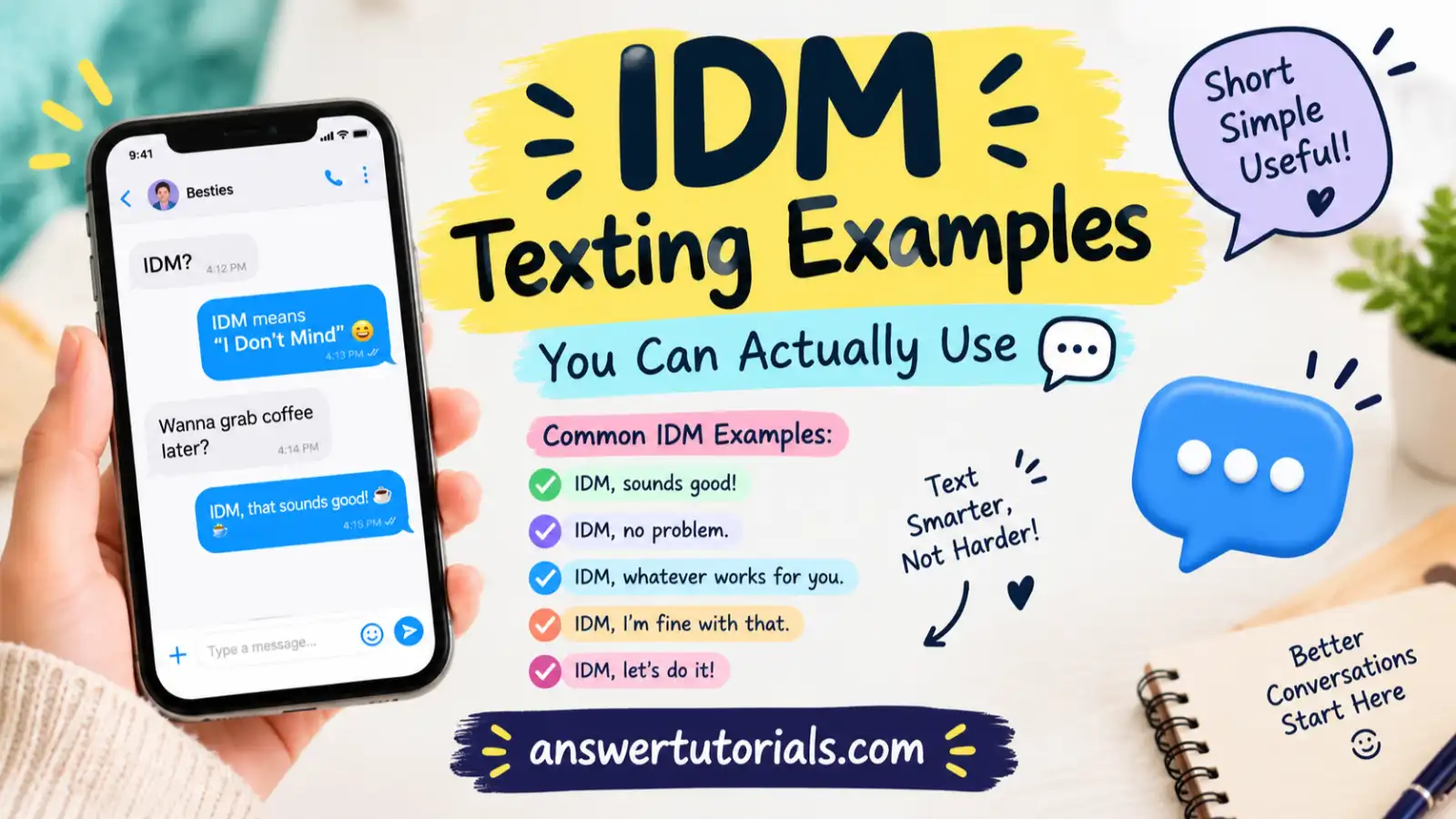
Understanding examples makes texting abbreviations much easier.
Here are realistic examples of IDM meaning in text.
Example 1: Food
Friend: “Pizza or Chinese?”
You: “IDM, honestly.”
Meaning:
“I don’t mind. Either one is fine.”
Example 2: Meeting time
Friend: “Do you want to meet at 4?”
You: “IDM.”
Meaning:
“I’m okay with 4.”
Example 3: Movie choice
Friend: “Comedy or horror?”
You: “IDM 😂”
Meaning:
“I’m fine with either.”
Example 4: Weekend plans
Friend: “Do you want to go out or chill at home?”
You: “IDM.”
Meaning:
“I have no strong preference.”
Example 5: Location
Friend: “Want to meet at the café or the park?”
You: “IDM, you decide.”
Meaning:
“Both work for me, so you can choose.”
Example 6: Social plans
Friend: “Is it okay if we bring another person?”
You: “IDM.”
Meaning:
“I don’t have a problem with that.”
Example 7: Casual conversation
Friend: “I can call tonight or tomorrow.”
You: “IDM.”
Meaning:
“Either time is okay.”
Is IDM Casual or Formal? 👀
IDM is mainly casual and informal.
You are more likely to see it in:
- Text messages
- Instagram DMs
- Snapchat conversations
- Group chats
- Gaming chats
- Discord messages
- Casual social media conversations
- Conversations between friends
It is generally not appropriate for formal writing.
For example, you probably would not write:
“IDM which meeting time you choose.”
in a professional email.
Instead, you could write:
“Either meeting time works for me.”
Or:
“I’m flexible regarding the meeting time.”
This distinction is important because texting abbreviations depend heavily on the relationship and setting.
Casual
“IDM, you choose 😂”
More professional
“Either option works for me.”
Both communicate a similar idea, but the tone is different.
Where Did IDM Come From? 🕰️
The use of IDM as an abbreviation for “I don’t mind” comes from the broader culture of internet communication and text messaging.
Online communication encouraged people to shorten common phrases. Early chatrooms, instant messaging platforms, mobile texting, forums, and later social media all helped popularize abbreviated expressions.
People wanted to type quickly, especially on phones with smaller keyboards. As a result, phrases were often reduced to their first letters.
For example:
- I don’t know → IDK
- I don’t care → IDC
- I don’t mind → IDM
- In my opinion → IMO
- Be right back → BRB
- Talk to you later → TTYL
IDM fits naturally into this pattern.
The abbreviation is especially useful because “I don’t mind” is a phrase people use frequently when discussing choices.
Instead of typing the entire sentence, someone can simply type:
“IDM.”
That makes the conversation faster.
What Does IDM Mean Depending on Context? 🔍
Although “I don’t mind” is the common meaning in texting, context is always important.
Consider this message:
“Do you want tea or coffee?”
“IDM” almost certainly means:
“I don’t mind.”
But if the conversation is about computers, software, or downloading files, IDM may refer to something completely different.
In technology, IDM can also refer to Internet Download Manager, a software program associated with downloading files.
That is why you should never interpret an abbreviation without looking at the surrounding conversation.
Texting context
“Where should we go? IDM.”
Meaning: I don’t mind.
Technology context
“I installed IDM to manage my downloads.”
Meaning: Internet Download Manager.
So, when someone asks specifically about IDM meaning in text, the intended meaning is generally “I don’t mind.”
IDM vs. IDK vs. IDC: What’s the Difference? 🤔
Several texting abbreviations can look similar because they begin with ID.
However, they communicate different ideas.
| Abbreviation | Full Meaning | What It Communicates |
|---|---|---|
| IDM | I don’t mind | No strong preference |
| IDK | I don’t know | Lack of knowledge |
| IDC | I don’t care | Lack of concern or interest |
| IMO | In my opinion | Personal viewpoint |
| IMHO | In my humble opinion | Personal viewpoint |
IDM
“Which restaurant should we choose?”
“IDM.”
You are saying you are fine with either choice.
IDK
“What time does the movie start?”
“IDK.”
You are saying you don’t know the answer.
IDC
“Do you want pizza or burgers?”
“IDC.”
This can sound stronger than IDM. Depending on context, it may suggest “I don’t care” rather than simply being flexible.
Therefore, IDM is usually softer than IDC.
IDM vs. “I Don’t Care” ⚖️
This is one of the most important differences to understand.
At first glance, “I don’t mind” and “I don’t care” may seem identical. They are not always the same emotionally.
“I don’t mind”
Usually means:
“Either option is okay with me.”
Example:
“Do you want to sit inside or outside?”
“I don’t mind.”
This sounds neutral and flexible.
“I don’t care”
Can mean:
“I have no interest in deciding.”
Depending on tone, it can sound dismissive or irritated.
Example:
“Where do you want to go?”
“I don’t care.”
That response may sound annoyed.
Therefore, when someone sends “IDM,” you generally should not assume they are being rude. They may simply be saying that they are happy for you to choose.
How to Respond to IDM in Text 💬
Your response depends on what the other person said before using IDM.
If someone says:
“IDM, you choose.”
You can simply make the decision.
Casual responses
- “Okay, let’s do pizza 😄”
- “Cool, let’s go with the first option.”
- “Sounds good!”
- “Alright, I’ll choose.”
- “No problem 😂”
- “Perfect, I’ll decide.”
- “Cool, let’s meet at 6.”
Playful responses
- “So the pressure is on me now 😂”
- “Fine, I’m choosing the most chaotic option.”
- “You gave me too much power 😂”
- “Alright, my decision is final!”
If you want their actual preference
Sometimes you may want the other person to choose.
You can reply:
“You really don’t have a preference?”
Or:
“Anything at all is fine?”
Or:
“Okay, but what would you pick?”
This keeps the conversation going instead of ending it with another short message.
Can IDM Sound Rude? 😬
IDM itself is not necessarily rude. However, the way it is used can affect how the message feels.
Compare these:
“IDM 😊 You choose!”
and
“IDM.”
The first message sounds warm and cooperative.
The second message is much shorter and may feel neutral, uninterested, or slightly cold depending on the relationship.
Text messages do not contain facial expressions or voice tone, so short replies can sometimes be misunderstood.
If you want your message to sound friendlier, add a few words or an emoji.
Instead of:
“IDM.”
Try:
“IDM 😊 Whatever works for you.”
Or:
“IDM, you can choose!”
The meaning stays the same, but the tone feels more welcoming.
Common IDM Phrases and Their Meanings 📲
You may see IDM combined with other words.
| Text | Meaning |
|---|---|
| IDM | I don’t mind |
| IDM honestly | I genuinely have no preference |
| IDM tbh | I don’t mind, to be honest |
| IDM lol | I don’t mind, said casually |
| IDM you choose | I don’t mind, so you decide |
| IDM either way | Both choices are fine |
| IDM what we do | I don’t mind what we do |
| IDM where we go | I don’t mind where we go |
| IDM when | I don’t mind when |
| IDM 😊 | I don’t mind, in a friendly tone |
These combinations help communicate tone more clearly.
For example:
“IDM tbh, you choose.”
This sounds relaxed and shows that the person genuinely does not have a strong preference.
Common Mistakes When Understanding IDM 🚫
Even though the meaning is simple, people sometimes misunderstand the abbreviation.
Mistake 1: Thinking IDM means IDK
IDK = I don’t know.
IDM = I don’t mind.
They are completely different.
Mistake 2: Assuming IDM means excitement
Someone saying “IDM” is not necessarily excited about the choice.
They may simply be neutral.
Mistake 3: Assuming IDM is rude
A short answer can sometimes feel cold, but IDM does not automatically mean the person is annoyed.
Look at the conversation around it.
Mistake 4: Confusing IDM with IDC
IDC can sound more dismissive.
IDM usually communicates flexibility.
Mistake 5: Ignoring context
If you are discussing software, IDM might refer to Internet Download Manager instead of “I don’t mind.”
Always consider the topic before interpreting an abbreviation.
When Should You Use IDM? 📱
Use IDM when you are having a casual conversation and want to communicate that you have no strong preference.
It works particularly well when:
- Someone asks you to choose between two things.
- You are okay with someone else’s suggestion.
- You want the other person to decide.
- You are flexible about timing.
- You do not object to a plan.
- You want to keep the conversation brief.
- You are chatting with friends or people who understand texting slang.
For example:
“Can we meet at 3 instead?”
You can answer:
“IDM 👍”
This tells the person that the new time is acceptable.
For professional conversations, however, a complete sentence is usually clearer.
Instead of:
“IDM.”
Use:
“That works for me.”
This sounds more polished while keeping the same basic idea.
IDM Examples in Different Conversations 🌟
Let’s look at several everyday situations.
With a friend
Friend: “Should we watch a comedy?”
You: “IDM 😂”
Meaning:
“Sure, I don’t mind.”
With a family member
Family member: “Do you want to eat now or later?”
You: “IDM.”
Meaning:
“Either is okay.”
In a group chat
Person 1: “Saturday or Sunday?”
Person 2: “IDM.”
Meaning:
“Either day works for me.”
In a gaming chat
Friend: “Which map should we play?”
You: “IDM, pick one.”
Meaning:
“I don’t mind which map we play.”
In a casual dating conversation
Person: “Coffee or dinner?”
You: “IDM 😊 You choose.”
Meaning:
“I’m comfortable with either option.”
The context may change, but the core meaning remains the same.
Quick Answer: What Does IDM Mean in Text? ⚡
IDM usually means “I don’t mind” in text messages.
It tells someone that you have no strong preference and are generally comfortable with the options being discussed.
For example:
“Pizza or burgers?”
“IDM.”
Translation:
“I don’t mind. Either one is fine.”
In most casual texting situations, this is the meaning you should understand first.
However, context matters. In technology-related conversations, IDM can also refer to Internet Download Manager.
Remember this simple rule:
IDM = I don’t mind = I’m okay with it.
FAQs:
What does IDM mean in text?
IDM usually means “I don’t mind.” It is a casual texting abbreviation used when someone has no strong preference or is comfortable with a choice.
Is IDM slang?
Yes. IDM is an informal texting abbreviation rather than a formal English expression. It is commonly suited to casual digital conversations.
Is IDM the same as IDC?
No. IDM means “I don’t mind,” while IDC means “I don’t care.” IDM generally sounds more neutral and flexible, while IDC can sometimes sound more dismissive depending on context.
Can IDM mean something else?
Yes. In technology-related conversations, IDM can refer to Internet Download Manager. However, when someone uses IDM in an ordinary text conversation about plans or choices, it usually means “I don’t mind.”
How should I respond when someone says IDM?
You can simply make the decision if they are giving you the choice. For example, you could say, “Okay, let’s go with pizza 😊” or “Cool, I’ll choose.”
Final Thoughts 💭
Understanding texting abbreviations can make online conversations much easier. IDM meaning in text is usually simple: “I don’t mind.”
People use IDM when they are flexible, have no strong preference, or are happy to let someone else make the decision. It works well in casual conversations about food, plans, locations, timing, entertainment, and everyday choices.
Remember the key difference between similar abbreviations:
- IDM = I don’t mind
- IDK = I don’t know
- IDC = I don’t care
Most importantly, always consider the context. A short abbreviation can have another meaning in a different subject, especially in technology.
So, the next time someone texts “IDM,” you will know what they are saying: they are generally okay with the choice and don’t mind which option you pick. 📱✨

Ayan Zaman is a content writer and researcher at answertutorials.com, specializing in text meanings, slang, abbreviations, and everyday communication. He creates clear, practical, and easy-to-understand guides to help readers communicate with confidence. His content focuses on accurate explanations, real-world examples, and useful answers for modern digital conversations.