

HBU meaning in text is usually “How About You?” It is a short, casual texting abbreviation people use when they want to ask the same question back to someone. For example, if a friend texts, “I’m doing great, hbu?”, they are simply asking, “How about you?”
You may see HBU in text messages, social media comments, dating conversations, group chats, and online communities. Because texting often favors speed and simplicity, abbreviations such as HBU have become a natural part of everyday digital communication. 📱
But there is more to HBU than just three letters. The meaning can change slightly depending on the conversation, relationship, tone, and punctuation.
Understanding the context helps you know whether someone is casually checking in, keeping a conversation going, or showing genuine interest.
This guide explains HBU meaning in text, where it came from, how people use it, what it sounds like in different situations, and how you can respond naturally.
HBU Meaning in Text at a Glance 🔎
The most common meaning of HBU is:
HBU = How About You?
It is generally used after someone has answered a question or shared information about themselves.
Quick examples
- “I’m good, hbu?” → I’m good, how about you?
- “I love pizza. HBU?” → I love pizza. How about you?
- “My weekend was relaxing, hbu?” → My weekend was relaxing. How about yours?
- “I’m studying tonight. HBU?” → I’m studying tonight. What about you?
In most casual conversations, HBU is friendly and conversational. It does not usually carry a hidden meaning.
The abbreviation is particularly common when someone wants to avoid repeating a complete question. Instead of writing “How about you?”, they simply type HBU.
What Does HBU Stand For? 📝
HBU stands for “How About You?”
Each letter represents the first letter of a word:
- H = How
- B = About
- U = You
This follows a common pattern in internet and texting language. People shorten frequently used expressions to make messages quicker to type.
For example:
| Abbreviation | Full meaning |
|---|---|
| HBU | How About You? |
| WYD | What You Doing? / What Are You Doing? |
| WBU | What About You? |
| IDK | I Don’t Know |
| IMO | In My Opinion |
| BTW | By the Way |
| TTYL | Talk To You Later |
Although HBU and WBU can sometimes perform a similar conversational function, HBU specifically expands to “How About You?”
The exact wording someone chooses often depends on their personal texting style.
Origin and Evolution of HBU 🌐
The exact moment when HBU first appeared is difficult to pinpoint because internet slang developed gradually across different online communities.
The abbreviation follows a broader tradition of shortening everyday phrases. As texting, instant messaging, chat rooms, and social platforms became popular, users looked for faster ways to communicate.
Instead of typing:
“I’m having a really good day. How about you?”
someone could write:
“I’m having a good day, hbu?”
That small change saves time while preserving the meaning.
The rise of mobile messaging also encouraged short forms. Typing on a phone keyboard was once slower and less convenient than typing on a computer, so compact expressions became especially useful.
Today, HBU can appear across many digital spaces, including:
- Text messages 📱
- Instagram conversations
- Snapchat chats
- TikTok comments and messages
- Discord conversations
- Dating apps
- Online forums
- Group chats
- Gaming communities
So, while HBU is strongly associated with informal digital communication, its purpose remains simple: asking someone about their experience, opinion, condition, or situation after sharing your own.
How Is HBU Used in Text Messages? 💬
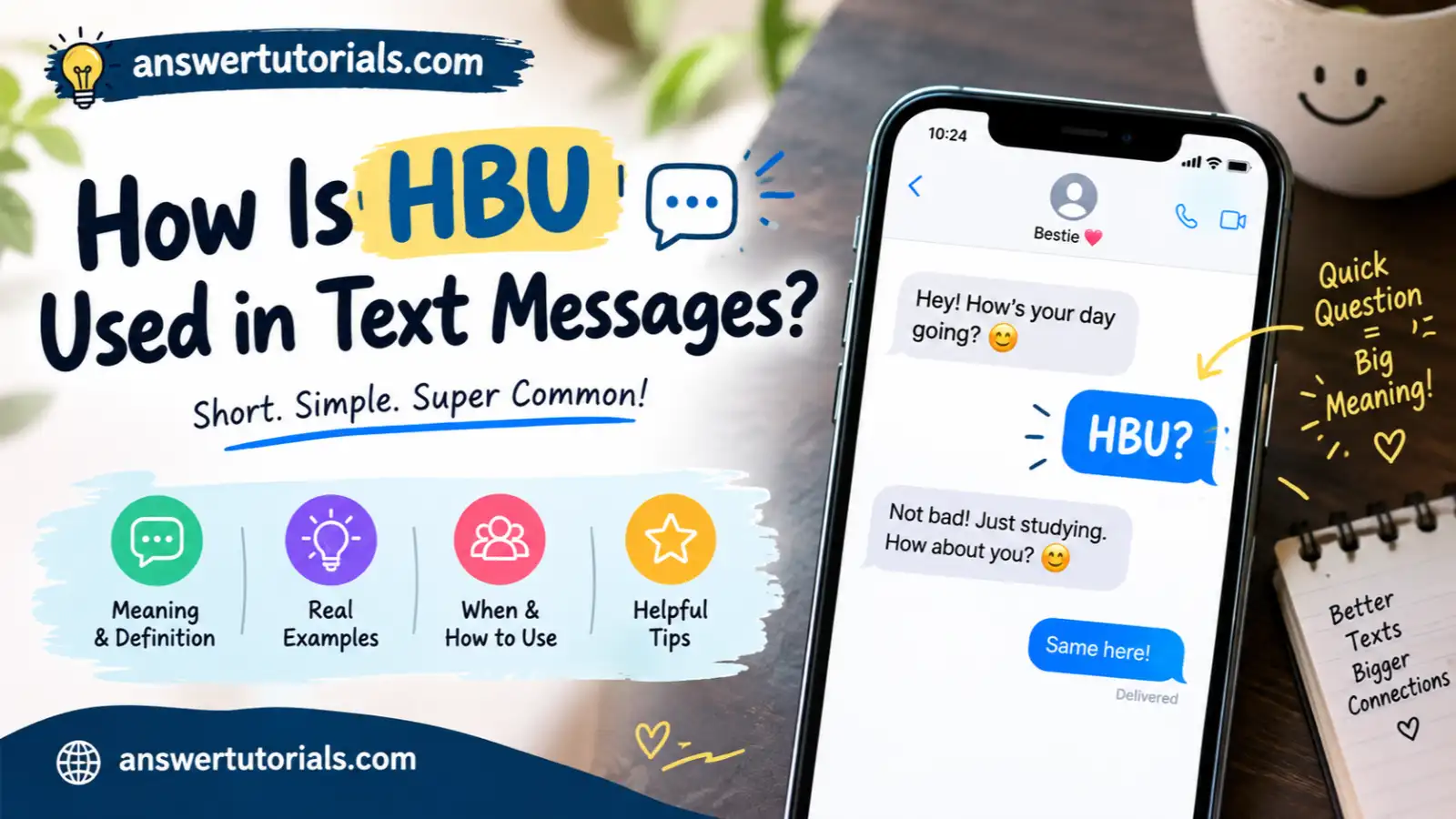
The easiest way to understand HBU meaning in text is to look at how people naturally use it.
Usually, one person says something about themselves and then adds HBU to invite the other person to respond.
Example 1: Asking about someone’s day
Person A: “My day was pretty busy, hbu?”
Meaning:
“My day was pretty busy. How about you?”
Example 2: Talking about food
Person A: “I’m having tacos tonight. HBU?”
Meaning:
“I’m having tacos tonight. What are you having?”
Example 3: Discussing plans
Person A: “I’m staying home this weekend, hbu?”
Meaning:
“I’m staying home this weekend. What are you doing?”
Example 4: Talking about feelings
Person A: “I’m feeling much better today. HBU?”
Meaning:
“I’m feeling much better today. How are you feeling?”
Notice that the exact replacement for HBU can change slightly depending on the subject. The basic idea stays the same: the person is turning the question back toward you.
HBU Examples in Different Conversations 🗨️
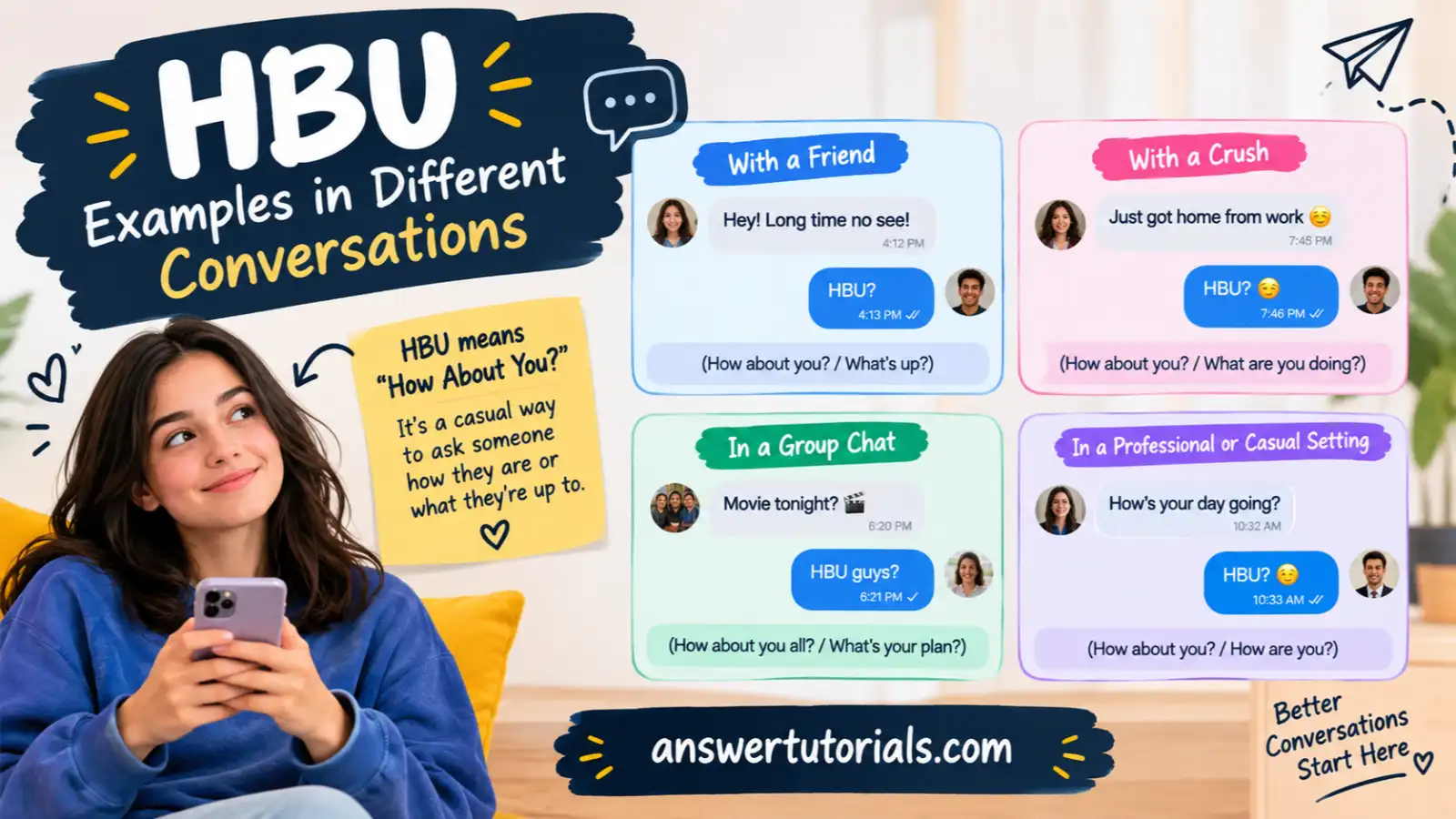
Context is important because HBU can follow almost any personal statement.
Here are several realistic examples.
Casual friendship
Friend: “I’m watching a movie right now, hbu?”
Meaning: “I’m watching a movie right now. What are you doing?”
School conversation
Classmate: “I finished my assignment. HBU?”
Meaning: “I finished my assignment. Did you finish yours?”
Work conversation
Coworker: “I’m working from home today. HBU?”
Meaning: “I’m working from home today. What about you?”
Dating conversation ❤️
Person: “I’m free Saturday evening. HBU?”
Meaning: “I’m free Saturday evening. Are you free too?”
Social media conversation
Person: “I’m obsessed with this song 😂 hbu?”
Meaning: “I really like this song. What do you think?”
Travel conversation
Person: “I’m visiting London next month. HBU?”
Meaning: “I’m visiting London next month. Do you have any travel plans?”
These examples show why HBU is so useful. It allows someone to share first and then invite you into the conversation.
What Does HBU Mean From a Girl or Guy? ❤️
If a girl or guy sends you HBU, the basic meaning is still “How About You?”
The abbreviation itself does not automatically mean flirting.
For example:
“I’m studying right now, hbu?”
This is probably just a normal conversational question.
However, the surrounding conversation matters. If someone repeatedly asks about your interests, plans, feelings, or personal life, HBU may be part of a broader effort to keep the conversation going.
Consider these examples:
Neutral:
“I’m watching football, hbu?”
More personal:
“I’m staying home tonight. Hbu? 😊”
Potentially flirty context:
“I’m free tonight… hbu? 👀”
The letters HBU remain the same, but the surrounding words, emojis, timing, and relationship can affect the overall tone.
So, rather than assuming that HBU is romantic, look at the complete conversation.
HBU vs. WBU: What’s the Difference? 🤔
A common question is whether HBU and WBU mean the same thing.
They are very similar.
HBU = How About You?
WBU = What About You?
Both can be used to return a question to another person.
Example
HBU:
“I’m going to the gym later, hbu?”
WBU:
“I’m going to the gym later, wbu?”
Both essentially ask the other person about their plans.
The difference is mainly in the wording:
- HBU uses “How.”
- WBU uses “What.”
In everyday texting, people may use either one without thinking much about the grammatical distinction.
HBU vs. WBU table
| Text slang | Meaning | Common use |
|---|---|---|
| HBU | How About You? | Asking about the other person |
| WBU | What About You? | Asking about the other person |
| WYD | What Are You Doing? | Asking about current activity |
| HRU | How Are You? | Asking about someone’s condition |
| WYA | Where You At? | Asking someone’s location |
Understanding these differences can make informal conversations much easier to follow.
How to Respond to HBU Naturally 💡
When someone sends HBU, the simplest response is to answer the question they were asking.
You do not need to overthink it.
They ask about your day
“Mine was pretty good too!”
If they ask about your plans
“I’m probably staying home tonight.”
If they ask about your opinion
“I actually love it!”
They ask about your feelings
“I’m doing okay, just a little tired.”
If you want to keep the conversation going
“I’m doing pretty well! What are you up to later?”
You want a playful response 😄
“Why, are you curious?”
If you’re interested in them ❤️
“I’m good, especially now that we’re talking.”
Your response should match the tone and relationship you have with the person.
A casual HBU does not require a complicated answer. A short, genuine response is often best.
Cute and Flirty Responses to HBU 💕
If the conversation already has a romantic or playful tone, you can make your response warmer.
Here are some examples:
- “I’m good, but talking to you made it better.”
- “Better now that you asked 😊.”
- “I’m doing pretty good. What are you up to?”
- “I’m good. Were you hoping I’d say something interesting? 😉”
- “I’m great. Maybe we should change that from texting to hanging out.”
- “Doing well. I was wondering when you’d text me.”
- “I’m good. Your message definitely helped.”
The key is context. A flirty answer can feel natural when both people are already comfortable with playful conversation. In a professional or unfamiliar conversation, a simple answer is usually more appropriate.
Funny Ways to Respond to HBU 😂
HBU also gives you an easy opportunity to add humor.
If someone says:
“I’m having a lazy day, hbu?”
You could reply:
- “Professionally procrastinating.”
- “Currently pretending to be productive.”
- “Surviving on snacks and optimism.”
- “Doing absolutely nothing with impressive dedication.”
- “Waiting for someone to bring me food.”
- “Trying to remember what I was supposed to be doing.”
- “Living my best low-energy life.”
Funny replies work best when they fit your existing relationship.
If the person normally communicates seriously, an overly dramatic joke might feel strange. If you’re already joking around, however, a playful HBU response can keep the conversation lively.
Is HBU Formal or Informal? 👔
HBU is informal.
It is best suited to casual digital communication rather than formal writing.
Appropriate situations
HBU can work well with:
- Friends
- Family members
- Close classmates
- Casual acquaintances
- Online friends
- Dating conversations
- Informal group chats
Situations where you should avoid it
Avoid HBU in:
- Formal business emails
- Job applications
- Academic essays
- Official documents
- Professional reports
- Formal customer communication
Instead of writing:
“HBU?”
in a professional email, write:
“How about you?”
or use a more specific question such as:
“How has your week been?”
Knowing when to use abbreviations is part of effective digital communication. The goal is not simply to know what an abbreviation means but to understand where it belongs.
HBU in Social Media and Online Chats 📲
Social media has made short expressions like HBU extremely common.
On fast-moving platforms, users often communicate with short messages, abbreviations, emojis, GIFs, and reactions.
HBU fits naturally into this environment because it is:
- Short
- Easy to recognize
- Quick to type
- Conversational
- Flexible
- Easy to combine with emojis
For example:
“I’m obsessed with this show 😭 hbu?”
Or:
“Going out later, hbu? 👀”
Or:
“I finally finished the project! hbu?”
The surrounding language gives the abbreviation its conversational meaning.
You may also see HBU written in different formats:
- hbu
- HBU
- Hbu
- hbu?
- HBU?
These generally communicate the same idea.
Capitalization is usually a matter of personal texting style rather than a change in meaning.
Common Mistakes When Using HBU ⚠️
Although HBU is simple, a few mistakes can make your message sound unnatural.
1. Using HBU in formal writing
HBU is casual slang. Avoid using it when professional language is expected.
2. Sending only “HBU?”
If the conversation has no previous context, the other person may not know what you’re asking about.
Instead of:
“HBU?”
you could say:
“I’m thinking about going out this weekend. HBU?”
That gives the other person something specific to respond to.
3. Assuming HBU is always romantic
HBU is not automatically flirtatious. It simply means “How About You?”
4. Overusing abbreviations
A message filled with abbreviations can become difficult to read.
For example:
“wyd hbu idk tbh lol”
may be understandable to some people but confusing to others.
Clear communication is more important than using as much slang as possible.
5. Ignoring the context
HBU can refer to feelings, plans, opinions, activities, preferences, and many other things. Look at the sentence before it to understand exactly what the person is asking.
HBU Meaning in Different Contexts 📚
The meaning remains essentially the same, but the question being returned changes with context.
| Context | Example | What HBU asks |
|---|---|---|
| Mood | “I’m feeling great, hbu?” | How are you feeling? |
| Plans | “I’m going out tonight, hbu?” | What are your plans? |
| Food | “I’m having pizza, hbu?” | What are you eating? |
| Entertainment | “I’m watching a movie, hbu?” | What are you watching/doing? |
| Opinion | “I love this song, hbu?” | What do you think? |
| School | “I finished my homework, hbu?” | Did you finish yours? |
| Work | “I’m working late, hbu?” | What about your work situation? |
| Dating | “I’m free Friday, hbu?” | Are you free too? |
This flexibility explains why HBU appears in so many different types of conversations.
Why Do People Use HBU Instead of “How About You?” 🤳
The biggest reason is convenience.
Texting is often quick and spontaneous. People may be talking while walking, working, watching television, or doing something else.
Typing:
“How about you?”
takes longer than:
“HBU?”
The shorter form also fits naturally into fast-paced conversations.
Another reason is familiarity. Once people learn common texting abbreviations, they become almost automatic.
HBU also creates a relaxed tone. Compare:
“How about you?”
with:
“hbu?”
The first can sound neutral and complete. The second feels more casual and conversational.
Neither is inherently better. The appropriate choice depends on the situation.
HBU in a Realistic Text Conversation 💬
Here is a complete example:
Alex: “Hey! What are you doing tonight?”
Sam: “Probably staying home and watching Netflix. HBU?”
Alex: “I might go out with some friends.”
Sam: “Nice! Where are you going?”
In this conversation, HBU keeps the exchange moving.
Without it, Sam might simply answer the question and stop there. By asking “How about you?”, Sam returns the conversational focus to Alex.
This is one reason HBU is useful: it helps create a two-way conversation instead of a one-sided exchange.
FAQs:❓
What does HBU mean in text?
HBU means “How About You?” It is a casual texting abbreviation used to ask another person the same or a related question after sharing something about yourself.
Is HBU the same as WBU?
They are very similar. HBU means “How About You?”, while WBU means “What About You?” Both are commonly used to return a question to someone.
What should I reply when someone says HBU?
Answer the question they are returning to you. For example, if someone says, “I’m having a good day, hbu?”, you can say, “I’m doing pretty well too!”
Is HBU flirty?
Not necessarily. HBU is normally neutral and casual. It can appear in flirting, but the romantic tone comes from the surrounding conversation, wording, emojis, and relationship rather than from HBU itself.
Can I use HBU professionally?
It is generally better to avoid HBU in formal professional communication. Use the complete phrase “How about you?” or ask a more specific question instead.
Final Thoughts 💭
Understanding HBU meaning in text is simple once you recognize its purpose. HBU stands for “How About You?” and is mainly used in casual conversations to turn a question back toward another person.
You might see it after someone talks about their day, plans, feelings, food, hobbies, work, school, or opinions. The abbreviation is flexible, quick, and informal.
Remember these key points:
- HBU = How About You?
- It is mainly used in casual texting and online conversations.
- It can be used with friends, family, classmates, and romantic interests.
- HBU does not automatically mean flirting.
- WBU has a very similar function.
- The surrounding conversation determines the exact question being asked.
- HBU is usually inappropriate for formal or professional writing.
- A simple, natural answer is usually the best response.
Once you understand the context, seeing HBU in a message becomes easy. It is simply a quick way for someone to say, “Okay, that’s my answer now tell me about you.” 💬

Ayan Zaman is a content writer and researcher at answertutorials.com, specializing in text meanings, slang, abbreviations, and everyday communication. He creates clear, practical, and easy-to-understand guides to help readers communicate with confidence. His content focuses on accurate explanations, real-world examples, and useful answers for modern digital conversations.