

If you have ever received a text like “I’m tired AF,” “That’s cute AF,” or “This movie is funny AF,” you may have wondered what AF meaning really is.
In modern texting, social media, gaming chats, and casual online conversations, AF usually means “as fuck.” It works as an intensifier, adding strong emphasis to the word or phrase before it.
For example, “I’m hungry AF” does not simply mean “I’m hungry.” It means “I’m extremely hungry.” Likewise, “That was scary AF” means something was very scary.
Although AF is short and simple, its tone can change depending on the conversation. It can sound funny, dramatic, excited, annoyed, or even rude. Understanding the situation is therefore important before using it.
This guide explains the AF meaning in text, where the abbreviation came from, how people use it, examples, tone, texting etiquette, and common mistakes.
What Does AF Mean in Text?
The most common AF meaning in text is “as fuck.” It is an informal slang expression used to make an adjective or description much stronger.
In simple terms, AF means “very,” “extremely,” or “really” in casual texting.
| Text Example | Meaning |
|---|---|
| “I’m tired AF.” | I’m extremely tired. |
| “That’s funny AF.” | That’s extremely funny. |
| “It’s cold AF.” | It’s very cold. |
| “She’s confident AF.” | She’s extremely confident. |
| “This food is good AF.” | This food is extremely good. |
| “I’m happy AF.” | I’m extremely happy. |
The word “fuck” in the original expression is profanity. However, AF has become a widely recognized internet abbreviation, especially among younger users and people who communicate casually online.
The abbreviation usually does not introduce a new idea. Instead, it adds intensity to an existing idea.
What Does AF Stand For?
AF stands for “as fuck.”
Here, “as fuck” functions as an informal intensifier. It emphasizes the word that comes before it.
For example:
“I’m nervous AF.”
The speaker is not simply saying they are nervous. They are saying they are extremely nervous.
Similarly:
“That exam was hard AF.”
This means:
“That exam was extremely difficult.”
Because the full phrase contains profanity, some people avoid saying or writing it directly. AF provides a shorter and slightly less explicit-looking alternative, although most people still understand what it represents.
It is important to remember that AF remains very informal slang. It is not normally suitable for professional reports, formal emails, academic assignments, or business communication.
Why Do People Use AF in Text Messages?
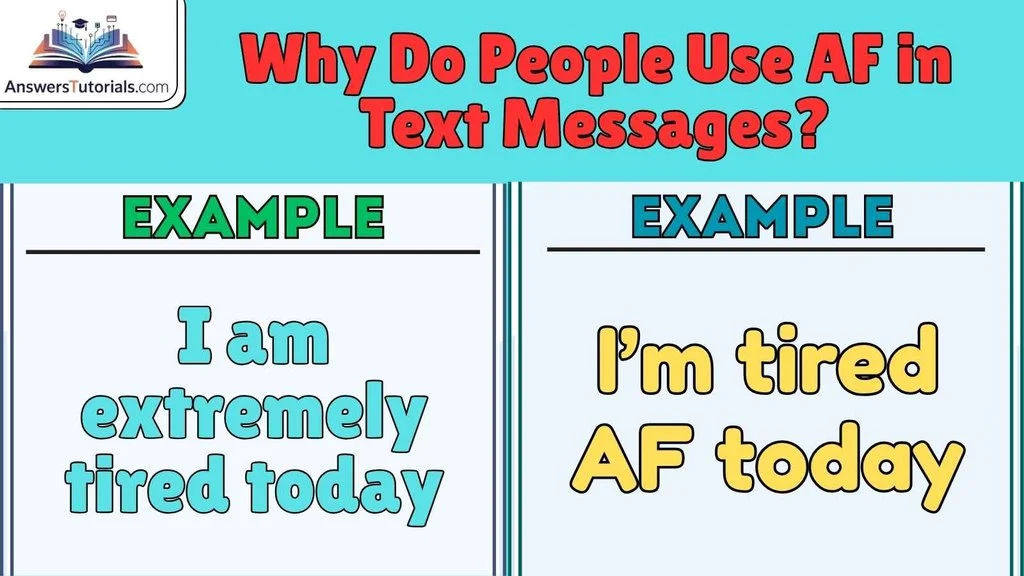
People use AF because texting is fast, expressive, and often informal. A short abbreviation can communicate emotion without requiring a long sentence.
Instead of writing:
“I am extremely tired today.”
Someone might write:
“I’m tired AF today.”
The second version feels more casual and emotionally intense.
There are several reasons people use AF:
- ⚡ It saves typing time.
- 😂 It can make a message funnier.
- 🔥 It adds emphasis.
- 😭 It can express strong emotions.
- 💬 It fits casual internet language.
- 😎 It can make a message sound more relaxed.
- 📱 It is widely understood in online conversations.
AF is particularly common when someone wants to exaggerate a feeling or reaction.
For instance, saying:
“I’m hungry.”
is neutral.
Saying:
“I’m hungry AF.”
makes the feeling sound much stronger and more dramatic.
AF Meaning on Social Media
The AF meaning on social media is generally the same: “as fuck.”
You may see AF in captions, comments, memes, posts, replies, and direct messages.
Examples include:
- “This outfit is cute AF.”
- “Monday is exhausting AF.”
- “That sunset is beautiful AF.”
- “I’m confused AF.”
- “This song is catchy AF.”
- “He’s funny AF.”
- “That plot twist was wild AF.”
Social media encourages short, expressive language, so abbreviations such as AF fit naturally into posts and comments.
You may also see AF attached to a hashtag or used as part of a humorous caption. In these cases, the abbreviation usually emphasizes a particular characteristic.
For example:
“Summer AF.”
This could describe something that strongly feels like summer.
Another example is:
“Cozy AF.”
This means something is extremely cozy.
The meaning comes from the word being emphasized and the surrounding context.
Examples of AF in Everyday Conversations
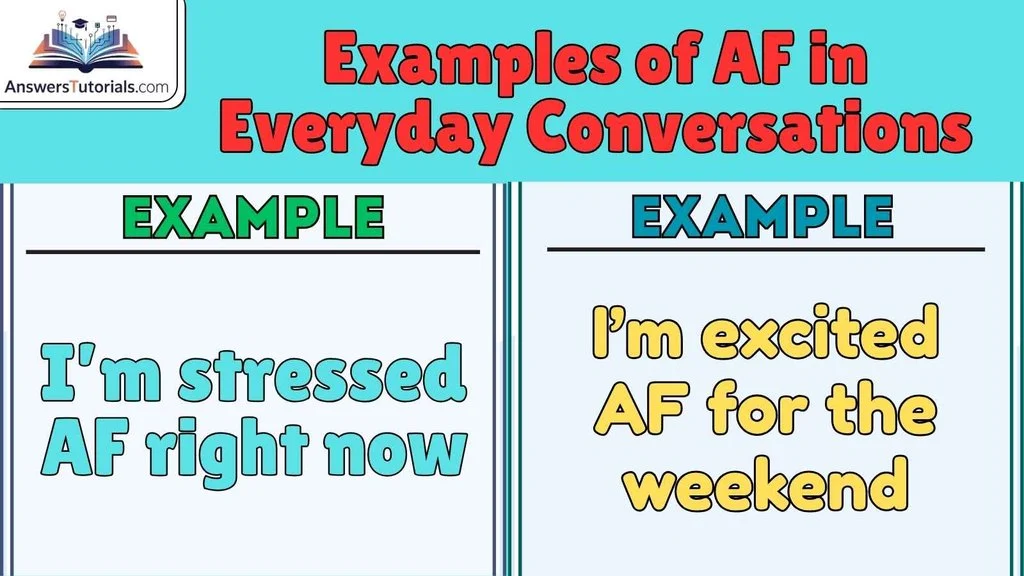
Understanding examples is one of the easiest ways to learn AF meaning.
Here are common situations where you might see it.
Talking About Feelings
“I’m excited AF for the weekend.”
: I’m extremely excited for the weekend.
“I’m stressed AF right now.”
Meaning: I’m extremely stressed right now.
“She looked nervous AF.”
: She looked extremely nervous.
Talking About Food
“This pizza is good AF.”
Meaning: This pizza is extremely good.
“I’m hungry AF.”
: I’m extremely hungry.
“That curry was spicy AF.”
Meaning: That curry was extremely spicy.
Talking About Weather
“It’s hot AF today.”
Meaning: It is extremely hot today.
“It’s cold AF outside.”
Meaning: It is extremely cold outside.
Talking About Appearance
“You look good AF.”
Meaning: You look extremely good.
“That dress is cute AF.”
Meaning: That dress is extremely cute.
Talking About Experiences
“That roller coaster was scary AF.”
Meaning: That roller coaster was extremely scary.
“The concert was loud AF.”
Meaning: The concert was extremely loud.
These examples show the main pattern: AF usually intensifies the word immediately before it.
AF Meaning From a Girl or Guy
If someone uses AF in a message to you, the abbreviation itself usually does not indicate romantic interest or a specific gender-related meaning.
The surrounding words matter much more.
For example:
“You’re cute AF.”
This is a strong compliment and may sound flirtatious depending on the relationship.
But:
“I’m tired AF.”
is simply a statement about being tired.
Likewise:
“That guy is funny AF.”
does not necessarily have any romantic meaning.
If a Girl Uses AF
A girl might use AF casually with friends, family, coworkers she knows well, or someone she is interested in.
For example:
“You’re funny AF 😂”
This could be friendly or flirtatious depending on the conversation.
If a Guy Uses AF
A guy might use AF in exactly the same way.
For example:
“That game was hard AF.”
This is simply an intensified description.
So, AF does not have a different basic meaning when used by a girl or a guy. Context determines the emotional meaning.
Is AF a Bad Word?
Technically, AF represents profanity, because it comes from “as fuck.”
However, its use has become common in casual internet slang. Many people understand it without treating every use as seriously as the complete phrase.
Still, that does not mean AF is appropriate everywhere.
Think of AF as casual and potentially offensive slang rather than standard English.
It is usually safer with:
- Close friends
- Casual group chats
- Informal social media conversations
- Memes
- Casual online communities
- People who already use similar slang
It may be inappropriate in:
- Job applications
- Professional emails
- Academic assignments
- Formal presentations
- Customer service communication
- Official documents
- Conversations with someone who dislikes profanity
When you are unsure, use “very,” “really,” “extremely,” or “incredibly” instead.
How to Use AF Correctly in a Sentence
The most common structure is:
[adjective] + AF
For example:
- tired AF
- happy AF
- cute AF
- busy AF
- cold AF
- hot AF
- funny AF
- scary AF
- expensive AF
- weird AF
You can then place that phrase naturally inside a sentence.
Examples:
“I’m tired AF after work.”
“That new restaurant is expensive AF.”
“Your dog is cute AF.”
“This weather is hot AF.”
Another common structure is:
[verb or situation] + AF
Although the adjective pattern is especially common, informal speakers sometimes use AF more creatively.
The key is to remember that AF is used for strong emphasis, not as an independent replacement for words such as “very” in every situation.
AF vs. Other Texting Abbreviations
AF belongs to a large family of internet abbreviations. Comparing it with similar expressions makes its role easier to understand.
| Abbreviation | Common Meaning | Typical Use |
|---|---|---|
| AF | As fuck | Strong emphasis |
| TBH | To be honest | Sharing an honest opinion |
| IMO | In my opinion | Giving an opinion |
| IDK | I don’t know | Showing uncertainty |
| LOL | Laughing out loud | Showing amusement |
| OMG | Oh my God | Strong surprise |
| FR | For real | Agreement or emphasis |
| NGL | Not gonna lie | Introducing honesty |
| RN | Right now | Referring to the present |
| BTW | By the way | Adding information |
For example:
“I’m tired AF rn.”
Here, AF intensifies “tired,” while rn means “right now.”
Another example:
“That movie was scary AF, fr.”
Here, AF adds intensity, while fr emphasizes sincerity or agreement.
What Is the Difference Between AF and Very?
Although AF and “very” can communicate similar levels of intensity, they have completely different tones.
Very is neutral and works in formal and informal writing.
AF is slang and strongly casual.
Compare:
“The weather is very hot.”
with:
“The weather is hot AF.”
The first sentence sounds normal and appropriate almost anywhere.
The second sounds much more informal, expressive, and potentially humorous.
Another comparison:
“I’m very tired.”
versus:
“I’m tired AF.”
Both communicate intense tiredness, but the second carries more attitude and slang-based emphasis.
This distinction is important when choosing your words.
When Should You Avoid Using AF?
Even if you understand AF meaning, you should think about your audience before using it.
AF can be perfectly normal among friends but inappropriate in a professional setting.
For example, you probably should not write:
“I’m busy AF today, so I can’t attend the meeting.”
to a manager or client.
A more appropriate version would be:
“I’m extremely busy today, so I may not be able to attend the meeting.”
Similarly, avoid AF in formal schoolwork.
Instead of:
“The results were surprising AF.”
write:
“The results were extremely surprising.”
The general rule is simple:
Match your language to the relationship and setting.
Common Mistakes When Using AF
People sometimes misunderstand or misuse internet abbreviations. Here are a few mistakes to avoid.
Mistake 1: Using AF in Formal Writing
AF is informal slang. Avoid it in professional or academic writing unless you are specifically discussing internet language.
Mistake 2: Assuming AF Always Sounds Friendly
AF can sound funny, enthusiastic, sarcastic, or aggressive depending on the sentence.
For example:
“You’re annoying AF.”
That is clearly negative.
But:
“You’re talented AF.”
is a compliment.
Mistake 3: Thinking AF Means One Thing Everywhere
The most common texting meaning is “as fuck,” but abbreviations can have different meanings in different communities.
Context always matters.
Mistake 4: Assuming It Is Automatically Flirty
A phrase such as:
“You’re cute AF.”
may be flirtatious.
But:
“This puppy is cute AF.”
is simply an enthusiastic comment.
The subject and relationship provide the real clues.
Mistake 5: Overusing It
Using AF in every sentence can make your messages feel repetitive.
Instead, use it when you genuinely want strong emphasis.
AF Meaning in Memes and Internet Culture
AF has become especially popular because internet culture favors exaggerated expressions.
Memes often rely on short phrases that communicate a strong emotion immediately.
For example:
“Me on Monday: tired AF.”
The humor comes from exaggerating a familiar experience.
Similarly:
“This cat is confused AF.”
The phrase makes the caption sound more dramatic and playful.
Internet users also combine AF with other slang:
“That was wild AF, ngl.”
“I’m hungry AF rn.”
“This is weird AF fr.”
These combinations demonstrate how modern digital communication layers several abbreviations into a single short message.
The result is often informal, expressive, and highly conversational.
How to Reply When Someone Uses AF
If someone sends you a message containing AF, you usually do not need to comment on the abbreviation. Simply respond to what they are saying.
For example:
Them: “I’m tired AF.”
You could reply:
“Same 😂 Today was exhausting.”
Or:
“You definitely need some rest.”
If they say:
Them: “That movie was scary AF.”
You could respond:
“Seriously! I almost jumped out of my seat.”
If someone says:
Them: “You look good AF today.”
Possible responses depend on your relationship:
“Haha, thank you!”
“That’s sweet of you.”
“You’re looking pretty good yourself.”
The best reply depends on whether the conversation is friendly, playful, romantic, or simply casual.
Other Possible Meanings of AF
Although “as fuck” is the dominant meaning in casual texting, AF can represent other phrases in different contexts.
For example, depending on the subject, AF may appear as an abbreviation for a specific organization, technical term, workplace phrase, or name.
Some people may also encounter AF in gaming, business, education, medicine, technology, or other specialized communities.
That is why you should not automatically interpret every occurrence of AF as slang.
Ask yourself:
- Is this a casual conversation?
- Is AF placed after an adjective?
- Does replacing AF with “very” make sense?
- Are other texting abbreviations being used?
- Is the conversation about a specialized subject?
If AF appears after a word such as “tired,” “happy,” “cold,” “funny,” or “beautiful,” the slang interpretation is usually clear.
Quick AF Meaning Cheat Sheet
Here is a simple reference you can save for later. 📱
| Phrase | Simple Meaning |
|---|---|
| Tired AF | Extremely tired |
| Happy AF | Extremely happy |
| Cute AF | Extremely cute |
| Funny AF | Extremely funny |
| Busy AF | Extremely busy |
| Cold AF | Extremely cold |
| Hot AF | Extremely hot |
| Scary AF | Extremely scary |
| Hungry AF | Extremely hungry |
| Expensive AF | Extremely expensive |
| Weird AF | Extremely weird |
| Good AF | Extremely good |
The easiest way to remember it is:
AF = strong emphasis in casual online language.
FAQs:
What does AF mean in texting?
AF usually means “as fuck” in texting. It is an informal intensifier used to mean “very,” “really,” or “extremely.”
What does AF mean from a girl?
The basic AF meaning from a girl is still “as fuck.” The abbreviation itself does not indicate romantic interest. The rest of her message and the relationship between you determine the tone.
What does AF mean from a guy?
When a guy uses AF, it normally has the same meaning: “as fuck.” It can emphasize an emotion, opinion, compliment, complaint, or description.
Is AF rude?
AF contains profanity, so it can be considered rude or inappropriate in some situations. It is generally best for casual conversations, especially with people who are comfortable with slang.
Can I use AF in professional messages?
It is better to avoid AF in professional communication. Use alternatives such as very, really, extremely, highly, or incredibly when you need a more professional tone.
Final Thoughts:
Understanding AF meaning is useful if you regularly communicate through texts, social media, comments, or online communities. In most casual conversations, AF means “as fuck” and works as an intensifier.
Words such as “tired AF,” “happy AF,” “funny AF,” and “cold AF” all use the abbreviation to make the description much stronger.
The most important thing to remember is context. AF can sound humorous, enthusiastic, dramatic, friendly, or offensive depending on the words around it and the person receiving the message. It is also highly informal, so it should generally stay out of professional and academic writing.
In short, when you see AF after an adjective in a casual text, think “extremely” or “very” while remembering that the original abbreviation contains profanity. Once you understand that pattern, AF becomes one of the easiest texting abbreviations to recognize.

Ayan Zaman is a content writer and researcher at answertutorials.com, specializing in text meanings, slang, abbreviations, and everyday communication. He creates clear, practical, and easy-to-understand guides to help readers communicate with confidence. His content focuses on accurate explanations, real-world examples, and useful answers for modern digital conversations.