
Admin meaning usually refers to administrator a person, account, or role responsible for managing, controlling, organizing, or maintaining something. You may see “admin” on a website, social media group, workplace system, computer, school platform, gaming server, or business account.
For example, if someone says, “Ask the admin,” they usually mean the person who has special authority to manage a group, system, page, or organization.
But the word can mean slightly different things depending on where you see it. An admin might approve members, manage settings, remove content, handle users, solve technical issues, or simply keep things organized. 🔐
This guide explains admin meaning, its origin, common uses, examples, related terms, and what an admin can actually do in different situations.
What Does Admin Mean?
Admin is a shortened form of administrator. It describes someone who manages or oversees a system, organization, group, account, website, or other activity.
In simple words:
Admin = a person or account with responsibility and management authority.
The exact responsibilities depend on the situation.
For example:
- A Facebook group admin manages members and posts.
- A website admin manages website content and settings.
- A computer admin can control important system settings.
- A workplace admin may organize schedules, documents, or office tasks.
- A Discord admin may manage users, channels, and permissions.
- A database admin maintains databases and controls access.
- A school admin may manage students, staff, records, and policies.
So, when you encounter the word admin, think about management, responsibility, access, and control.
Admin Meaning in Simple English
If you want the easiest possible definition, admin means a person who manages something.
Imagine a large online group with hundreds of members. Someone needs to:
- Approve new members
- Remove spam
- Enforce rules
- Change group settings
- Help users
- Manage permissions
- Deal with problems
That person may be called the admin.
The same basic idea applies outside social media.
A company might have an admin who organizes documents and schedules. A computer might have an administrator account with higher permissions. A website may have an admin dashboard where authorized users control the site’s content.
Therefore, the meaning changes slightly by context, but the central idea remains management and authority. ⚙️
Where Did the Word Admin Come From?
The word admin comes from administrator.
“Administrator” has roots connected to the Latin word administrare, which means to manage, assist, or carry out responsibilities. Over time, administrator became a common English word for someone responsible for managing an organization, process, or system.
As communication became faster, people naturally shortened administrator to admin.
Today, “admin” is especially common in technology and online communities because digital platforms often need people with special management privileges.
You might see terms such as:
- Admin account
- Admin panel
- Admin dashboard
- Group admin
- Server admin
- System admin
- Page admin
- Network admin
The abbreviation is now so common that many people use admin more often than the full word administrator.
Admin Meaning on Social Media
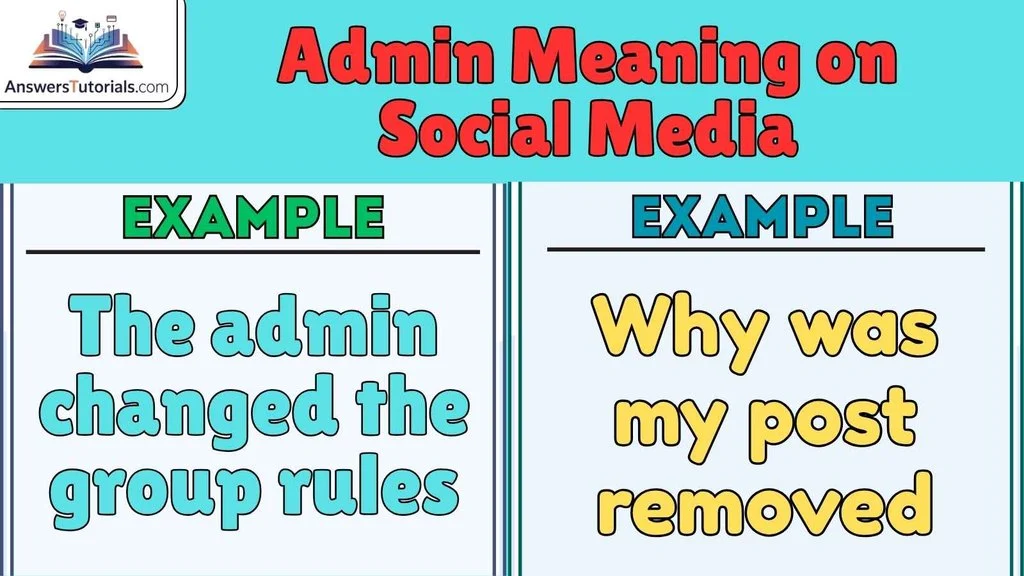
On social media, admin usually means someone who manages a page, group, community, or account.
For example, a Facebook group may have several admins. They can typically perform management tasks such as approving members, moderating posts, enforcing community rules, and changing certain settings.
On other platforms, an admin may have similar responsibilities.
Common social media admin duties
- Managing members
- Approving or rejecting requests
- Removing inappropriate content
- Responding to community issues
- Enforcing rules
- Managing moderators
- Changing group settings
- Controlling permissions
- Handling reports
For example:
Person A: “Why was my post removed?”
Person B: “Ask the admin.”
Here, admin refers to the person responsible for managing the community.
Another example:
“The admin changed the group rules.”
This means the person with administrative authority updated the rules.
📱 In online conversations, “admin” often means the person in charge of managing the digital space.
Admin Meaning in Technology and Computers
In technology, admin can refer to a person or account with elevated permissions.
An administrator may have access to settings that ordinary users cannot change.
For example, on a computer, an administrator account might be able to:
- Install software
- Change system settings
- Create or remove user accounts
- Manage security settings
- Access restricted features
- Configure devices
- Change permissions
This is why you may see messages such as “You need admin privileges to perform this action.”
It means the current user does not have enough authority to make that particular change.
What is an admin account?
An admin account is an account with higher-level permissions.
A normal user might only be able to use an application. An admin may be able to configure the application for everyone.
For example:
Regular user: Uses the company’s software.
Admin: Configures the software, manages users, and controls permissions.
This distinction is important for security because administrative access can affect an entire system. 🔒
Admin Meaning in the Workplace
In a workplace, admin can have a broader meaning.
It may refer to an administrative employee, an administrator, or general administrative work.
Administrative work often involves keeping an organization organized and functioning efficiently.
Examples include:
- Scheduling meetings
- Managing records
- Organizing documents
- Handling emails
- Preparing reports
- Maintaining databases
- Coordinating appointments
- Supporting employees
- Managing office processes
For instance:
“She works in admin.”
This could mean she works in the administrative department.
Another example:
“Please send this form to the admin team.”
Here, the term refers to people responsible for administrative tasks rather than necessarily one specific person.
💼 In professional settings, admin does not always mean someone with technical control. It can simply mean someone who handles organizational or administrative responsibilities.
Admin Meaning in Online Groups and Communities
Online communities often use admin to describe someone who has authority over the community.
This could include:
- Facebook groups
- Discord servers
- Reddit communities
- Forums
- Messaging groups
- Gaming communities
- Professional communities
An admin may have more authority than an ordinary member.
However, admin and moderator are not always the same thing.
An admin usually has broader management permissions, while a moderator may focus mainly on enforcing community rules.
For example:
| Role | Common Responsibility |
|---|---|
| Member | Participates in the community |
| Moderator | Enforces rules and manages discussions |
| Admin | Manages the community and its settings |
| Owner | Usually has the highest level of control |
These roles can vary from platform to platform.
A community might give moderators many administrative abilities, while another community may keep those powers separate.
Admin vs. Administrator: Is There a Difference?
In most everyday situations, admin and administrator mean essentially the same thing.
The biggest difference is formality.
Administrator is the complete word and sounds more formal.
Admin is the shorter, more casual form.
For example:
- “Contact the administrator.” — More formal
- “Contact the admin.” — More casual
- “The system administrator changed the settings.” — Professional or technical
- “Ask the admin to approve you.” — Informal and conversational
So, if you’re writing a formal business document, administrator may sound more appropriate. In everyday communication, admin is perfectly normal.
Common Examples of Admin in Everyday Conversations
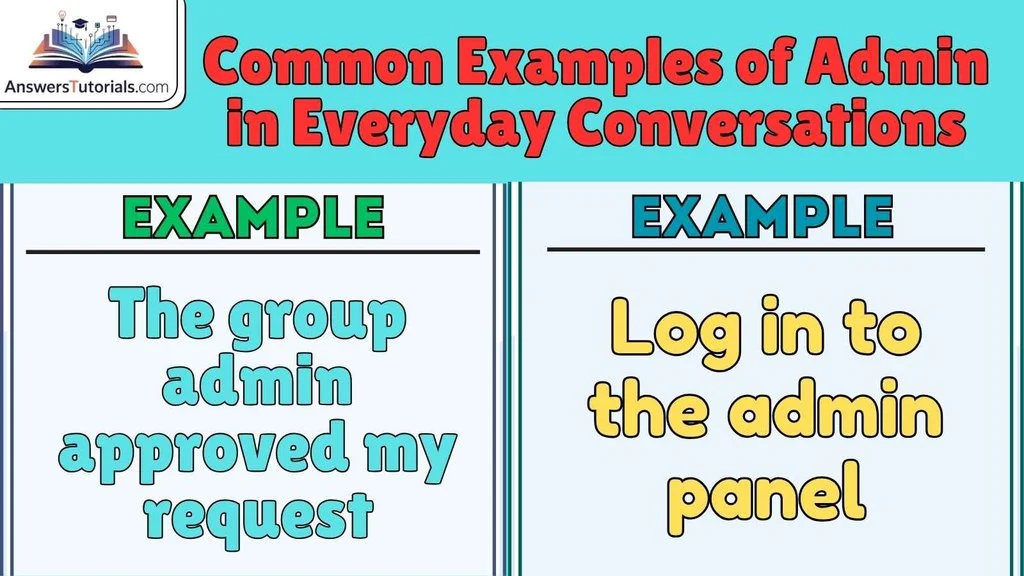
Understanding examples makes the meaning much easier. Here are several realistic situations. 💬
Example 1: Social media
“The group admin approved my request.”
Meaning: The person managing the group allowed the user to join.
Example 2: Workplace
“I need to speak with the admin about my schedule.”
Meaning: The speaker wants to contact someone responsible for administrative matters.
Example 3: Computer
“You need admin access to install this program.”
Meaning: The user needs administrator-level permission.
Example 4: Online community
“The admin removed the post because it violated the rules.”
Meaning: The community manager removed the content.
Example 5: Website
“Log in to the admin panel.”
Meaning: Open the management area of the website.
Example 6: Gaming
“The server admin banned the player.”
Meaning: The person responsible for managing the server blocked that player.
Example 7: Messaging group
“Only admins can change the group name.”
Meaning: Regular members do not have permission to make that change.
What Does “Admin” Mean in a Text Message?
When someone uses admin in a text message, the meaning usually depends on the conversation.
It may refer to:
- A group administrator
- A workplace administrator
- A website administrator
- A system administrator
- A person managing an online community
For example:
“Ask the admin to add you.”
This most likely means the person who manages the group or platform.
If someone says:
“The admin will handle it.”
They probably mean that the person responsible for managing the relevant system or organization will take care of the issue.
Unlike many internet slang terms, admin is not normally an abbreviation created for texting. It is simply a shortened form of administrator.
That distinction is useful because people sometimes assume every short word online is slang. Not every abbreviation is slang. Some are simply common shortened forms of longer words.
What Is an Admin Panel?
An admin panel is a private management area used to control a website, application, service, or system.
Think of it as the control room behind a digital platform. 🖥️
Depending on the system, an admin panel may allow authorized users to:
- Add or remove content
- Manage users
- Change settings
- View reports
- Control permissions
- Update information
- Review activity
- Manage products or services
For example, a website owner may use an admin dashboard to publish articles, edit pages, manage comments, and review website activity.
Ordinary visitors usually never see these controls.
This is why an admin panel is often protected by authentication and permission systems.
Different Types of Admin Roles
The word admin covers many different jobs and responsibilities.
Here are some common types:
System Admin
A system administrator, often called a sysadmin, manages computer systems, servers, software, and related infrastructure.
Network Admin
A network administrator manages computer networks, connectivity, devices, and network access.
Website Admin
A website admin manages website content, users, settings, and other administrative functions.
Database Admin
A database administrator manages databases, data access, performance, backups, and security.
Social Media Admin
A social media admin manages pages, groups, communities, posts, users, and moderation tasks.
Office Admin
An office administrator handles organizational and administrative responsibilities within a workplace.
Server Admin
A server admin manages a server or online environment and may handle configurations, users, security, and performance.
Although these roles differ, they share one important feature: responsibility for managing something.
Admin Permissions and Access Levels
One of the most important ideas connected to admin is permission.
Not everyone using a system should have the same level of access.
A platform might divide users into several levels:
| Access Level | Typical Ability |
|---|---|
| Visitor | View public information |
| User | Use standard features |
| Moderator | Manage certain content |
| Admin | Manage users and settings |
| Super Admin | Control multiple administrative areas |
The exact names vary.
The purpose is to give people only the access they need.
For example, a moderator may be allowed to remove comments but not change the entire platform’s configuration. An admin might have permission to change those settings.
This system helps organizations maintain security, accountability, and control. 🔐
Why Admin Access Matters
Admin access is powerful because it can affect other users.
If someone has administrative privileges, they may be able to change settings, manage accounts, remove content, or access important information.
That is why organizations generally treat admin accounts carefully.
Good administrative practices often include:
- Using strong passwords
- Protecting login credentials
- Giving access only to trusted users
- Reviewing permissions regularly
- Removing access when someone leaves
- Using additional security protections where available
In simple terms, greater access comes with greater responsibility.
A person should not receive administrative privileges simply because they need to perform one small task. Access should match the responsibilities of the role.
Common Phrases With the Word Admin
You may encounter “admin” in many phrases.
Here are some common examples:
- Admin account — an account with administrative privileges
- Admin access — permission to perform administrative actions
- Admin panel — an area used to manage a system
- Admin dashboard — a management interface
- Admin rights — administrative permissions
- Admin team — people responsible for administrative duties
- Group admin — person managing an online group
- Server admin — person responsible for managing a server
- System admin — person managing computer systems
- Office admin — person handling administrative office tasks
These phrases all connect to the same central concept: management and responsibility.
Admin Meaning: Synonyms and Related Words
Depending on the context, several words can have a similar meaning to admin.
Possible alternatives include:
- Administrator
- Manager
- Supervisor
- Moderator
- Coordinator
- Operator
- Controller
- Organizer
- System administrator
- Office administrator
However, these words are not always interchangeable.
For example, a manager may supervise employees, while an admin may manage records, systems, or settings.
Similarly, a moderator may enforce community rules without having all the powers of an administrator.
So, always consider the context before replacing “admin” with another word.
Is Admin a Slang Word?
Admin is not usually considered slang.
It is a common abbreviation or shortened form of administrator.
People use it in casual conversations, workplaces, technology, online communities, and professional settings.
For example:
Casual: “Ask the admin.”
Professional: “Please contact the administrator.”
Both sentences communicate a similar idea.
The word “admin” feels shorter and more conversational, but it remains widely accepted in professional and technical contexts.
How to Understand Admin From Context
If you’re unsure what admin means in a particular sentence, look at what is being managed.
Ask yourself:
- Is this about a computer?
It probably means someone with elevated system permissions. - Is this about a Facebook or online group?
It probably means the person managing the group. - Is this about a workplace?
It may refer to an administrative employee or department. - Is this about a website?
It may mean the person who manages the site’s backend. - Is this about a gaming server?
It probably refers to someone who manages the server.
This simple approach usually makes the meaning clear.
FAQs:
What does admin mean?
Admin means administrator, usually referring to a person or account responsible for managing a system, group, organization, website, or other environment.
Is admin short for administrator?
Yes. Admin is a shortened form of administrator. It is commonly used in technology, workplaces, online communities, and everyday communication.
What does admin mean on social media?
On social media, an admin is generally someone who manages a page, group, or community. They may control members, content, settings, and permissions.
What does admin access mean?
Admin access means having elevated permissions that allow a person to perform management tasks that ordinary users cannot perform.
Is admin the same as moderator?
Not necessarily. An admin usually has broader management powers, while a moderator often focuses on enforcing rules and managing content. However, platforms can define these roles differently.
Conclusion:
The simplest admin meaning is administrator someone who manages, organizes, controls, or oversees something.
You can encounter the term almost anywhere, from social media groups and gaming servers to office environments, websites, databases, and computer systems. 💻
The exact responsibilities depend on the context. A social media admin may manage members and posts, while a system admin may control computer systems and permissions. An office admin may organize schedules and records.
The key idea is always the same: an admin has responsibility for managing a particular environment.
So, when you see phrases such as admin access, admin account, admin panel, or group admin, think of management authority and special permissions.
In short:
Admin = a person or account responsible for managing something.
Understanding the context will tell you exactly what type of administrator the word refers to.

Ayan Zaman is a content writer and researcher at answertutorials.com, specializing in text meanings, slang, abbreviations, and everyday communication. He creates clear, practical, and easy-to-understand guides to help readers communicate with confidence. His content focuses on accurate explanations, real-world examples, and useful answers for modern digital conversations.