

If you have ever received a strange five-letter abbreviation in a text and wondered what the person was trying to say, you are not alone.
ACGAF meaning can look confusing at first, especially when it appears without any explanation. In casual online conversations, ACGAF is generally used as a strong expression of indifference.
The abbreviation is commonly understood as “Absolutely Couldn’t Give A F*.”** In simple terms, it communicates something like “I really do not care” or “I absolutely have no concern about that.” 😎
However, the meaning is only part of the story. The abbreviation also carries a particular tone. Depending on the conversation, it can sound confident, humorous, dismissive, frustrated, or even rude.
This guide explains the ACGAF meaning in text, its full form, origin, examples, tone, appropriate uses, and differences from similar texting slang.
What Does ACGAF Mean in Text? 💬
ACGAF is an informal internet abbreviation generally meaning “Absolutely Couldn’t Give A F*.”**
It expresses an extremely strong lack of concern about a person, situation, opinion, event, or topic.
In everyday English, the closest translations might be:
- I absolutely do not care.
- I really do not care.
- It does not bother me at all.
- I have zero concern about it.
- What they think does not matter to me.
The important point is that ACGAF is much stronger than simply saying “I don’t care.” The profanity in its expanded form gives the expression a blunt and aggressive edge.
For example:
Friend: “People are talking about your new haircut.”
You: “ACGAF 😂”
The sender is essentially saying that other people’s opinions about the haircut do not bother them.
Quick Meaning
| Term | Meaning | Tone |
|---|---|---|
| ACGAF | Absolutely Couldn’t Give A F*** | Very strong |
| IDC | I Don’t Care | Mild |
| IDGAF | I Don’t Give A F*** | Very strong |
| Whatever | It doesn’t matter | Casual |
| I don’t mind | No strong preference | Polite |
So, when someone asks “what does ACGAF mean?”, the shortest answer is: It is a strong slang way of saying that you absolutely do not care.
ACGAF Full Form Explained 🔎
The commonly used expansion of ACGAF is:
A = Absolutely
C = Couldn’t
G = Give
A = A
F = F*
Together, the letters form “Absolutely Couldn’t Give A F*.”**
Each part contributes to the overall tone.
“Absolutely”
The word absolutely adds emphasis. It makes the statement stronger than an ordinary expression of indifference.
“Couldn’t Give”
This suggests that the speaker has no willingness or ability to care about the subject.
“A F***”
This is the profanity that gives the phrase its particularly blunt tone. It makes ACGAF unsuitable for many formal situations.
Therefore, the expression does not merely communicate:
“I don’t care.”
It communicates something closer to:
“I genuinely have zero concern about this.”
That difference matters when interpreting someone’s message. 🧠
What Does ACGAF Actually Express? 😎
The ACGAF slang meaning is usually connected to strong indifference, but the emotional message can vary.
Someone may use it to communicate:
- 😎 Confidence — “I am comfortable with my decision.”
- 🙄 Dismissiveness — “Your opinion does not matter to me.”
- 😤 Frustration — “I am tired of dealing with this.”
- 😂 Humor — “This situation is ridiculous, and I am not taking it seriously.”
- 💯 Indifference — “This simply does not bother me.”
- 🛡️ Defiance — “I will do what I want regardless of criticism.”
This is why you should never interpret an acronym from the letters alone.
Context controls tone.
For example:
“ACGAF 😂”
could be playful between close friends.
But:
“ACGAF.”
sent during an argument can feel cold, hostile, or intentionally dismissive.
The words are the same. The relationship, punctuation, previous messages, and situation change the emotional meaning.
The Origin of ACGAF 📚
There is no single, universally established inventor or exact creation date for ACGAF.
Like many internet abbreviations, it appears to have developed from an already existing informal expression and the broader culture of shortening phrases for digital communication.
The underlying expression involving “couldn’t give a f*”** existed in informal spoken English before people began turning phrases into online abbreviations. As texting and social media became more common, users increasingly shortened longer expressions into initials.
This created a style of communication built around:
- Faster typing ⌨️
- Shorter messages
- Memorable abbreviations
- Strong emotional expression
- Casual online language
ACGAF fits naturally into that pattern.
It is also useful to distinguish between the origin of the phrase and the origin of the abbreviation. The underlying phrase may have existed long before ACGAF became a recognizable acronym.
Because internet slang often spreads through private chats, forums, gaming communities, and social media, it can be difficult to identify one exact moment when an abbreviation was “created.”
Why Did ACGAF Become Useful?
Digital conversations reward brevity.
Instead of typing a long sentence, someone can use five letters to communicate a strong attitude immediately.
That makes abbreviations useful in:
- Text messages
- Group chats
- Social media comments
- Direct messages
- Gaming conversations
- Online communities
However, popularity does not necessarily mean universal understanding. Some people may know ACGAF immediately, while others may have never encountered it.
ACGAF Meaning in Different Conversations 💬
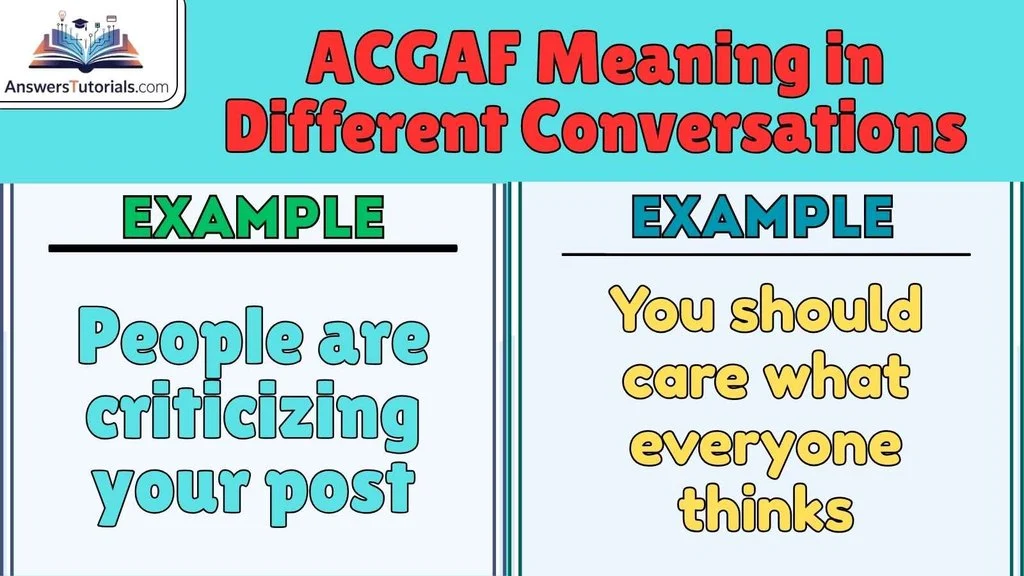
The ACGAF meaning in text can change slightly depending on the subject being discussed.
When Discussing Opinions
Friend: “They don’t like your opinion.”
You: “ACGAF. I said what I think.”
Here, ACGAF communicates confidence and indifference toward criticism.
When Discussing Gossip
Friend: “Did you hear what they said about you?”
You: “Nope. ACGAF.”
Here, the speaker is saying that they do not want to spend emotional energy on gossip.
During an Argument
Person A: “You should care what everyone thinks.”
Person B: “ACGAF.”
In this setting, the abbreviation can sound particularly dismissive.
When Discussing Social Media
Friend: “People are criticizing your post.”
You: “ACGAF 😂”
The emoji can make the message feel more playful and less aggressive.
When Someone Is Trying to Provoke You
Friend: “They’re trying to get a reaction from you.”
You: “Let them. ACGAF.”
Here, the expression communicates emotional detachment.
ACGAF Examples in Everyday Texting 📱
Seeing realistic examples can make the meaning much easier to understand.
Example 1: Someone’s Opinion
Alex: “They said your outfit looks terrible.”
Jordan: “ACGAF 😂 I like it.”
Meaning: Jordan does not care about the criticism.
Example 2: Online Drama
Mia: “Everyone is arguing in the comments.”
Sam: “ACGAF. I’m staying out of it.”
Meaning: Sam has no interest in the online argument.
Example 3: Gossip
Chris: “People are talking about you again.”
Taylor: “ACGAF. They can talk.”
Meaning: Taylor is not concerned about the gossip.
Example 4: Personal Choices
Jamie: “Are you worried people won’t like your decision?”
Morgan: “Honestly, ACGAF.”
Meaning: Morgan does not care whether other people approve.
Example 5: Friendly Humor
Friend: “You really ordered another dessert?”
You: “ACGAF 😂🍰”
Here, the expression is being used humorously to say that the speaker does not care about the teasing.
Example 6: Criticism
Person A: “They said you should change your style.”
Person B: “ACGAF. I’m happy with it.”
The speaker is rejecting outside criticism.
When Is It Appropriate to Use ACGAF? ⚠️
Because the full expression contains profanity, ACGAF should generally remain in casual communication.
It may work when you are talking with:
- Close friends
- Trusted peers
- People who regularly use internet slang
- Gaming friends
- Casual online communities
- People who understand your sense of humor
Even then, consider the context.
If the conversation is serious, emotionally sensitive, or potentially confrontational, ACGAF may make the situation worse.
A good rule is:
If you would hesitate to use the full phrase out loud, don’t assume the abbreviation makes it automatically appropriate.
Abbreviating profanity does not necessarily make the underlying message polite.
When Should You Avoid ACGAF? 🚫
There are many situations where using ACGAF is a bad idea.
Avoid it in:
- Job applications
- Business emails
- Workplace communication
- School assignments
- Messages to teachers
- Customer service conversations
- Formal presentations
- Professional networking
- Serious apologies
- Messages to people you barely know
For example, imagine your manager asks:
“Can you explain why the report is late?”
Replying:
“ACGAF.”
would likely come across as disrespectful.
A more professional response would be:
“I apologize for the delay. I’m working on it and will have it completed soon.”
The lesson is simple: know your audience.
ACGAF vs. IDGAF vs. IDC 🤔
ACGAF is often compared with other expressions of indifference.
The closest comparison is IDGAF, which is much more widely recognized.
| Abbreviation | General Meaning | Strength | Formal? |
|---|---|---|---|
| ACGAF | Absolutely Couldn’t Give A F*** | Very strong | ❌ |
| IDGAF | I Don’t Give A F*** | Very strong | ❌ |
| IDC | I Don’t Care | Mild | ⚠️ Casual |
| IDK | I Don’t Know | Neutral | ✅ |
| TBH | To Be Honest | Neutral | ✅ |
| IMO | In My Opinion | Neutral | ✅ |
ACGAF vs. IDGAF
Both expressions communicate strong indifference.
The difference is mainly in wording and emphasis.
IDGAF essentially says:
“I don’t give a f***.”
ACGAF adds an emphatic sense of:
“I absolutely couldn’t give a f***.”
Both are vulgar and highly informal.
ACGAF vs. IDC
IDC is much softer.
For example:
“IDC which movie we watch.”
This sounds casual and relatively harmless.
Compare that with:
“ACGAF which movie we watch.”
The second version sounds much more aggressive because of the profanity behind the abbreviation.
If you want to communicate indifference without sounding hostile, IDC is generally the safer choice.
ACGAF Tone: Funny, Rude, Confident, or Sarcastic? 🎭
One of the most important things to understand about ACGAF meaning is that tone is not fixed.
The same abbreviation can have very different emotional effects.
😎 Confident
“People can judge my choices. ACGAF.”
The person is showing independence.
😂 Funny
“I said I was dieting, but this pizza exists. ACGAF 😂🍕”
The phrase is clearly being used as humor.
😤 Angry
“ACGAF what you think anymore.”
In an argument, this can sound aggressive.
🙄 Dismissive
“ACGAF about their opinion.”
This suggests that the speaker deliberately rejects someone else’s viewpoint.
😏 Sarcastic
“Oh no, they unfollowed me. ACGAF.”
Here, the speaker may be mocking the importance of the situation.
Context is everything.
An emoji, punctuation mark, or previous message can completely change how the reader interprets the abbreviation.
Common Mistakes People Make With ACGAF ❌
People who are unfamiliar with internet slang can easily misunderstand ACGAF.
Here are some common mistakes.
1. Assuming It Is Polite
It is not a polite expression. The expanded version contains profanity.
2. Using It Professionally
Even if your coworkers understand internet slang, ACGAF is usually inappropriate for professional communication.
3. Assuming It Always Means Anger
Not necessarily.
Close friends may use it jokingly or casually.
4. Ignoring the Conversation
A standalone “ACGAF” may be difficult to interpret without knowing what came before it.
5. Treating Every Acronym as Universal
Internet slang differs between communities. A term that seems obvious to one group may be completely unfamiliar to another.
6. Thinking Emojis Remove the Profanity
An emoji can soften the perceived tone, but it does not change the underlying meaning.
Polite Alternatives to ACGAF 🌿
Sometimes you want to communicate the same general idea without sounding rude.
Fortunately, there are plenty of alternatives.
Casual Alternatives
- IDC
- “I don’t really care.”
- “It doesn’t bother me.”
- “I’m not worried about it.”
- “Whatever works.”
- “I’m good either way.”
Polite Alternatives
- “I’m not concerned about that.”
- “It doesn’t really matter to me.”
- “I’m comfortable with whatever you decide.”
- “I don’t have a strong preference.”
- “That’s not something I’m worried about.”
Confident Alternatives
- “I’m happy with my decision.”
- “I’m going to do what works for me.”
- “Other people’s opinions don’t affect me.”
- “I’m comfortable with who I am.”
These options let you communicate independence or indifference without using profanity.
How to Reply When Someone Says ACGAF 💭
If someone sends you ACGAF, your response should depend on the situation.
If They Are Clearly Joking
You can respond playfully:
“😂 Fair enough.”
If You Agree
“Same honestly.”
You Want to Stay Neutral
“I get you.”
If You Are Unsure What They Mean
Simply ask:
“What do you mean by ACGAF?”
There is nothing wrong with asking. Slang changes constantly, and not every abbreviation has one universally recognized interpretation.
If It Sounds Rude
You can avoid escalating the conversation.
For example:
“Okay, I understand.”
This acknowledges the message without turning the conversation into another argument.
Is ACGAF a Bad Word? ⚠️
ACGAF itself is an abbreviation, but its commonly understood expansion contains profanity.
That makes it a vulgar and highly informal expression.
Whether someone considers it offensive depends on their personal standards, relationship with the sender, and the setting.
Among close friends, it may be completely normal.
In a workplace or formal environment, it may be viewed as inappropriate.
The safest approach is to consider three things:
- Who are you talking to?
- Where are you communicating?
- Could the message be interpreted as disrespectful?
If the answer to the third question is yes, choose a softer phrase.
Is ACGAF Still Used in Online Conversations? 🌐
Internet slang changes rapidly.
Some abbreviations become mainstream, while others remain limited to specific online communities. ACGAF is considerably less universal than abbreviations such as LOL, IDK, IDC, TBH, or IMO.
That means you should not assume everyone will recognize it.
You may encounter it in casual:
- Text messages
- Group chats
- Social media posts
- Comments
- Direct messages
- Gaming conversations
- Online communities
If you see ACGAF and the surrounding message does not make its meaning obvious, context should guide your interpretation.
And if context still does not help, asking the sender is better than confidently assuming the wrong meaning.
Quick ACGAF Meaning Cheat Sheet 📝
Here is a simple summary you can save:
| Question | Answer |
|---|---|
| What does ACGAF mean? | Absolutely Couldn’t Give A F*** |
| What does ACGAF mean in text? | A strong expression of indifference |
| Is ACGAF slang? | Yes |
| Is it formal? | No |
| Does it contain profanity? | Yes, in its expanded form |
| Can it be humorous? | Yes |
| Can it sound rude? | Yes |
| Is it similar to IDGAF? | Yes |
| Is IDC a softer alternative? | Yes |
| Should you use it at work? | Generally no |
The easiest way to remember it is:
ACGAF = an extremely strong, informal way to say you do not care.
FAQs:
What does ACGAF mean in text?
ACGAF generally means “Absolutely Couldn’t Give A F*.”** It is an internet slang abbreviation used to express strong indifference or a complete lack of concern.
Is ACGAF rude?
It can be rude, especially in serious conversations or when directed at someone personally. Its commonly understood full form contains profanity, so it is best reserved for casual situations where that language is acceptable.
Is ACGAF the same as IDGAF?
They have a very similar overall meaning. Both communicate strong indifference and use profanity in their expanded forms. ACGAF adds the word “absolutely,” making the expression particularly emphatic.
Can I use ACGAF at work?
It is generally better to avoid ACGAF in professional communication. Even if your coworkers understand it, the profanity and dismissive tone can make a message sound disrespectful.
What is a polite alternative to ACGAF?
You can say “I don’t really care,” “It doesn’t bother me,” “I’m not concerned,” or “I don’t have a preference.” These expressions communicate indifference without the profanity.
Final Thoughts:
Understanding ACGAF meaning is really about understanding more than five letters. The abbreviation is commonly used as a strong, informal way to express complete indifference, with the commonly understood expansion being “Absolutely Couldn’t Give A F*.”**
Its tone can range from 😎 confident and 😂 playful to 😤 frustrated or 🙄 dismissive. That is why the surrounding conversation matters so much.
Remember these key points:
- ACGAF is internet slang.
- It generally expresses very strong indifference.
- Its expanded form contains profanity.
- It is mainly suited to casual conversations.
- It can sound humorous, confident, dismissive, or rude depending on context.
- IDGAF has a closely related meaning.
- IDC is a much softer alternative.
- Professional, academic, and formal communication should generally avoid it.
In short, when someone uses ACGAF in a text, they are usually emphasizing that they absolutely do not care about the subject being discussed. The exact emotional tone, however, depends on the relationship and context surrounding the message.

Ayan Zaman is a content writer and researcher at answertutorials.com, specializing in text meanings, slang, abbreviations, and everyday communication. He creates clear, practical, and easy-to-understand guides to help readers communicate with confidence. His content focuses on accurate explanations, real-world examples, and useful answers for modern digital conversations.
1 thought on “ACGAF Meaning Full Slang Explained”